Feeds:
Posts
Comments

Archive for the ‘Marie’s Musings’ Category

I see a flock of robins beside the road, pecking in the soil, and that reminds me.

One summer, when I visited my sister in southeastern Washington, I heard a mockingbird sing. I didn’t know mockingbirds lived that far north. In fact, I was sure they didn’t. “You don’t have mockingbirds here, do you?” I asked. No, of course not. Finally, I spotted the songster—a robin!

Every winter the robins come to Florida, a happy place to escape from cold and snow. I seldom notice when they arrive. They must meander though North Florida in small numbers, seeking the balmier south. Then come February, large flocks gather on the way back to their summer nesting grounds. That’s when I see them congregate on roadsides and fields, hopping about in search of dainties. The struggle for domination between winter and spring provides a balanced diet. As the sun warms the soil, worms and insects emerge among small green plants seeking a head start on summer growth. The robins feast. Then frost nips these hopes and drives the little creatures back into the ground. Undeterred, the robins dine on seeds left by last year’s weeds and wildflowers.

The birds also assemble in berry-laden trees and shrubs. They swallow the fruit whole, then fly over wooded areas, pooping out seeds which fall to fertile ground to complete the cycle of growth. That is why I have so many beauty-berry bushes in my woods. Unfortunately, robins also gobble up the fruit of camphor trees and pyracantha, both invasive species, and spread them far and wide, so be careful what you plant. No bird will appreciate these fancy foreigners when they crowd out our native plants.

As the robins pass through my neighborhood, the mockingbirds pick up their song and sing it through summer, long after the robins have abandoned us. That’s why I associate the “cheerily carol” with the mockingbird.

Last summer I visited my daughter in Virginia. Sitting on her front porch, enjoying the mountain air, I heard a familiar, “Cheery-up, cheery-o, cheery-up, cheery-o!” A mockingbird? I knew I was within their range this time, but no, again it was a robin.

What a happy place, I thought, to have the music of both mockingbirds and robins.

Read Full Post »

Grandma Rogers loved flowers. On the south side of her house, where the winter sun warmed the cinder-block wall of the garage, she had a large flower bed. I could not name all she grew there, but I remember roses, and pansies, which she loved because they looked like little faces, and the bright yellow and orange blossoms we called snow flowers. We so named them because one autumn while they were in full bloom, we had an early snow. The snow flowers were undeterred. They did not turn brown and die, but continued to bloom through the snow, subsequent thaw, and past Indian summer, until winter claimed them at last. Later in life, I learned that our snow flowers are called Calendulas.

Last year I came across some Calendula seeds at a store. I remembered Grandma’s snow flowers and thought it would be nice to plant some. They grew and bloomed bravely in the cool weather. Calendulas like full sun and my yard is shady, but when the oak trees shed their leaves, the flowers enjoyed winter sunshine. Then came spring and the oaks’ new foliage cast shadows over the flower bed. With summer, my Calendulas seemed to melt in the Florida heat and humidity.

In the meantime, I learned more about these amazing flowers. Their petals and leaves are edible and Calendula officinalis, has medicinal properties. To my knowledge, my grandmother never used Calendula for food or medicine. This puzzles me. Dandelion greens were an annual spring ritual and, despite limited formal education, Grandma was a skilled practical nurse. I was a recipient of her herbal skills when, as a colicky infant, she soothed me with catnip tea. Catnip is still my favorite medicinal herb. One plant thrives in the same shady bed where the snow flowers melted.

Calendula is related to the marigold and called Pot Marigold because the Germans used the petals in soup. Other European and Asian cultures used them in various dishes, to color butter, for tea, and as a dye. The flowers are also an important nectar and pollen source for bees and other pollinators, including butterflies.

We planted Calendula in a butterfly plot at the local elementary school. The other day, the children and I surveyed the butterfly beds where cassia, fennel, and salvia had succumbed to frost. All that remained were dry brown sticks and a few seed heads. I explained to the children that the plants weren’t dead. Only the tops had frozen, but the roots, safe below the soil, were alive and would send out new growth come spring. I pointed out some leaves that had already emerged on brown stems and said we would wait a little longer to be sure what was dead before we cut them back.

Then, around on the south side of the school, in full sunshine, one Calendula stood against the brown of winter, bright yellow flowers and green leaves belying the season.

My grandmother’s Calendula came to mind and I told the children the story of her snow flowers. I am now resolved to plant more Calendula.


Read Full Post »

Almost all my life I have been fortunate to live in the country where wild trees are available for Christmas. The area I lived in as a child used to be dairy country. Once there must have been a dozen small dairy farms within a mile of our house. Through the years, one by one, they went out of business. Today, I doubt any remain in operation.

Back in the day when houses were heated with firewood, farmers maintained wood lots to ensure a steady source. My grandparents had more trees on their farm than many – havens for climbing grandchildren and shady places for the cows in summer. Most farmers seemed to begrudge the few square feet under trees where grass and crops would not grow and kept their pastures and hay fields cleared. Hence the importance of wood lots. When my father was a boy, he planted a corner of the farm in trees as a 4-H project. By the time I was old enough to play in the woods, his trees had attained some size, but young trees, just right for Christmas, grew from seeds they dropped.

There was no thought of buying a Christmas tree. We went to the woodlot and cut one of suitable size. A variety were available: pine, spruce, fir, and hemlock. As my brothers and I grew big enough, we would harvest the tree without adult assistance.

One year sticks out in my mind. I must have been twelve or thirteen. Grandma and Grandpa Masters lived over the hill in Finch Hollow. Grandpa hunted in the woods behind their house. That year he spotted several perfect trees on their property and offered us one. We had hiked cross-lots to their place in summer and thought it would be no problem to haul a tree over the hill on a sled.

But this was winter and snow was knee deep. We got over the hill OK and up to Grandpa’s woods where we selected our tree, cut it, and tied it on the sled. We warmed up in Grandma’s kitchen, sipping hot cocoa, before we pulled the sled down through the hollow and tackled the big hill. Wading through grass and brush in summer is one thing. Struggling through snow tangled in grass and brush is another. Cold as we were, asking for help was out of the question as we could not lose face. Besides, we were a good distance from any road and no one had snowmobiles. We made it over the hill and through the fields to our house, tree and all,  frozen to the bone, but proud. And happy once we warmed up and put on dry clothes.

Our first Christmas in Florida, we lived in the Ocala National Forest where sand pines grow. Not as nice as fir or spruce, nevertheless, with their short needles and dense growth, the young ones make suitable Christmas trees.

Then I grew up and moved on. Today I live in pine flatwoods, too wet for sand pines but host to other varieties: long leaf, loblolly, and slash pine. While these grow into beautiful adult trees, they have long needles and their branch whorls are at least a foot apart. The saplings look like Charlie Brown Christmas trees, but when dressed in lights, ornaments, and tinsel, they are as pretty as any store-bought.

A few years when I had the money, I bought fragrant fir trees from a lot at a friend’s church. After they went out of the Christmas trees business, I resumed cutting trees from my woods or a neighbor’s. Occasionally we had cedar trees. They are very pretty with dense foliage to rival any spruce, but the branches are prickly. You almost need gloves to decorate them or your hands end up looking like you’ve been picking blackberries.

This year, my son Joel and his family spent Christmas with me. Did the children want me to buy a tree? No. The Spirit of Christmas Trees Past spoke to them. They remembered previous Christmas times when they accompanied me to find a tree. It was fun. It was tradition. That was what they wanted.

I was so busy with holiday preparations, Joel took the children out to the abandoned pasture behind my house. They were gone a long time, tromping through marsh and blackberry brambles, but fortunately no snow. They brought back the perfect tree. Almost perfect. One side had few branches, so we set it against the wall. The children helped me trim it, and I believe it is the prettiest Christmas tree I’ve ever had.

Is it the commercialization of Christmas that drives us back to old practices that have little place in modern life? What practical purpose does a Christmas tree serve? Besides the time and expense, I’m required to rearrange furniture to make room for a place to pile gifts. A table would do as well. Boxes of ornaments are hauled from the attic and hung on the tree. Not to mention the mess, tinsel and pine needles all over the floor. After Christmas, everything must be undone and put away. And why cut a living tree? A tree-hugger like myself should shun the practice, but I have never been drawn to artificial trees.

If only a fresh tree will do, I can afford to buy a pretty, well shaped fir which was grown for this purpose and whose scent is unequaled. But like my grandchildren, I am drawn to the woods this time of year, to bear the cold and brambles, to harvest a tree and bring it into my home. It has meaning beyond the large decoration crowding my living room. It is a connection with the Earth, with my roots. It keeps me centered and gives life a meaning that cannot be expressed in words.

Read Full Post »

When I was a child, Grandma Rogers ran a little dairy with about half dozen milchers. She and my father milked the cows twice a day, morning and evening. When my brothers were old enough, they helped. After each milking, they carried the pails into her creamery where the milk was strained and poured into the separator. This contraption was about four feet tall with a large bowl on top to receive milk. Grandma would wind it up by turning a large crank on its side, and the milk would spiral through the machine, centrifugal force separating the lighter cream from the heavier milk. The liquids would exit through separate spouts to be collected in containers. Grandma always reserved some of the rich whole milk for the family. The skim milk was mostly fed to calves.

Her creamery was located in the cellar of the house, a short walk from the barn. That corner of the cellar was always clean and cool, even in summer. During winter, the furnace put out enough heat to temper the cold. Buckets and separator parts were washed in a double stone sink, and her large chest freezer doubled as a work bench. She had a collection of crocks imbued, I’m sure, with just the right microorganisms to ferment the cream.

When it was ready, Grandma took the cream upstairs to the kitchen. Instead of an upright dash churn such as you see in pictures, hers resembled a section of a barrel turned on its side. I’m sure her barrel churn was more efficient than the upright model. A crank on its side turned a paddle inside the barrel, beating the particles of butterfat together until they coalesced into a golden mass floating in buttermilk.

I used to watch her knead the butter and add salt, unless a customer wanted “sweet” butter for health reasons. She’d take about a pound of butter, form it into a block and weigh it with a spring scale which hung on a hook above the doorway. The scale supported a shallow pan for the butter. If the block was too heavy, she’d remove a little, if too light, add some. Once it was exactly one pound, she’d pat it into shape and wrap it in wax paper. I seldom saw her use a wooden butter mold such as you see in antique stores.

Butter route day fell on Thursdays. Since Grandma didn’t drive, her sister, Aunt Hazel, would take her. She always drove a Plymouth. When her car got too old, Aunt Hazel would get a new one, always a Plymouth. Unless we were in school, my siblings and I took turns accompanying them on the butter route.

Aunt Hazel would take us into Binghamton. Most of the butter customers were elderly ladies from the “Old Country”, Eastern Europe, Russia, and Armenia. The farm fresh butter may have cost more than store bought, but it reminded them of home. They were accustomed to cultured butter such as they had in the Old Country and found commercial butter a disappointment. I could not find Armenia on the map. I was too young to realize it had been swallowed up by the Soviet Union. Sometimes I wondered if all Armenians lived in Binghamton.

One day a customer’s daughter answered the door and hollered, “The butter lady is here!” I thought that was rather rude. My grandmother had a name. Her customers called her Mrs. Rogers. When I mentioned this to Grandma, she dismissed it, saying the young lady just didn’t know better.

These ladies baked delicious food with exotic names, and sometimes they’d offer us some. One was a Czechoslovakian fruit-filled pastry with a name that sounded like “ka-lach-key”.

Occasionally a butter customer would give me a nickel or a dime. After we completed the route, we’d shop at the A&P for groceries. Unless I decided to save my money for something else, I could spend it at the store. Nickels and dimes went a long way then. Back at Grandma’s house, she’d warm up canned soup for lunch. That was always a treat, a change from home cooked meals.

A lifetime later, I went to Texas for a niece’s wedding. Imagine my surprise when I spotted a donut shop advertizing “Kolaches, $1 or $11 a dozen”. How had these Old Country treats traveled from an eastern city to a cattle town half a continent away? Had people from Eastern Europe settled here, too? The girl behind the counter was Asian and she pronounced them “Ka-lat-keys”. I bought a dozen. This version was new to me. Instead of a fruit-filled pastry, it was a sausage wrapped in sweet dough. Texans like their meat. It was still delicious and reminded me of my “old country.”

I forgot to ask how Kolaches came to Texas. Maybe I need to go back and find out.

Read Full Post »

Morning sunlight slants from the South. On my shady front porch, the thermometer reads 67, but it must be over 70 in the sun because the butterflies are out and about. A large brown moth checks out a Rosemary plant, probably attracted to its scent, but finding no blossoms, it moves on to the Swedish Ivy.

Neither Swedish nor Ivy, these plants have spikes of delicate white flowers that curve into the paths of butterflies. I hang them outdoors in summer where they can drink up tropical weather. Sometimes branches of their fragile foliage break off and root in my yard. Here, nurtured by warm rains, they grow into a lovely ground cover. Soon they will succumb to frost unless I pot them and move them indoors. I can’t keep that many, so I will give some away.

Their flowers must be rich in nectar. A yellow Cloudless Sulphur comes by to visit blossom after blossom. One afternoon while I crocheted on the front porch, a Zebra Longwing kept company with the Swedish Ivy. It would flitter to a blossom for a sip then fly off. A few seconds later, I would see a little shadow out of the corner of my eye, the Zebra Longwing back for another drink.

Most everyone loves these flying flowers. Most everyone. In college I had a zoology professor who maintained that the entire order Lepidoptera was harmful to mankind. No redeeming qualities. We asked, what about butterflies?  Destructive. Of no benefit. What about silk worms? Even them. That was a long time ago, when the understanding of ecology was still in its infancy. My professor focused on the destruction of agricultural crops by the larvae of butterflies and moths. To him, beauty had nothing to do with it.

Black Swallowtail and Gulf Fritillary on Bidens alba.

Black Swallowtail and Gulf Fritillary on Bidens alba.

Times have changed. We now are aware that even “bad” bugs have their place in nature and to annihilate them would upset the delicate balance of the world order. And Lepidoptera are no longer bad bugs. Now they are seen as pollinators. With the decline of the honey bee, other pollinators are becoming more valued, a benefit to agriculture and mankind, despite the destruction caterpillars wreak. Other pollinators, such as native bees, are less conspicuous than butterflies, but a healthy butterfly population indicates an environment friendly to bees. When we plant wildflowers to attract butterflies, we nurture other pollinators as well. I wonder what my old professor thinks about Lepidoptera now.

A few years ago, my late summer bean crop was infested with leaf rollers. Once they are done feasting on the foliage, these little caterpillars roll a leaf around them to pupate. But I didn’t let them. Every day I went through my bean patch with a vengeance and squashed every one I could find. Later, I learned I had been killing baby butterflies! Fortunately, I didn’t wipe them all out. The next year they returned to my bean patch and this time I left them alone. Guess what? My beans produced as well that season as they had the year before when I killed all those “pests”.

In the spring, I grew parsley in a container garden on my kitchen deck. One day when I picked some, I noticed the undersides of the leaves were covered with tiny pearls. I had observed Black Swallowtails lighting on the parsley not long before and knew those must be butterfly eggs. Not wanting to eat baby butterflies, I foraged among the parsley to pick only the leaves with no eggs.

Then I was busy for a time, almost too busy to cook. When next I noticed my parsley plants, the leaves were gone and the container garden was crawling with cute little striped caterpillars. They did not look big enough to pupate but they had eaten all the parsley. Hoping to find something else to feed them, I researched their diet. They eat plants in the parsley and carrot families. Alas, I could find none of those currently growing in my yard. All I could do was let nature take her course and hope the little butterflies would find their way. They must have, as my yard is full of Swallowtails.

A neighbor with a butterfly farm tells this story. She helped a little old lady plant a butterfly garden. All went well until the lady called to complain that “worms” were eating her plants. Those worms turned out to be the larvae of the butterflies she wanted to attract to her garden! My friend tried to explain you can’t have butterflies unless you feed them when they are children. All to no avail. It didn’t sink in. The little old lady just wanted to know how to kill those “worms”.

What can I say? If we want to live, we must let live. In The Last Child in the Woods”, Richard Louv writes, “Nature is beautiful, but not always pretty.” How true!

Read Full Post »

This September, National Weather Service in Jacksonville celebrated the 50th anniversary of Hurricane Dora, the only tropical cyclone to hit the area in recorded history. I remember Dora quite well. It was one of my family’s many adventures. We weathered the storm in the men’s bathhouse at Ocean Pond Campground, in the Osceola National Forest, just west of Jacksonville.
Let’s back up. This was not my first hurricane. When I was a little girl, Hurricane Hazel ripped up through the eastern United States. All I remember was that she badly damaged our cherry tree.
In January, 1964, we moved to Florida, first settling in the Everglades, in Moore Haven, a small town on the shore of Lake Okeechobee. We rented a house on the bank of the Caloosahatchee River, a picturesque cottage on stilts, which had the distinction of having survived the 1928 Okeechobee Hurricane.
In the early 20th century, a small earthen dike had been built around Lake Okeechobee. In 1926, storm surge from a deadly hurricane breached the dike. The 1928 storm was even worse. Hundreds of acres were flooded, some areas under twenty feet of water. Thousands of houses were swept away and at least 2500 lives were lost. Many bodies were never recovered. Our house, and presumably its inhabitants, survived because, being built on stilts, the water washed under the house.
Thirty six years later, the disaster remained fresh in the memory of survivors and their descendents, who recounted the horror to anyone who would listen. The old two-story schoolhouse still stood, with scars on the walls of the second floor where boats had scraped against it during the flood. After 1928, the Army Corps of Engineers had erected a huge levee around the lake, but our neighbors said they didn’t really trust it.
August brought Hurricane Cleo. My parents stayed glued to the radio for storm predictions. I remember townspeople expressing anxiety as Cleo approached, but few made plans to evacuate. One of my friends said her family might shelter at the high school, but that building had a ground floor only. We didn’t take chances. We packed our camping trailer and tents and headed north on Highway 27.
After fifty miles or so the flat Everglades gave way to sandy hills. We pulled into Highlands Hammock State Park. Cleo followed. She snaked up the east coast of Florida as a Category 2 storm, slowing to a Category 1 as her eye passed fifty miles east of us. We were safe from flood, but the wind would have blown our tents away. Fortunately, the park rangers let us stay in the lodge, a sturdy building built by the Civilian Conservation Corps during the Depression.
This storm was unlike anything I’d experienced. Instead of heavy raindrops pounding the earth as in a thunderstorm, which finishes its business and moves on, falling rain danced all day at the mercy of the gale. Through the windows we watched trees thrashing in the wind and heard its incessant howl. I recall being more bored than afraid. There was little to amuse us in the dim light of the lodge. Once the weather cleared, we returned home. The Lake had remained within its banks and surrounding communities were safe.
For various reasons, not limited to hurricanes, my parents decided to move to the northern part of the state. A week or so later, we were camped near Olustee while my father looked for another job.
Were hurricanes out to get us? Two weeks after we fled Cleo, Hurricane Dora caught up with us. She headed straight towards North Florida as a Category 3 storm. For the second time, we found ourselves with only a few sheets of canvas between us and a tempest. At least we didn’t worry about a 20 foot flood, since Ocean Pond is a tea cup compared to Okeechobee. Other campers packed up and went home. We had no home to go to, having given up our house in Moore Haven. One other family remained, a retired couple in a pop-up camper.
The men’s bathhouse had a large open area surrounded by concrete block walls. We moved our bedding in as Dora slammed into Jacksonville as a Category 2 hurricane. The other couple joined us, their little pop-up no match for 110 mph winds. Cleo had been gracious enough to hit Florida during the day. Not Dora. She made landfall at 2 am, but we had felt her blast hours before.
The bathhouse was lit by an open skylight, practical in fair weather, but not in a major weather event. Mom and Dad put tarps over our beds, so we could sleep dry, but they did not sleep. As the wind roared through the night and rain swirled through the open roof, I woke now and then to see them pacing the floor. I remember Mom adjusting a tarp that had blown loose. Little splatters of rain hit my face, but I felt safe. Only when I experienced a tropical storm as an adult could I appreciate what my parents must have endured.
As daylight came, the storm subsided. By early afternoon she moved on. The retired couple crawled into their camper to get a few supplies and the lady cooked grits. What food supplies weren’t soggy must have run low and I was hungry. Those plain grits were the best thing I ever tasted. When it was safe to go outdoors, we went down to the lake. To our surprise, a plastic orange fish came bobbing across the lake toward us, carried by the wind and waves. My little sisters scooped it up. We had no way of knowing who it belonged to, so we kept it. That orange fish stayed in the family for years and is featured in several old photographs. I wonder what became of it.
After a few more adventures, my family settled in Scrambletown, Florida. More adventures were to follow, but the next time a hurricane blustered through, we had a strong cypress house to protect us from its wrath.

Read Full Post »

The pavement ends. Potholes and asphalt yield to stony dirt, intersected by little gullies dug by rain on its way to the river. You’ve not merely crossed from Oklahoma to Arkansas, from Road to Trail. You have entered another place and time, where cell phones receive no signal and the internet and social media do not intrude.

Peace settles over you as the dust settles to the roadbed. Stop a moment and gaze at the bucolic scene, a scattering of houses among fields of hay and cattle. And forests. On your left Walker Mountain slopes up into the trees. On every quarter section sits a house with a front porch. Porch swings and rocking chairs invite you to visit. Gaze across the valley and the Black Fork River to the mountain brooding beyond. An occasional gash of gray from a rock slide interrupts the medley of greens and browns of the forest. Long ago people abandoned the mountain to wild things and memories. Not so much as a radio tower tarnishes the wilderness.

Once this valley buzzed with activity. Cotton was King. Black Fork, valley and mountain, boasted of stores and schools, homesteads and share croppers. Then came the Boll Weevil. Only sketchy tales linger of the many who left to seek fortunes elsewhere. The remains of their homes, reduced to debris, mingle with arrowheads cast aside by earlier denizens of the valley.

A small clapboard building perches on the bank of the road in front of an abandoned stone house. The old post office was small enough to move up and down the valley as the duty of postmaster shifted from neighbor to neighbor. Black Fork once had its own Zip Code, but the post office closed some forty years ago. Today, a rural carrier brings mail from Mena, on the other side of the mountain, over in Polk County.

One day when I visited my mother, the mail lady drove into the yard with a package too large for the box. No yellow slip of paper giving notice of something on a shelf miles away. When Mom asked about her recent trip, the carrier grabbed her photos and joined us in the kitchen. So, the neighbors’ mail would be a few minutes late today.

Two church buildings remain in the valley. Friendship Baptist Church still holds services for a handful, but most folks go to their chosen denominations in nearby towns. A few miles east, Piney Church once competed for the souls of the valley and doubled as a one room schoolhouse, but the building is now a social hall for a dwindling number of quilters. On the front porch is a pile of firewood for the pot-bellied stove. The door is unlocked. No one minds if you visit. The building is wired for electricity but has no running water. Out front is an old well and an outhouse in the back. A large quilt frame takes up much of the room. Look closely at the stitching – all hand crafted.

On the walls a few black and white group photographs attest that this was once a school. An eighth grade education was required for teachers. The scholars who remain in the valley are now grandparents. Their descendents are bussed to Acorn, a good 45 minutes away. Many children in the valley are home schooled.

Black Fork is 45 minutes from everywhere. Haw Creek, over in Oklahoma, has a thriving church and a mom-and-pop gas station which periodically goes out of business. Better gas up before you venture here. However, should your truck or farm equipment need repairs, Black Fork Garage is the one thriving business in the valley.

Most small communities lose population as the young people move elsewhere for jobs and the old move to cemeteries, but Black Fork is different. Retired people are moving into the valley and building homes and some of the young choose to stay. They have to commute to jobs or dabble in small local endeavors. Why do they live here? Because life is good.

This is no utopia. Lives have been lost in flash floods. Logging and farming can be hazardous, and Black Fork is not immune to illegal drugs and crime. By nature or nurture, some people have light fingers, so if something comes up missing, you can bet the owner has an idea who took it. If the suspect is innocent by reason of being in jail, well, it must have been his brother.

One hot August, some convicts escaped from a prison over in Oklahoma and one found his way to Black Fork. He hid in the woods and raided vacant kitchens for sustenance. Having lost his shoes, he stole a pair, but they were too big and left him with blisters. Because he was afraid of bears, he slept in trees, unaware that bears can climb. When the authorities caught up with him, dirty, scratched, plagued with ticks and chiggers, he was happy to go home to his cell.

People in Black Fork make do or do without. Or mobilize the community. Emergency vehicles take 45 minutes to get here, or if a train is parked at the crossing in Page, twice as long. So the citizens organized a Volunteer Fire Department, raising funds through bake sales and raffles, government grants and support from nearby VFDs. Everyone pitched in to build a firehouse and garner necessary equipment. Volunteers went to training and several became first responders.

Last winter, an ice storm downed power lines. Members of the VFD checked on the elderly and disabled, ensuring their safety and providing them with food, water, and firewood if needed. Roads had to be cleared before electricity could be restored. The fire department cut their way through over twenty miles of fallen trees. Service was restored in half the time it would have taken the utility company alone.

Looking out for one another is a way of life. After a flood damaged many vehicles, Black Fork Garage made repairs, charging customers for parts only, not for labor. “We didn’t do anymore than anyone else would have done in our shoes. The best pay is the love and appreciation we get from our neighbors, and the satisfaction of being the Lord’s hand extended to others.”

Visiting Black Fork is like returning to a forgotten way of life. Not a perfect life, but one we rediscover when we slow down. The visitor can set aside worries for a time and hold responsibilities at arm’s length. I always leave with regret and look forward to coming back.

Read Full Post »

The biosphere of Planet Earth is a miracle. We know of no other world where we could live outdoors. The moon is inhospitable, Venus a furnace, Mars’ air thin and oxygen-poor. Forget the other planets in our solar system. And we know little about those beyond. By comparison, Earth is a paradise. Every day we should rejoice in the sunshine, breathe deeply with gratitude, and take water as a sacrament. So why do we spend so much time inside?


Once I took a plane trip on a perfect day in May. Flowers bloomed and trees wore new leaves. We flew at low altitudes where I could see the towns and neighborhoods, parks and school yards, fields and forests below. But no children played on the playgrounds. No one walked or jogged. No farmers worked their fields. No workmen or fishermen were evident. How could they stay indoors on such a beautiful day?


People move to Florida “for the weather”, then find it too hot, too cold, too humid, or too many mosquitoes. Day and night they keep windows closed and the air conditioner running. Why not live where the climate requires such confinement?


“When was the last time you spent the entire day outdoors?” A character in a movie asked another. Nothing substitutes for the physical, mental, and spiritual refreshment you find in the open air. Last January on the Mirage, we lived outdoors the entire week. Only the cabins are enclosed. The dining area, where we spent mealtimes and evenings, is open to the elements. Surrounded by wilderness with no light pollution, we stood on deck at night and enjoyed the stars. We spent our days on the water, under the sun, in the wind, and it was good.


But not perfect. Nature is not always kind. In Pine Island Sound, destruction by Hurricane Charley nearly a decade ago is still evident: heaps of uprooted, storm-tossed trees.


Monday’s sun heated the cabins below deck. To hasten cooling, I left my hatch open until bedtime. By then, my cabin was full of mosquitoes. I don’t know how many I swatted before I started to count, then I killed sixteen, more during the night, and probably another dozen in the morning. Afterwards, I was more vigilant.


If you kayak in the sub-tropical sun, you need skin protection. I wore a hat, long sleeved shirt, and long pants all week. Splashing waves cooled me. I used sunscreen on my face and hands, but forgot UV protection for my lips, which burned, cracked, and peeled. A lesson learned.


At least I didn’t turn into a Gumbo Limbo. Natives call it the “tourist tree” because its bark is red and peeling. On Wednesday, we encountered the human variety. The kayak trail in Commodore Creek was choked with tourists. Poorly prepared, they probably lathered on sunscreen, but did little else to protect themselves. Most wore shorts and short sleeved shirts or tank tops and, while they remembered sunglasses, few wore hats. Even though Commodore Creek is shaded by mangroves, I’m sure by evening they resembled Gumbo Limbo trees.


The week was not all smooth paddling. Wednesday morning was calm but the wind picked up when we returned to Mirage. We skirted the shore in Pine Island Sound but had to cross open water to get to the boat. The wind kept blowing me off course. I’d paddle several times on one side to get straight, then over-correct and be blown the other way. Finally, Jun suggested I align myself perpendicularly with the waves and let the wind blow me along. I told him I was trying to align myself with Mirage. He said to align myself with the waves and Mirage would take care of herself. He was right. The wind blew me right to the ship. Nature is bigger than we . Why exhaust ourselves trying to work against her? Better to cooperate.


That evening, waves too choppy for kayaks, we took the dinghy out to North Captiva Island, beached on the inland side, and crossed a short neck to the Gulf of Mexico. We collected shells and watch the sunset. The water was cool but pleasant enough for a swim.
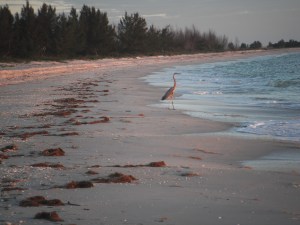
Kayak voyage 081


Thursday dawned with a nice south wind, but a cold front loomed in the northwest. When we reached the south point of North Captiva Island at 1 pm, the wind shifted and picked up speed, the weather turned cold and the water choppy. Paddling became difficult. We hugged the shore until we came to a shoal too shallow to paddle, so Elke and I got out and waded, towing our kayaks. Keith and Jun detoured the shoal and landed on a small beach. My muscles cramped from the chill. Jun came back for our kayaks, allowing us, thankfully, to walk on the sand.


From there, as the gull flies, Mirage was not far, but I struggled against the wind. When I’d stop for a brief rest, it blew me back. At one point a strong current caught us. Keith offered to tow me. Fatigue and pain eventually conquered my stubborn pride, and I let him. Sometimes you just have to accept help.


Tarps were lowered around the dining area to shelter us and we wore coats to supper. All night, the rigging snapped in the wind and Mirage swung back and forth on her moorings. There’s a saying in Florida: if you don’t like the weather, wait a few hours. The morning dawned cool but soon warmed and we enjoyed beautiful weather the rest of the week.


Did discomfort diminish my pleasure? Only temporarily. Afterward, I could laugh and reflect. I don’t go looking for trouble and “No pain, no gain” is rubbish, but roadblocks lead to self discovery, adversity to growth. Adventures yield good memories once we are safe at home. Being outdoors all week was well worth it.


As I write on this beautiful day in May, the sun is shining, the birds are singing, and the yellow flies are biting. I almost need armor to go outside. Oh, well. At least my windows are open so I can breathe fresh air. I don’t have to leave the house to pump water, so I can take it as a sacrament.


Read Full Post »

When I was a teenager, we lived in Scrambletown, Florida, a small community in the Ocala National Forest. Scrambletown is a tale unto its self which I may tell one day. Living some twenty miles from the nearest city, there was little an adolescent without a car could do to earn money. Even the adults had to be creative to make a living. One Mr. Godwin, who lived a few miles from us, dealt in Deer Tongue, among other pursuits.

Deer Tongue, which goes by many names, including Vanilla Plant, is a wildflower. A rosette of basal leaves grows close to the ground. These are long and shaped, I suppose, like a deer’s tongue. In its second year, a tall stem shoots up and produces a spike of beautiful purple flowers. If you brush against the plant it emits a pleasant fragrance. In the past it was used as a tobacco additive and in some cosmetics.

Picking Deer Tongue was a way for us country kids to make spending money. My brothers and sisters and I would go out into the woods with burlap bags in search of the plants. We would collect the basal leaves and go home once the sack was full. My dad would take our harvest to Mr. Godwin, who would pay us by the pound. If you went to his house, you would see his front yard covered with Deer Tongue leaves drying in the sun. Once dry, he would sell them to tobacco companies.

Even as a kid, I was mindful of the need for these plants to reseed themselves, so I was careful not to disturb the flowering stalks, but I doubt that every picker was so vigilant. As the years went by, Deer Tongue became harder to find. But I grew up and went on to greater pursuits.

Deer Tongue grows in the woods where I now live. Occasionally I catch a whiff of its fragrance. One day I noticed some growing on the margin of my son’s yard, close to a stand of pine trees.

“When I was a kid…” I went on to tell him the story about picking Deer Tongue for money. He listened patiently as I related this bit of family lore.

Then he said, “When I was a kid, when I visited my grandparents, Grandpa would send me and my cousins out into the woods to pick Deer Tongue. Then he would pay us for it. He dried it and sold it somewhere.”

Well. What can I say?

Read Full Post »

Last month I began to relate my adventures aboard Mirage, the mother ship for Kayak Voyagers. This month, I focus on the parallels between life on a small boat and existence on a small planet.

We view our world as a big place and seldom consider how everything comes from the Earth. Once we regarded her resources as limitless. We Americans are especially guilty, originally gifted with a sparsely populated continent, virtually unfarmed, uncut, un-mined, immense. Over the past half century, we have become painfully aware that all this land, water, forest, and wildlife are finite after all. If we want to continue to enjoy them, we must be careful.

A planetary disk of white cloud formations, brown and green land masses, and dark blue oceans against a black background. The Arabian peninsula, Africa and Madagascar lie in the upper half of the disk, while Antarctica is at the bottom.

To prepare for the trip, Elke had sent me a “What to Bring” list. The first words were, “Pack light”. How do you pack “light” for a week with no opportunity to do laundry? I usually travel in my Road Trek which has the capacity for a complete wardrobe. In my defense, driving from Florida to points North, I must pack for more than one climate, but I tend to plan for every contingency, forgetting I’m in a civilized country with access to stores and washing machines. But Mirage was cruising in wilderness areas with no stores or laundromats. Storage space on a boat is limited, so packing lightly is imperative. I had to be more resourceful, making do with less.

Technically, Mirage is a catamaran, seventy feet long and twenty six feet wide, but little of this is living space. Her main hull (the vaka) is only eight feet wide. Three passenger cabins and two for crew are nestled in the vaka. My cabin, accessed by a hatch on the deck, could sleep three, but I had the luxury of being the only occupant. Like my pioneer ancestors, I could to spread out my things without bumping elbows with anyone. I suppose Mirage could sleep a dozen, but the open-air dining area accommodates only eight. With just four of us on board, we were comfortable.

Technically, Earth is a satellite of the star we call the Sun. Her circumference is about 25,000 miles, equal to about a dozen round trips between Disney World and New York City. Like Mirage, Earth is unique. She is the mother world for our species and millions of others. Compared to the few other planets we know, she is a paradise. We have nowhere else to live. Over seventy percent of Earth’s surface is water, so we air breathers are confined to less than a third of our planet’s area. Earth’s population is increasing astronomically. We do not yet know how many she can accommodate.

On Sunday, Elke hauled a car load of groceries out to Mirage. She had to plan meals carefully. The food must be not only tasty and nutritious, but adequate for the week. Additional trips to the store would have been inconvenient and wasteful. Another consideration was food storage. The Mirage has only two small refrigerators, one gas and one electric, a cooler for frozen foods, and only a few shelves for non perishables. Careful planning is important.

Earth has no stores floating around in outer space to replenish our supplies. We are restricted by what we have here and what we can make from it.

In preparation for the voyage, Keith emptied the holding tank and filled the fresh water reservoir. This water is for washing and had to last the week. An almost inexhaustible supply of sea water is available to flush toilets, with a caveat – the capacity of the holding tank is finite, with no opportunity to empty it during the voyage. Storage space for trash is also limited. Once, people just dumped their garbage and waste in the ocean. Now we understand we need to keep our only home clean, so we generated as little waste as possible on our Blue Boat Home.

Each of us had a water bottle labeled with our names. Elke had bought several gallons of drinking water to refill our bottles as needed, nothing wasted. Despite the quantity of water on Earth, we are learning how precious clean drinking water is and struggle to conserve it.

Mirage is propelled by two large outboard motors. Again, the fuel supply is finite and has to last a week. Electricity on board is at a premium despite the solar panels and limited to 12 volts unless the generator is running or the boat driving, both which require fuel. Besides the refrigerator and lights, laptops, cell phones, and camera batteries require daily charging. Running the motors charges the storage batteries, but only when driving to a new location.

Earth’s supply of fossil fuel is also limited, but she does have a virtually infinite source of solar energy. Like the solar panels on the ship, we need better ways to harness it for our use.

Of course we were not confined to the Mirage the entire week. Every day we paddled out to the mangroves for birding or to the beach for shelling. We visited a lagoon occupied by manatees. Every day Keith would move Mirage to a new location. Twice we lunched at shore side restaurants. But for our daily living, our resources were confined to what we had on board. All this may sound like a hardship, but it was not. We only had to stay mindful.

How often in our busy lives do we stop and think about the consequences of our actions? Of carelessness? Perhaps we could all benefit from a voyage like this, an opportunity to leave behind all the extraneous fluff and focus on true needs. More than the sea shells and photographs, as much as the memories, I cherish the lessons in ecology and sustainability I brought home from my voyage.

 Standing on these mountains and plains
Far away from the rolling ocean
Still my dry land heart can say
I’ve been sailing all my life now
Never harbor or port have I known
The wide universe is the ocean I travel
And the earth is my blue boat home
(Peter Mayer)


Read Full Post »

« Newer Posts - Older Posts »

Abandoned Southeast

Preserving the Past | A Photoblog of Hundreds of Abandoned, Historic, and Forgotten Places

Bonnie T. Ogle

Award Winning Childrens Author

filmmaven

A great WordPress.com site

The Tony Burgess Blog

The Home Of T-Bird From The Dork Web.

Wells Family Genealogy

The study of my Family Tree

Alien Resort

A Terrestrial Romance

douglasfelton.wordpress.com/

Compelling Young Adult fiction from author Doug Felton

Hidden River Arts

Dedicated to Serving the Unserved Artist

Green Life Blue Water

Where Eco Meets Life

Pattie Remembers

Sunsets and Buzzards, and Other Stories

koolkosherkitchen

Welcome to my Kool Kosher Kitchen where food is fun and fun is to create food!

The Life in My Years

An anthology of life

cookingforthetimechallenged

Fast, easy, all natural, healthy, kosher cooking

CarpeDiemEire

Travel Through Ireland and Europe

Yeah, Another Blogger

An Arts-Filled, Tasty And Sometimes-Loopy Jaunt Through Life