Feeds:
Posts
Comments

Archive for the ‘Marie’s Musings’ Category

When I was a teenager, we lived in Scrambletown, Florida, a small community in the Ocala National Forest. Scrambletown is a tale unto its self which I may tell one day. Living some twenty miles from the nearest city, there was little an adolescent without a car could do to earn money. Even the adults had to be creative to make a living. One Mr. Godwin, who lived a few miles from us, dealt in Deer Tongue, among other pursuits.

Deer Tongue, which goes by many names, including Vanilla Plant, is a wildflower. A rosette of basal leaves grows close to the ground. These are long and shaped, I suppose, like a deer’s tongue. In its second year, a tall stem shoots up and produces a spike of beautiful purple flowers. If you brush against the plant it emits a pleasant fragrance. In the past it was used as a tobacco additive and in some cosmetics.

Picking Deer Tongue was a way for us country kids to make spending money. My brothers and sisters and I would go out into the woods with burlap bags in search of the plants. We would collect the basal leaves and go home once the sack was full. My dad would take our harvest to Mr. Godwin, who would pay us by the pound. If you went to his house, you would see his front yard covered with Deer Tongue leaves drying in the sun. Once dry, he would sell them to tobacco companies.

Even as a kid, I was mindful of the need for these plants to reseed themselves, so I was careful not to disturb the flowering stalks, but I doubt that every picker was so vigilant. As the years went by, Deer Tongue became harder to find. But I grew up and went on to greater pursuits.

Deer Tongue grows in the woods where I now live. Occasionally I catch a whiff of its fragrance. One day I noticed some growing on the margin of my son’s yard, close to a stand of pine trees.

“When I was a kid…” I went on to tell him the story about picking Deer Tongue for money. He listened patiently as I related this bit of family lore.

Then he said, “When I was a kid, when I visited my grandparents, Grandpa would send me and my cousins out into the woods to pick Deer Tongue. Then he would pay us for it. He dried it and sold it somewhere.”

Well. What can I say?

Read Full Post »

Last month I began to relate my adventures aboard Mirage, the mother ship for Kayak Voyagers. This month, I focus on the parallels between life on a small boat and existence on a small planet.

We view our world as a big place and seldom consider how everything comes from the Earth. Once we regarded her resources as limitless. We Americans are especially guilty, originally gifted with a sparsely populated continent, virtually unfarmed, uncut, un-mined, immense. Over the past half century, we have become painfully aware that all this land, water, forest, and wildlife are finite after all. If we want to continue to enjoy them, we must be careful.

A planetary disk of white cloud formations, brown and green land masses, and dark blue oceans against a black background. The Arabian peninsula, Africa and Madagascar lie in the upper half of the disk, while Antarctica is at the bottom.

To prepare for the trip, Elke had sent me a “What to Bring” list. The first words were, “Pack light”. How do you pack “light” for a week with no opportunity to do laundry? I usually travel in my Road Trek which has the capacity for a complete wardrobe. In my defense, driving from Florida to points North, I must pack for more than one climate, but I tend to plan for every contingency, forgetting I’m in a civilized country with access to stores and washing machines. But Mirage was cruising in wilderness areas with no stores or laundromats. Storage space on a boat is limited, so packing lightly is imperative. I had to be more resourceful, making do with less.

Technically, Mirage is a catamaran, seventy feet long and twenty six feet wide, but little of this is living space. Her main hull (the vaka) is only eight feet wide. Three passenger cabins and two for crew are nestled in the vaka. My cabin, accessed by a hatch on the deck, could sleep three, but I had the luxury of being the only occupant. Like my pioneer ancestors, I could to spread out my things without bumping elbows with anyone. I suppose Mirage could sleep a dozen, but the open-air dining area accommodates only eight. With just four of us on board, we were comfortable.

Technically, Earth is a satellite of the star we call the Sun. Her circumference is about 25,000 miles, equal to about a dozen round trips between Disney World and New York City. Like Mirage, Earth is unique. She is the mother world for our species and millions of others. Compared to the few other planets we know, she is a paradise. We have nowhere else to live. Over seventy percent of Earth’s surface is water, so we air breathers are confined to less than a third of our planet’s area. Earth’s population is increasing astronomically. We do not yet know how many she can accommodate.

On Sunday, Elke hauled a car load of groceries out to Mirage. She had to plan meals carefully. The food must be not only tasty and nutritious, but adequate for the week. Additional trips to the store would have been inconvenient and wasteful. Another consideration was food storage. The Mirage has only two small refrigerators, one gas and one electric, a cooler for frozen foods, and only a few shelves for non perishables. Careful planning is important.

Earth has no stores floating around in outer space to replenish our supplies. We are restricted by what we have here and what we can make from it.

In preparation for the voyage, Keith emptied the holding tank and filled the fresh water reservoir. This water is for washing and had to last the week. An almost inexhaustible supply of sea water is available to flush toilets, with a caveat – the capacity of the holding tank is finite, with no opportunity to empty it during the voyage. Storage space for trash is also limited. Once, people just dumped their garbage and waste in the ocean. Now we understand we need to keep our only home clean, so we generated as little waste as possible on our Blue Boat Home.

Each of us had a water bottle labeled with our names. Elke had bought several gallons of drinking water to refill our bottles as needed, nothing wasted. Despite the quantity of water on Earth, we are learning how precious clean drinking water is and struggle to conserve it.

Mirage is propelled by two large outboard motors. Again, the fuel supply is finite and has to last a week. Electricity on board is at a premium despite the solar panels and limited to 12 volts unless the generator is running or the boat driving, both which require fuel. Besides the refrigerator and lights, laptops, cell phones, and camera batteries require daily charging. Running the motors charges the storage batteries, but only when driving to a new location.

Earth’s supply of fossil fuel is also limited, but she does have a virtually infinite source of solar energy. Like the solar panels on the ship, we need better ways to harness it for our use.

Of course we were not confined to the Mirage the entire week. Every day we paddled out to the mangroves for birding or to the beach for shelling. We visited a lagoon occupied by manatees. Every day Keith would move Mirage to a new location. Twice we lunched at shore side restaurants. But for our daily living, our resources were confined to what we had on board. All this may sound like a hardship, but it was not. We only had to stay mindful.

How often in our busy lives do we stop and think about the consequences of our actions? Of carelessness? Perhaps we could all benefit from a voyage like this, an opportunity to leave behind all the extraneous fluff and focus on true needs. More than the sea shells and photographs, as much as the memories, I cherish the lessons in ecology and sustainability I brought home from my voyage.

 Standing on these mountains and plains
Far away from the rolling ocean
Still my dry land heart can say
I’ve been sailing all my life now
Never harbor or port have I known
The wide universe is the ocean I travel
And the earth is my blue boat home
(Peter Mayer)


Read Full Post »

We sing a hymn at my church, “Blue Boat Home” by Peter Mayer. Even a landlubber like me can’t resist rolling with the rhythm. Some of the words are:

                                The wide universe is the ocean I travel                                                                              And the earth is my blue boat home.

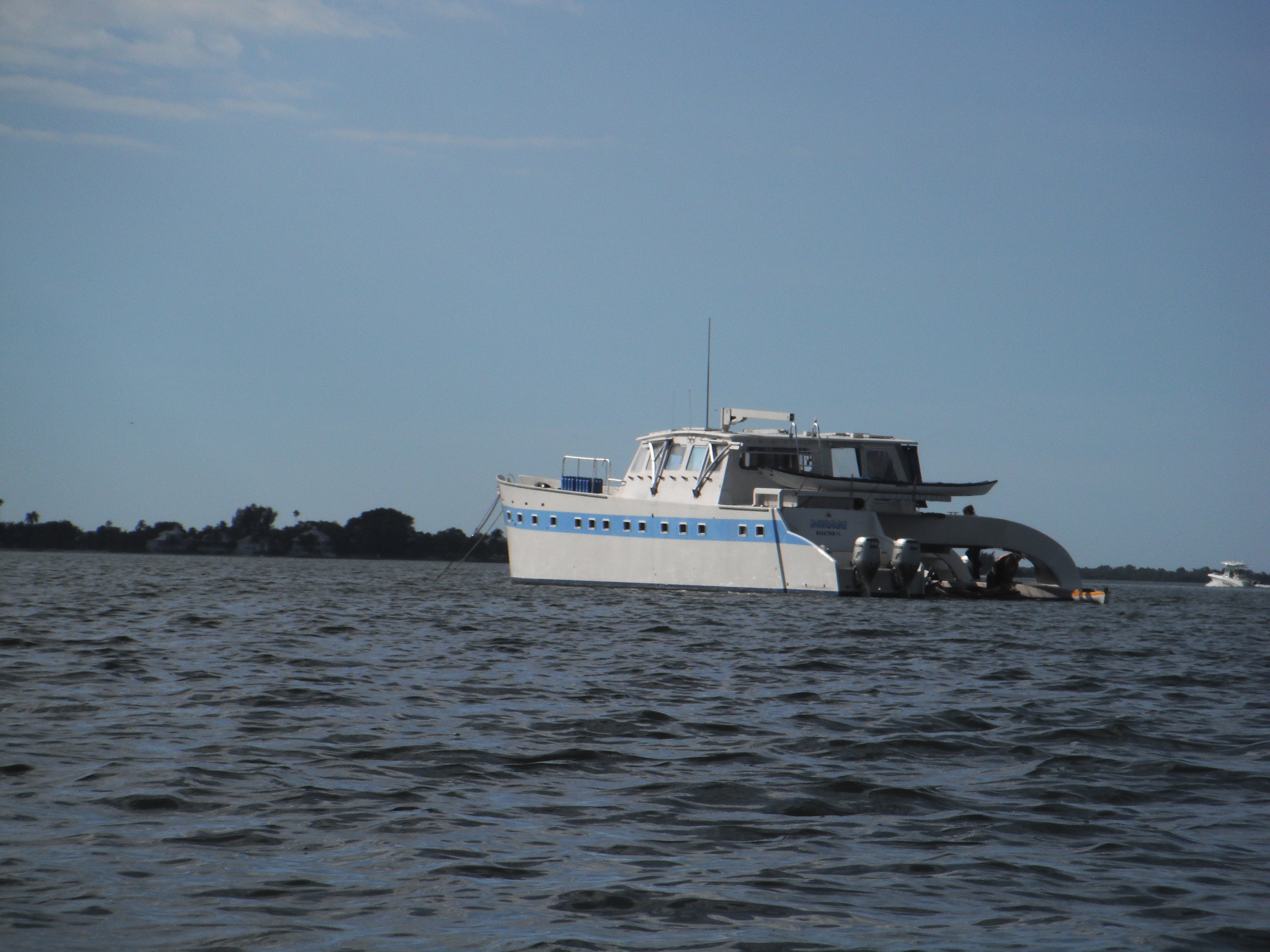
Of course, this refers to the Earth in her voyage through the heavens, but whenever I hear the song, I think of another blue boat home, the Mirage. Last January, I was privileged to spend a week on board, cruising Pine Island Sound near Ft. Myers, kayaking through the mangroves, viewing birds and other wildlife. A white boat trimmed in blue, on blue water under blue sky, Mirage is a magnificent sight. Viewed from the port side, she resembles a substantial yacht. Seen from other angles, your head snaps back for a second look. “Did I see that right?” Hence, the name Mirage. She is unique, custom built by John Bartlett and operated by Kayak Voyagers out of Alva, Fla. There is no other like her.
Kayak voyage 165

The Mirage is seventy feet long and twenty six feet wide. Her main hull, called the “vaka”, is only eight feet wide. This is joined to the outrigger, the “aka”, by two arches called the “ana”. Mirage is not a luxury yacht. She is a mother ship for a small fleet of sea going kayaks. On our trip, there were only four of us aboard but she can comfortably accommodate twice that many.

In “Taking Pictures from a Kayak” I wrote about one aspect of my adventure. This post will be one of a series I have been working on as I digest the meaning of the experience.

Much more than a pleasure trip, it was the breaking of a mold for me. I was a late-comer to open water. My childhood was spent in the foothills of the Catskill Mountains and I never laid eyes on a body of water larger than a lake until I was fourteen. Then my family migrated to Florida. I caught my first glimpse of the Atlantic Ocean as we drove over a high bridge in Savannah. That night, we stopped on a Florida beach after dark, my first intimate contact with salt water. I was unprepared for the sheer power of the ocean. Roaring like a lion, it surged forward, receded with a sigh, then attacked again. By the headlights of our car, I could see only those lion paws clawing the sand and the black depths of the sea and the sky. No way would I commit my body to that behemoth!

Of course, living in Florida brought better acquaintance with beaches, and with lakes, canoes, and sail boats. Then work and family responsibilities kept me from the water for many years. I did not touch a kayak until after I retired.

On my first kayaking adventure, I tagged along with my daughter Amber and her friends to the SuwanneeRiver. I did not tell anyone I’d never been on a kayak before. I hoped I could fake my way through the experience, and I did. As we launched, I considered strategy. Those young people could paddle all day without breaking a sweat, but could I? I suggested we paddle upstream, so that the return trip would not be too difficult if we were tired, and everyone went along with it. I was pleased with myself at day’s end.

But when the opportunity arose for a week-long kayak voyage in South Florida, I had second thoughts. And third thoughts. Was I up to it physically? I had obligations on my schedule. Could I be gone from home that long? These concerns only masked my trepidation over trying something entirely new, engaging in an activity for which I had few skills, spending a week with people I had yet to meet.

I took a deep breath, cleared my calendar, and broke the mold. I committed myself to the adventure.

On the appointed day, I drove half the length of the peninsula to the Ft.Myers area. Many years had passed since I’d visited southwest Florida and I expected to see the countryside covered with concrete. I was pleasantly surprised by the amount of farm land, mostly cattle ranches and orange groves, which survive, and the wilderness areas that have been preserved.

I enjoyed the scenery so much I took a wrong turn in Punta Gorda, heading north toward Tampa instead of south. As a result, night had fallen by the time I reached Pine Island. Although the island is only fifteen miles long, the road seemed to stretch forever in the dark. Finally, I crossed the small bridge to Bokeelia Island. Out in the bay, I could see the lights of the Mirage. I parked by the dock and called Elke. What did we do before cell phones? Soon, I heard the put-put of the dinghy and Elke pulled up to the dock. We loaded my stuff and cruised over to the Mirage.

I knew I would have my own cabin and head. I pictured a hallway in the hull with cabins opening from it, but the hull is too narrow and that would have been wasted space. To my surprise, my cabin was accessed by a hatch on the deck and a steep set of stairs almost like a ladder.

Keith had gone to the airport to meet Jun, our other passenger. When he called from shore, Elke picked them up in the dinghy. After introductions, Elke rustled up a nice supper, which we enjoyed in the open air dining area. In the morning after breakfast, we embarked on our first paddle, around Back Bay.

In the week that followed, we explored mangrove islands and swamps, wildlife refuges, and an Indian mound. We viewed untold numbers of birds, visited manatees, collected shells, and took lots of pictures. The days brought not only good times, but lessons in self sufficiency and interdependence, ecology and sustainability. Stay tuned for the next installment.

For more about the Mirage, visit http://kayakvoyagers.com.

Read Full Post »

On a cold, rainy day, when it’s not nice enough to work outdoors, cleaning out the attic is a worthy endeavor. Every year I have good intentions to do this, but the Road to Hell is paved with Good Intentions. For once, this year I strayed from that road, at least in this regard. As a bonus, I uncovered a trove of treasure.

A genetic trait of the Rogers family is the propensity to save things. This goes back three generations, probably more. We are not hoarders as such. We just save anything that might be useful someday. This is a survival skill. Have you ever discarded or given away something you never use, only to need it six months later? That’s why we save things. My father used to make fun of me. He once accused me of saving old toilet paper. He was only exaggerating, of course (another family trait – have you noticed?) but he was a great one to talk. My widowed mother, who does not carry the trait, has been sorting through his stuff for over six years and there’s no end in sight.

My house has three attics, so imagine the trouble I can leave my heirs. In the little attic above my kitchen, I store holiday decorations. This winter I cleared everything out of there, including all the dirt and debris. I reorganized the Christmas stuff and stored it neatly in one area. There were a few boxes of Easter baskets and Thanksgiving decorations, plus some camping equipment and luggage. These were easily dealt with. Then I had to contend with an unbelievable pile of empty boxes, Styrofoam peanuts, and other packing material. Much of that was  recycled  or thrown away, but it’s wise to keep some in case I want to mail a package. Wise, but even wisdom needs its limits. I can’t keep ALL of it.

Last, but not the least challenging, was the large box of Halloween costumes. If you are a student of ancient history, you may remember when Curtis Mathis TVs had the longest warranty on the market. Well, I still have my TV and it still works. It came in a huge box which had sat in my attic full of Halloween things for over twenty years. I cannot recall when I last sorted through it.

I remembered many of the costumes stored there: a clown/scarecrow suit, some monster masks, square dance apparel complete with pantaloons and petticoats, and some tunics that could serve as Indian or medieval costumes. There were several half-surprises, things I had nearly forgotten: a box of grease paint (from my college days!), a variety of hats crushed by time, a battered wig, a wine skin, blouses from the hippie days, clothes from the 80s, and some men’s coveralls.

Then came the forgotten surprises. One old hat has a band made from a real rattlesnake hide. A plastic Transformers mask, perhaps Optimus Prime, had survived from the 80s. I found a straight jacket made of muslin, a hospital gown, and several almost doll-sized garments, including a little red and white cheerleader skirt. I made these for my girls when they were little. Very little. Several things may have started out as clothing later to become costumes: large full skirts, a garish pair of shorts like the surfing shorts popular in the 80s, a rather nice leather jacket “Custom Tailored in Hong Kong”, a wrap-around (and around and around) skirt, and some thrown-together pieces, costumes for fantasy characters.

It was fascinating to go through everything, trying to remember who wore them and when. But what should I do with them now? If I boxed them up, they could remain forgotten for another twenty years.

In another attic I found a solution. A clothes rack held old prom dresses, majorette outfits, and some coats and blouses. Many of those are an appropriate addition to a costume collection, so I unloaded the rack and set it up in the kitchen attic. I sorted through everything and restored the gowns and other articles to the rack. Then I hung up all the other costumes. The rack is very full. There is no room for anything else. Maybe I can find good homes for some items. Maybe my children will want some of them.

I threw out the old paper ghosts and pumpkins and even the grease paint and the old Curtis Mathis box. Everything has its life span. The few salvageable Halloween treasures now fit into a smaller box.

Today my attic looks less like a trash heap and more like those old attics you see in movies, festooned with period costumes. Everything is still dusty and could use a good laundering. After that has been accomplished, a fun thing to do on a rainy afternoon would be to introduce my granddaughters to the attic and let them go treasure hunting.

Read Full Post »

Lately, I’ve been watching a lot of movies. There is probably no genre I do not enjoy, as long as the movie is good. I like classical films and period pieces, many of them British, where the only firearms are hunting pieces, but I also watch action films in which fast car chases, explosions, and machine gun fire are the order of the day. I avoid those which fail to rise above the violence, that feed only fantasies of rage and revenge. I can’t relate to them. But many have heroes, sometimes anti-hero heroes, who engage in a mission, wrestle with inner demons as well as diabolic villains, and save not only the world, but their own souls. Stories of any kind get me to thinking. Here are some of my observations.

WHY ARE THE BAD GUYS SUCH POOR SHOTS?

This puzzles me. Our hero, armed with only a hand gun (which in reality would have limited range and accuracy) can pick off the bad guys 100 feet away while literally running to save the heroine, or his own life, or both. At the same time, the bad guys are spraying the atmosphere with automatic weapons, and not one bullet hits our hero. Or our heroine, unless it is written into the script that she is to die in order to deepen his distress.

Come on, now. I can do more damage with a water hose.

The only explanation I can find for this phenomenon (besides its being written into the script) is that heroes wear invisible armor, an aura of protection, which evil cannot penetrate (unless it’s written into the script). The bad guys, of course, have no such armor, with the exception of the arch villain whose life must be spared for a sequel. So they are doomed to die like flies.

Actually, that is a poor metaphor. Have you ever tried to kill a fly?

I WANT ONE OF THOSE SUITCASES

Have you paid attention to suitcases in movies?

I used to marvel at how my then-teenage daughter would pack more bags for an overnight visit than I require for a week’s vacation. Then I watched an old movie about a group of people gathering for a weekend at a haunted house. One comely young lady arrived carrying only her modest purse and a suitcase that would barely hold a teenager’s cosmetics. I couldn’t believe she came so poorly prepared.

This week I watched “White Christmas”. The heroines are a pair of sisters who perform a song and dance act, traveling by train up and down the eastern seaboard. Early in the movie, they are threatened with arrest due to a landlord dispute. The heroes help them escape through a back window. When they pass three or four suitcases through the window and place them in a taxi, the inattentive viewer might imagine that was a lot of luggage. But stop and think. This took place in the early 50’s. These stylish gals wore crinolines that occupied a square yard of floor space each. The girls also had their costumes, which included headpieces with large feather plumes. Plus their clothing.

Edith Head had a hey-day designing costumes for this movie. Every time the girls stepped in front of the camera, they sported new outfits. Sure, they borrowed each other’s dresses, but half a boxcar would be needed to haul all the clothing the movie displayed.

One sister decides to go off on her own. She is seen at the train station with a single suitcase barely large enough to hold her spare crinoline. In succeeding scenes, she again changes clothes every time the camera man takes a break. If she had successfully crammed all she owned into that one bag, she would not be able to lift it. In those days, luggage did not come with rollers.

It must be magic. Something like Dr. Who’s Tardis, roomier inside than it appears, and all that weight dissipating into something ethereal that a skinny young actress can pick up and carry. As I pack for a week’s getaway, I’m thinking, “I wish I had one of those suitcases.”

MAN ON THE ROOF OF A TRAIN

Not long ago, I watched “The Great Train Robbery” starring Sean Connery, a movie well worth watching. It was released in 1979 when he was still young (well, 49) and special effects were still in their infancy. This was long before 007 began jumping out of perfectly good airplanes to ski down mountain sides so he could tangle with bad guys.

The story takes place in 1854 and our hero is a train robber. The most exciting scene, showing Sean Connery walking on the roof of the moving train, takes several tense minutes. The train is pulled by a steam locomotive spewing smoke. Our hero climbs from his passenger car onto the roof and tries to walk on the jolting, swaying cars, jumping from one to another to get to the back of the train where the loot is stashed. What made it most thrilling is that it is Sir Sean himself, not a stunt man, on the roof of that train.

As I watched the movie, I was struck by how this simple stunt, without the aide of CGI, equaled the more sophisticated antics we have become accustomed to. Actually, it more than equals them. I found it more thrilling because, although staged, it was real.

Read Full Post »

Every year, the commercial Christmas season seems to distend earlier into autumn. This year, stores set out Christmas decorations before Halloween and soon broadcast Christmas music.

Bah! Humbug! Even store employees agreed.

I remember Grandma Rogers, one of the nicest people I’ve ever known, saying, “I’m going to join the Jehovah’s Witnesses”. This seemed so out of character. She was no Scrooge, but grew up in a family of modest means and reared her children during the Great Depression. The increasing commercialization of Christmas must have grated on her. Now I understand. I find myself making the same threat.

But TODAY is the day after Thanksgiving. The Spirit of Christmas beckons. Don’t worry, you won’t find me at the mall, or even a convenience store. I may or may not glance through the stack of catalogs that have cluttered my mailbox for weeks, but I will start making lists. After almost two months of Scrooge, it is time to welcome Christmas.

This holiday embodies a magic unrelated to material things and goes beyond the joy of giving. Remember the Christmas Truce of 1914? During World War I, Allied and German soldiers in the trenches spontaneously stopped fighting, sang Christmas carols, and crossed battle lines to exchange fellowship, food, and souvenirs. Unsanctioned by their superiors, this event will long be remembered as a triumph, however brief, of love over hate.

The magic of Christmas survives adversity. In 1989, we had an ice storm.  On December 22nd, my children and I visited my parents in Scrambletown, planning to spend one night. My parents didn’t know that my sister Lorraine, a missionary in Africa, was coming home for Christmas.  She arrived with the freezing rain and snow.  Our parents were surprised and overjoyed and no one minded the bitter cold.

 But we cold not get home. The Ocala National Forest is a veritable island, surrounded on two sides by the Ocklawaha River and the St. Johns River on a third. The bridges were iced and closed. The only way out was south through Lake County, but weather conditions made travel inadvisable. Our northern friends may scoff, but they do not want to share icy roads with Floridians. We are a menace.

Sunshine melted the ice and I drove home Christmas Eve. Patches of frost remained on shady areas of roadway, but we arrived safely. We came home to no electricity or heat. Water left in a jar was frozen and my houseplants were history. However, our spirits were not chilled. With a gas stove, we could cook. Somehow I procured a kerosene heater. We survived and celebrated a very happy Christmas.

 Of course, Christmas cannot overcome all misfortune. A neighbor of my parents was killed one Christmas Eve riding home on a mini-bike intended for his children. These things happen. Lesser troubles occur. When I was about eleven, some of my brothers and sisters came down with measles and my mother had to stay home with them while the rest of us visited our grandparents on Christmas. The last year of my marriage, I was heartbroken when my spouse neglected to give me a gift. But my children’s generosity buoyed my spirits.

Christmas brings anxiety. As a parent, I always worried I wasn’t doing enough for my children. Then one year, when my oldest boy was about five, he remarked that he got too many presents. I used to have a recurring dream, that it was Christmas Eve and I did not have gifts for some of my loved ones. After a few years, the dream ceased to bother me. Then one year the dream did not come! I worried that I would actually forget someone.

Most of my memories of Christmas are happy. As a child, we would wake at 3:00 am and find our stockings filled. Santa must have come by at 2:30. One Christmas we woke to a living room full of child-size wicker chairs, one for each of us. I still wonder how Santa managed that.  One season we tried to peek into what our parents had bought us. That ruined our fun and we never did it again. Before we moved to Florida, Christmas lasted all day. We ate breakfast at home and opened presents. Then we went to Grandma Rogers’ for dinner and more gifts. For supper, we went to Grandma Masters’ for aunts, uncles, cousins, and even more presents.

Maybe that’s why I still try to make Christmas last all day. My children were allowed to get their stockings when they woke up, but they were not to open presents until Mama had a cup of coffee. Even then, my preference was to limit it to one gift before breakfast, which of course drove the kids nuts.

Occasionally, we went to the Christmas Eve service at church, but I prefer to spend that night at home. Before my children grew up and moved away, we had a tradition of snacking on hors d’oeuvres and wrapping gifts until bedtime. Last year, my daughter-in-law’s gift was to take me to the Christmas Eve matinee at the Alhambra Dinner Theatre in Jacksonville. The food was delicious and  “White Christmas” brought me to tears. Although the cast faced an evening performance, their spirits were high and some took time to chat with us afterwards and sign autographs for my granddaughter.

The magic didn’t end there. We stopped at the riverfront on the way home and enjoyed the scenery and the cool but pleasant evening. A handful of other pedestrians and bicyclists were abroad. Total strangers, we greeted one another with, “Merry Christmas!”

Today, after I post this, I will start my lists: cards, gifts, cookies, fruitcakes, and groceries. I will retrieve decorations from the attic and stick plastic poinsettias in my houseplants. That makes them happy. In a few weeks I will search the woods for a suitable tree.

Today is the day after Thanksgiving.  Scrooge has been visited by his ghosts. It is now the time to look forward to Christmas.

Read Full Post »

October begins bright yellow. Helianthus and Goldenrod literally glow on the roadsides and vacant lots. Goldenrod grows along my driveway and on the margins of my garden, but I had been unsuccessful in coaxing wild sunflowers to take root here. Then one gloomy day last fall, as I glanced toward a fallow area of my garden, a splash of sunshine greeted me. A Helianthus had burst into bloom when I wasn’t looking. It reseeded itself and they are back this year, shining in greater numbers.

White is also the color of October. Bidens alba grows in neglected places everywhere, especially in my yard. I keep them for the butterflies, but if I walk too close, the seeds, called Spanish needles, will spring out and cover my clothing. I appreciate these weeds because the butterflies love them. Unless we have a hard freeze, they will bloom all winter, providing nectar when all else is gone. On the roadsides, white banks of Bidens grow a foot high. The air above those little daisy-like flowers teems with butterflies. The county could not have provided a better show if they had planned it.

Every year I look for the date the Dog Fennel starts to bloom. They predict six weeks until the first frost. I have been watching this phenomenon for years and it seems to be pretty accurate. This year, they began to bloom on October 1st. Look for frost in mid November. Did you know these little white fountains have a scent? A very delicate one and you have to get close to detect it, but please, take the time to smell the Dog Fennel.

The colors of October are also purple and blue and pink and red. Earlier this month, I was cheered by the tiny, purple blossoms of Elephant’s Foot winking up at me against their intense green foliage. By now they have gone to seed but the purple spikes of Blazing Star have replaced them in the landscape. In wet areas, alongside ditches, in both sun and shade, Blue Mistflower blooms in dense clouds. Asters and other wildflowers too numerous to list brighten my daily walks along the dirt road. Spotted Horsemint is abundant. This is a wildflower you may overlook as they are not ostentatious, but familiarity breeds appreciation. Most are white, but last year I found purple Horsemint, and they are more numerous this season. I have collected seeds to plant along my driveway. Various colors of Morning Glory climb atop brush or twine across mowed spaces, mostly pink or blue or white. In similar areas, the Scarlet Creeper’s diminutive red blossoms are a pleasant surprise.

Besides collecting seeds, in coming seasons I will happily move some of the volunteers to areas where I want wildflowers to grow. But I must expect an argument out of them. They do not take kindly to domestication.

You cannot ignore the flying flowers. The butterflies are busy drinking their fill against encroaching winter. Yellow sulfurs everywhere dance in pairs high above the ground. Swallowtails of various colors, brown Hairstreaks, skippers, and the orange Gulf Fritillaries and Little Metalmarks delight in the sunshine while the Zebra Longwing enjoys the shade of my woods.

The butterflies are wise to seize the day because the season is fading. November approaches. Many wildflowers have lost their maiden glory and are gone to seed. Here in North Florida, we do not get the flashy fall foliage of the northern states. Some of our trees will turn yellow or red, but not in the profusion seen there. When northern trees have lost their autumn show and become bare and brown, my oak trees will still be green. They will clutch their frostbitten leaves all winter, then discard them in time for new growth and pollen-laden blossoms. I rake my yard more in spring than in fall. But while northern trees still sleep, our maples will announce Spring with their beautiful red florescence.

Read Full Post »

THE WRONG WAY TO DO THINGS

As I look back on my life, I realize that since childhood I have been taught the wrong way to do things. When I brush my teeth, I think about elementary school, when we had lessons on dental hygiene every year. They told us never to brush sideways. We were to place the brush at the gum line and brush away, to remove the food particles and what not. At some point in the intervening years, this “wisdom” changed. Now you are supposed to brush sideways and use floss to remove the food particles and what not. To be on the safe side, I now do both, brushing up and down first, then sideways. If “wisdom” reverses itself again, my bases are covered.

They also told us to brush after every meal, without fail. I guess we were supposed to take a tooth brush to school, but no one ever did. Nor did they give us the time or opportunity to brush after lunch. Now I hear that brushing immediately after a meal is the wrong thing to do. Now, food softens the tooth enamel and makes it susceptible to damage. You should wait at least twenty minutes before brushing. Or go to bed with dirty teeth if you snack within twenty minutes of bedtime.

In fourth grade, our elementary school campaigned for better nutrition at breakfast. They ran a contest, giving points for each “healthy” thing students ate: eggs, bacon, juice, and toast. In those days, most mothers did not work outside the home and had the time and energy to cook breakfast. Of course, the economically advantaged families could afford bacon, eggs, and juice, so their children won the contest. My mother was a good cook but we had a large family. Although we lived on a farm, we did not have chickens at the time and had to buy eggs, not to mention bacon and juice. Our breakfast was usually bran flakes and milk. Today, as far as I know, juice is still acceptable, but bacon is verboten and eggs are sometimes the wrong thing to eat, depending on how the “experts” feel about cholesterol this week. What is the recommended breakfast today? Bran flakes and milk.

Do you remember when you should never go swimming for at least an hour after eating? After spending half a day driving to the beach and arriving at lunch time, you had to wait an hour before getting your feet wet. Why? Because you would get cramps and drown. Now I understand this prohibition has been lifted. Eating has nothing to do with life threatening cramps. Eat, and enjoy your swim.

When I became a mother, we were told never to put a baby on his back. He would spit up and choke to death. Since I wanted to be a good mother, I always laid my babies on their bellies. By the time I became a grandmother, “wisdom” had changed. Putting a baby on his belly is now the wrong thing to do. He will suffocate. Now you must put them on their backs. I guess they no longer spit up and choke. As a middle ground, you can lay them on their sides. Right. They’ll stay that way and not roll over onto their backs or bellies to certain death.

Don’t get me wrong. I am all for having experts to advise us. After all, they are supposed to be up to date on knowledge and research. But sometimes I wish they would make up their minds. In the meantime, I think I will rely on common sense.

Read Full Post »

Before I became more than casually interested in my family’s history, William Lewis Rogers had been a shadowy figure in our past. I knew two of his sons, Uncle Will and Grandad, who were old men when I was a child.  Family lore proclaimed W.L. was wounded at the Battle of Gettysburg and spent the night hiding in a corn crib where he had to fend off rats. We knew this about him because he kept a journal. But no one knew what became of the journal. It has been lost.

One summer, my sister Sue, our family genealogist, and I visited the county in Pennsylvania where W.L. had lived as a child. I helped her search records at their historical society for information on his family. We visited his mother’s grave.

Threads from diverse sources gather to weave a tale.

My daughter lived in Virginia Beach for a time. Traveling to or from her home, I took back ways to break the monotony of the usual route. Once I noticed a large bear by the road. It was a sign for a park, but later I could not recall where I was, or indeed what highway I’d traveled. On a later trip, back roads again, I spotted the bear and this time I stopped. Neuseway Nature Park in Kinston, NC has become one of my favorite places to visit when I’m in the neighborhood. There is no admission charge and the camping fee is almost indecently low.

Then my son moved to West Virginia. Well, we had ancestors in that state, too. Once Sue learned about my plans to visit there, she set me on the quest. Given a list of ancestor’s names and the location of the Hampshire County Library, which has a genealogical section, I reported, like a dutiful sister, intending to spend two hours in research. After three hours, I had to make myself stop. Not only did I need fresh air, I had to digest the volume of information I had acquired. I was hooked on genealogy.

W.L. Rogers had been born in Connecticut and died in West Virginia. Grandad always said, “Don’t go to West Virginia. They’ll kill you there.” Well, who killed William, and why? Unfortunately, my hours of research failed to solve the mystery. Could we find old newspaper stories or police reports that would answer the question? I would have to wait for another trip.

After West Virginia I proceeded to Virginia Beach. On my way home, I drove through Kinston. This visit was bittersweet because my daughter was moving from Virginia Beach and I thought I would have no reason to come through here again.

The following year, on my return to West Virginia, I searched through death records and learned the identity of my ancestor’s murderer–cancer! Cancer? So why did Grandad say he had been killed? Who knows! Grandad was more than a little paranoid. Knowing where W.L. was buried, I visited his grave. Below his name and the dates of birth and death was engraved, “Co. A 85th Regt. NY Vol.”

One mystery solved, another reared its head. Sue obtained W.L.’s military records. Guess what – Gettysburg was fought in 1863 and he did not enlist until the following year. So much for family lore! What about the corncrib and the rats? Was that part true or did the family once have possession of some other soldier’s journal? We will not know until it surfaces.

But we did learn that W.L.’s regiment had fought in the Battle of Wyse Fork which took place near Kinston, NC. Was that what kept drawing me to the place? Now I had an excuse to go back.

Wherever I go seeking historical information, I find people who are not only proud of their history, but willing to share what they know. This was no exception. I had a nice visit with Shirley at the Kinston/Lenoir County Visitor’s Center and left with a wealth of information, including a driving tour of the Battle of Wyse Fork. Armed with the pamphlet and my camera, I set out to trace the footsteps of my ancestor.

W. L. may be forever nameless in the history books, but what a thrill it was to drive around the battle area thinking, I am in the footsteps of my ancestor. I could not help imagining what this young man, only 21 at the time, was thinking and feeling amid the noise and terror of the guns, death, and suffering. No, W.L. did not fight through three sweaty days in July, but through three cold days in March, in rain and mud and snow. I followed his path from Wyse Fork, through Kinston, and as far as Goldsboro but I lacked the time to visit everywhere his regiment went.

My quest is far from complete. We have documentation that after the war W.L. married Nancy Turk who, we believe, was part Cherokee. He taught school in Pepin, Wisconsin, then homesteaded in Kansas. Family lore has stories of the family’s experiences in Kansas. How much is true? I hope to find out.

Why did they leave Kansas? What adventures took him to West Virginia? I am still on the quest for this ancestor.

Read Full Post »

          I must have been six or seven when Grandma Masters made this skirt for me out of brown corduroy. She cut several autumn leaves out of brightly colored fabric and applied them to the front, where they appeared to drift down from waist to hem like falling leaves. I was proud of that skirt. It was unique. But Grandpa Rogers would tease me every time he saw me wear it. He’d say something like, “There you go again, with that old patched-up skirt.” I’d argue and try to tell him that they were leaves, not patches. Of course, he’d tease me just to hear me protest.

            Grandma must have put a large hem in the skirt to be let out as I grew taller, which took quite some time. Even today I’m often accused of lying about my height.

I remember the teachers at Harry L. School saying that I was a nervous child. They would tell me not to “ring” my hands. I had no idea what they were talking about and they never explained. Of course I was a nervous child. After attending a one-room school house in the first grade, I was out of my element in the big city school. None of my schoolmates from Barnum Hill School were in my second grade class. I was alone with the more savvy city kids and strange new customs and rules.  I was suffering from mild PTSD long before such a label was thought of!

Eventually, I grew enough for the hem to be let out of my skirt. I’m not sure if Mom didn’t have the time to press it (which I doubt because she always ironed) or if the crease was just so ingrained by then that it couldn’t be pressed out. I remember fingering the hem and crease to keep my hands busy at school. I guess the teacher thought I had put the crease in the skirt by playing with it. “Now look at what you’ve done,” she scolded. I don’t remember being allowed to say anything in my defense.

It’s a wonder I ever learned anything under those conditions.


Read Full Post »

« Newer Posts - Older Posts »

Writer Beware

Shining a small, bright light in a wilderness of writing scams

Abandoned Southeast

Preserving the Past | A Photoblog of Hundreds of Abandoned, Historic, and Forgotten Places

Bonnie T. Ogle

Award Winning Childrens Author

filmmaven

A great WordPress.com site

The Tony Burgess Blog

The Home Of T-Bird From The Dork Web.

Wells Family Genealogy

The study of my Family Tree

Alien Resort

A Terrestrial Romance

douglasfelton.wordpress.com/

Compelling Young Adult fiction from author Doug Felton

Hidden River Arts

Dedicated to Serving the Unserved Artist

Green Life Blue Water

Where Eco Meets Life

Pattie Remembers

Sunsets and Buzzards, and Other Stories

koolkosherkitchen

Welcome to my Kool Kosher Kitchen where food is fun and fun is to create food!

The Life in My Years

An anthology of life

cookingforthetimechallenged

Fast, easy, all natural, healthy, kosher cooking

CarpeDiemEire

Travel Through Ireland and Europe