Feeds:
Posts
Comments

Archive for the ‘Marie’s Musings’ Category


Why are we willing to spend so much money on a dumb animal? I used to think people were crazy to pay large veterinary bills for a cat or dog. I never thought I would be one of those crazy people until I had a million dollar dog of my own.

Country people don’t always take their animals to a vet. My parents never did. Teddy was my first dog to get veterinary care. Living in the woods, with the possible threat of rabies, and having children around, I took no chances. I kept his check-ups and shots up to date.

When the vet recommended he be neutered so he wouldn’t “chase the ladies,” I had it done. I felt bad for him, but Teddy didn’t seem to mind. He always liked going to the vet, despite all the indignities they inflicted on him. All I had to do was say, “Time to go to the vet,” and he’d hop in the truck.

Often I wished I could clone Teddy, because he was such a good dog. Maybe that’s why I was willing to pay a $1500 emergency clinic bill to keep him alive. Here is how it came about. On our walks I noticed he’d pee only a few drops at a time. I thought he was just marking territory. Then he started dragging around, not acting his usual self. When I found him under the porch steps totally listless, I knew I had to do something. Since my vet didn’t have emergency services, I took him to a clinic an hour away.

The young veterinarian said Teddy had kidney stones and was unable to pass water. He was near death and needed immediate surgery. Or I could choose to euthanize him. I weighed my choices—money or dog. But, really, what choice did I have? This was the dog who was willing to lay down his life for his family. (Read “Pup Dog” if you haven’t already.) I paid for the surgery with my credit card and spent the night in the waiting room. After this, I kept him in the house and nursed him to full recovery.

Even that wasn’t the end of the expense. I took Teddy to his vet for follow up and was told he needed to be kept on a special diet for the rest of his life. The food was expensive, but I didn’t want a repeat of the kidney stones episode. After I retired and could no longer afford the special food, the vet prescribed a powder to add to regular dog food. Teddy never liked the special diet and refused to eat dog food laced with powder. Finally I gave up and fed him Old Roy and watched to see if he had any trouble urinating. He never had a recurrence of kidney stones.

In his later years, Teddy developed eczema, which required many trips to the vet. We tried several treatments, all temporary fixes. Often his beautiful coat was marred with bald patches. He also suffered with arthritis and hip dysplasia, and it became increasingly difficult for him to go on long walks or climb stairs. I laid boards over my porch steps to make him a “wheel chair ramp” but he refused to walk on it, even though climbing was obviously painful. The vet put him on drugs for arthritis pain. Then he became incontinent. More drugs. More expense.

At first it was no trouble to give him pills. I just put them in his food. Then one day he caught me in the act. He looked hard at his dish and ate around the pill. After that I had to trick him by crushing pills and mixing them with leftovers or canned dog food. He was so suspicious he wouldn’t eat unmashed peas because they looked like pills.

At every setback, I’d take him to the vet and each time he was prescribed more drugs. By now I was spending more money on Teddy’s medical care than on my own! I began to call him my “Million Dollar Dog.” But he was such a good dog.

One day a visitor referred to Teddy as an “antique dog.” That phase of our life together will be the subject of the final post of this series.


Read Full Post »

Travels with Teddy

When my daughter Amber lived at home, she took care of my animals when I traveled. Once she said Teddy missed me so much he wouldn’t eat when I was gone. It turned out she was feeding him twice as much as I did! He ate like a cat, nibbling his food throughout the day, not gulping it down all at once like some dogs. He’d leave what he didn’t eat.

When Amber was not available, a neighbor tended my animals. One summer, I came home to find Teddy wearing a pink flea collar. No one knew where he got it. Of course, he managed to scratch it off and lose it. One day Teddy and I took a walk on the dirt road. A neighbor I didn’t know well said, “Hello, Teddy.” I stopped to inquire how he knew Teddy and learned that while I was traveling, instead of staying home to keep the varmints out of the yard, my faithful dog was nearly living at their house! That’s where he got the flea collar.

After this, I took him with me. Teddy loved to travel. If I went somewhere in my van and didn’t take him, he’d pout. On the road, he was well- behaved and even tolerated a leash once I explained that city dogs had to wear them. He accompanied me as far north as West Virginia and as far west as Arkansas. On hot days, I couldn’t leave him in the van and tour a museum or antebellum house, but we stopped at parks and walked the trails. Here are Teddy and Tristan, both dog tired after a long walk through a North Carolina swamp:

2011 pics 391

One summer we spent several days on the Blue Ridge Parkway, stopping at every cabin and walking every trail that wasn’t too steep for him to climb. I’d go sightseeing and Teddy’d go smell-sniffing. He delighted in new and unusual smells. Here he is checking out something that looks disgusting to a human:

Copy of 10-15 131

He seemed to understand that the van was our home away from home. If a park ranger stopped by our campsite, Teddy would bark until I told him it was ok. One year we went to Arkansas. From there my mother and I flew to Washington to visit my sister Sue. I left Teddy and my van at Mom’s house, under the care of my nephew. Teddy made himself at home and didn’t leave the farm as long as my van was there.

But things were different in the city. One summer when we visited Amber in Virginia Beach, I tied Teddy in the back yard at night and slept in the house. The next morning he was gone. I hiked all over the neighborhood but no one had seen him. We called the pound but he wasn’t there. I was afraid I’d lost him forever.

That afternoon, Amber’s father-in-law returned home and said, “Get your damn dog out of my car.” He’d found Teddy! On a whim, he’d decided to take a different route home, spotted an Animal Control truck, and Teddy being led toward it. Randy convinced the officer he knew whose dog it was, and Teddy was released without bail. Apparently, Teddy had gone as far as a house on a lake and hung out in the backyard all day. When the owners got home from work, they called the pound. After this, I slept out in the hot van with Teddy so he wouldn’t escape again.

Teddy got along with most dogs but my sister Bonnie’s dog is jealously territorial. He wouldn’t let Teddy out of my van. Brutus sees me only once or twice a year but always greets me with wagging tail, even if no one’s home. He doesn’t even object when I use their hidden key to get into the house. Some watchdog! Bonnie said he senses I belong there. But Teddy was not welcome. Brutus had to be distracted so Teddy could get out to relieve himself. Then Brutus got curious about my van and wanted to check it out, but that was Teddy’s territory. He wouldn’t let Brutus near.

As he aged, Teddy had trouble climbing into the van. He could get his front paws in, but I’d have to pick up his hind quarters and shove. Sadly, his traveling days were over. I always felt safe when he was with me, and I missed his company when he wasn’t.

Next time I’ll tell you how Teddy became known as my Million Dollar Dog.

.


Read Full Post »

In the spring of 1999, Amber and my niece Arianne found a puppy on the side of the road. They brought him in the house wrapped in a towel and all I could see was a friendly little brown head. Then she took the towel off—there was not a hair on the rest of his body. He was covered with mange. The girls promised to find a home for him.

Teddy

They named him Teddy and took him to the vet. He responded well to treatment and before long, he was covered with a beautiful brindle coat. But before they found another home, I had grown attached. Teddy was a big a name for such a little puppy, so I called him Pup, and later Pup Dog. For the remainder of his life, he was known to the rest of the world as Teddy, but to me he was Pup Dog. If I called him Teddy, he knew I was mad at him.

At first I kept him on the front porch and cleaned up behind him, but I didn’t mind. What I did mind was when he ate the potted plants on the porch. If they were in plastic pots, he ate the pots, too. He even ate a bag of potting soil! I’d never seen a dog go through a worse puppy-chewing stage. Of course he’d also eat any shoes or other objects within reach.

I don’t think he ate anyone’s homework, but he did eat my beeper. One night when I was on-call, coming home late and tired, I must have dropped it in the driveway. I found it the next day, too badly chewed to function. I had a good excuse for work—my dog ate my beeper! He never got sick, so the diet must have agreed with him. In fact, he thrived. He grew to full size within a year.

I could not keep a collar on him. I bought a nice collar with his name on it, only to find its mangled remains in the bushes months later. Afterwards, I kept his dog tags with his vet records.

Teddy was an outside dog most of his life. He did a good job keeping varmints out of the yard. He’d sleep all day and patrol at night. I could hear him on one side of the house, then another, barking a brief warning to any intruders that infringed on his turf. His barking was never a problem. If someone drove into the yard, he’d bark once to let me know they were there. I never had any unfriendly visitors, but if I did, I believe Teddy would have kept them at bay.

Some people have problems with deer or rabbits eating their gardens. I never had such a problem when Teddy was in his prime. He also kept coyotes away. The only creatures he cowed to were wild hogs. A herd of them lived in the woods behind me and would come to my yard to eat acorns and earthworms. Teddy knew they were bigger and meaner, so he stayed out of their way. The only time he stood up to them was to protect Amber. One evening, she walked to the neighbor’s and when she came home, the hogs were in the yard. Teddy drove them off.

Then there was the cottonmouth. For a day or two, Teddy had fits, barking frantically at something in the yard. When we discovered the cottonmouth, Amber decided to kill it with a hoe. Unfortunately, I didn’t think to bring Teddy inside out of harm’s way. Amber chopped at the snake with the hoe and missed. She squealed and jumped back. Teddy thought the snake bit her. He immediately went after the snake, and the snake bit him. I took the hoe and finished off the cottonmouth, then took Teddy to the vet. Dogs often survive such snakebites because the snake is frightened and doesn’t always inject a full dose of venom, but I took no chances. What else could I do when the dog was willing to lay down his life for my child’s?

Teddy was good company. He’d follow me around the yard. He was so curious he’d get between me and whatever I was doing, which could be aggravating. When I went for walks, he always accompanied me. That is, until a rabbit or deer crossed his path. Then off he’d go, paying me no mind. Hours later, he’d trot home. I never worried about him getting lost. Sometimes he’d go off on his own excursions and bring home a dead animal. Farmers disposed of dead livestock in the woods. Teddy would find them and drag home part of a cow or some other unidentifiable beast. Cow skulls and bones littered my yard, and of course, Teddy would smell just as bad as the rotting carcasses.

I’d bathe him before taking him to the vet, and even then he’d manage to get smelly before we left the house. His veterinarian appreciated that he was a free-range country dog and said, “He sure leads a dog’s life.”

Next week I will write about my travels with Teddy.

Read Full Post »

I was sixteen when we settled in our house in Scrambletown, Florida, and probably in college by the time my family acquired another dog. They owned a series of them, including Rattler, Dammit, and some whose names I have forgotten. My little sisters (I won’t mention any names, but you know who you are) immortalized three dogs in a little skit they’d perform for the family. The girls would march onto the stage on all fours and chant:

We’re three dogs. Ruff, ruff, ruff.

My name is Speckles.

My name is Blackie.

My name is Jake.

We’re three dogs. Ruff, ruff, ruff.

After this, they would exit on all fours, keeping in step.

Speckles was white with black spots and Blackie was, of course, a white dog.

I finished college, moved on with life, and became a mere visitor to the homestead. Whenever I arrived, my family’s dogs never greeted me with hostility. They might bark to let everyone else know someone was there, but they seemed to sense that I was not an intruder, that I somehow belonged.

Duke was Dad’s special dog, his companion. Duke was a black Labrador, very intelligent and talented. He could climb trees–can you imagine a large black dog halfway up a live oak tree? Although Dad was not a biker, he had a motorcycle that he’d ride around for fun and into the woods to check his beehives. Duke would ride behind him on the bike. Somehow, he could balance and hold on. That was a sight to see.

Duke on a ladder

I couldn’t find a picture of Duke on the motorcycle or in the tree, but here he is climbing a ladder. He could climb down, too.

Dad’s last dog was a Rottweiler named Bee Bear. Actually she was half Lab, but she looked full Rottweiler. My only previous experience with a Rottweiler was brief and unpleasant. One day as I returned to my car in a parking lot and started to open the door, I heard a vicious snarling that made me recoil with alarm. A Rottweiler sat in the passenger seat of the car beside me.  He was probably only protecting his owner’s property, but if not restrained by that closed door, I think he would have attacked me. Upon reflection, I sure the poor dog had been mistreated because his reaction to me was brutal, not a mere territorial barking.

On the contrary, Bee Bear was a sweet, gentle dog. Only her appearance was fierce. I was never afraid of her. Dad took Bee Bear everywhere with him. She rode on the back of his truck on trips to Arkansas and other places. No one would bother his truck as long as Bee Bear sat there! Dad was not a cat person. He’d tell Bee Bear that a cat was a bear, and she would chase the cat, but I don’t think she ever harmed one.

Bee Bear and girls

This is Bee Bear with some of my nieces. These are not the girls who performed “We’re Three Dogs,” but are the offspring of one of them. (I still won’t mention any names.)

I remember when Bee Bear passed away. She was quite an old dog. It was Dad’s 80th birthday. Every one of his children surprised him by showing up at the farm in Arkansas. Even my sister Lorraine flew in from Djibouti. But Bee Bear was dying that day. Sadly, she died on his birthday, but at least he had family around. We buried Bee Bear in the back yard and my bother Ed, who is a preacher, gave a brief service over her grave. Surrounded by all his children, I think Dad had a good day despite his grief.

The last dog my parents owned was Valerie, a tiny part-hound who was terrified of thunderstorms. She would whimper and hide under the desk, and no one could comfort her. After my father died, Valerie was caught harassing the neighbor’s livestock, and she had to go. My mother is not a dog person.

Next week I will write about dogs I owned in my adult life.

(PS If you look for Scrambletown on a map of Florida, you won’t find it. It’s one of those places with no legal designation, but it has a colorful history. Google “Scrambletown” and you can find out how it earned its curious name.)

Read Full Post »

Dogs I Have Known

This summer, after sixteen years of companionship, I laid my good dog Teddy to rest. In saying goodbye, I thought back to other dogs I’ve known through the years.

When I was a child and we lived with Grandma and Grandpa Rogers, two dogs lived in the house with us, Grandma’s beagle Tinker and Aunt Hazel’s cocker spaniel Curly. In my memory they were big dogs, but at the time I was small. Curly had curly black hair. Tinker’s dog tags would tinkle whenever he moved, so I always associated his name with the sound. I remember them scurrying through the house, always together, it seemed, often underfoot. Grandma would call them to go out, or come in, “Curly and Tinker!” or “Tinker and Curly!” as though they were a single entity.

I recall one other dog on the farm, a German shepherd named Lady, who was kept chained up in the cellar. I felt sorry for her. We didn’t play with her like we did Tinker and Curly, but I don’t remember her being anything but docile. German shepherds were popular at the time and for awhile Grandma raised them. Lady had a litter of pups but we didn’t keep any. Mom said she disliked the breed because one of Grandma’s was mean and attacked her. Grandma probably kept Lady chained out of caution for her grandchildren.

I developed a dislike for German shepherds when I was older and we lived across the road from my grandparents. Our next door neighbor had a mean one he kept in a pen. Sometimes the dog would get out and come over to our yard. We were scared of him and would run inside if he got loose. Once when Mom was hanging out clothes, he chased her into the house. I never understood why my father didn’t shoot that dog.

Grandpa Masters had a hunting dog named Skeeter. He was a nice dog but had to be kept tied so he wouldn’t chase game out of season. His leash was attached to a clothesline so he could run back and forth. He lived in a cozy doghouse summer and winter.

My first dog was a small hound I named Poochie. I don’t remember where I got her, but I loved her very much. Unfortunately, she learned the bad habit of chasing cars from other dogs in the neighborhood. One day she chased the school bus. She ran into the wheel and died instantly. The bus driver was distressed, but it wasn’t his fault. I was inconsolable. Dad handled my grief by grumbling that I wouldn’t cry so much for him if he died. How unfair—I was thirteen and had probably told Dad many times that I hated him, but he knew better. I buried Poochie in my flower garden “with her tail to the North and her head to the South” as I wrote in a poem about her. After this, I tried not to let myself get so attached to a dog.

Before we moved to Florida, we had a nice little Scotch collie named Topsy. Since we couldn’t take her with us, we left her with Grandma and Grandpa Rogers. They grew to like her and kept her the rest of her life.

Next week I will write about dogs I knew in Florida, including Dad’s He had one who climbed trees and rode behind him on his motorcycle.

For another story about dogs, read:

https://marieqrogers.com/?s=Joe+and+Sally

Read Full Post »


Until I was about ten, my family lived upstairs in my grandparents’ house. When we were little, my brother and I shared a bedroom. On the wall above the bed hung a photograph of a young boy, Dad’s brother Donald, who died many years before I was born. That photo remained on the wall for decades, until my grandparents sold their farm and moved to Florida.
image001 (3)
I could not find that picture, but here is Uncle Donald and his baby brother Russell with their grandfather, George Brown.

In their cellar, hanging on the back wall under a thick layer of dust, was Uncle Donald’s bicycle. No one rode it. Even when my siblings and I were old enough to want bicycles, Donald’s stayed on the wall. No one offered it to us and I doubt any of us asked to ride it.

Who was this young man whose spirit remained a living presence in the lives of those who knew him? Donald was my father’s only brother, about three years older than he. He was a well-behaved child and a good student. By comparison, my dad was the wild one, mischievous, non-compliant. But he loved his brother more than he could express in words. Perhaps that’s why he didn’t talk much about Donald.

Uncle Donald suffered from health problems but no one seemed to know what was wrong with him. We only know that he died in his mother’s arms. Donald was only seventeen and had just graduated from high school. My dad was about fourteen. Losing his brother threw Dad into a tailspin he never seemed to recover from. In the middle of World War II, he quit school, joined the army, and was sent to the Pacific theater. I can only imagine my grandparents’ anguish, their only remaining child fighting in a war half-way around the world.

When my youngest brother was small, he developed a seizure disorder. I remember my father’s panic when Billy had seizures. That was uncharacteristic. Dad was quick to anger but not to panic. I remember him yelling that his brother died of a seizure. This alarmed me no end, so I asked my mother. She said Donald had seizures, but that was not what killed him.

One day I broke the code of secrecy and asked Grandma what Donald’s medical condition had been. She didn’t know its name, but said when he got sick he would have albumin in his blood. His doctor knew what to give him for it, but in his last illness, the doctor was out of town. Under the care of another physician, unfamiliar with Donald’s disorder or its proper treatment, and probably refusing to listen to the patient’s mother, he died.

My grandparents hoarded Donald’s possessions until the end of their lives. After they died, my parents packed up and moved from Scrambletown in the Ocala National Forest, where they lived for over thirty years, to Blackfork, Arkansas, where they’d bought a farm. Dad built a big house on the farm, large enough to store two lifetimes of accumulated treasures. Among them were Donald’s belongings, but I had no idea of their existence until this summer.

At our biennial family reunions, we always have an auction to raise money for the next one. Family heirlooms are in great demand. Before our reunion this summer, Mom and my sisters went through boxes of old pictures, ledgers, letters, knick-knacks, and diaries. None of these has much monetary value, but to us they are precious. They went to the auction block where they garnered high prices. Among them were Uncle Donald’s belongings.

From the handsome but sickly boy who had a bicycle, Uncle Donald emerged as a full human being. His high school class ring was among the auction items, in pristine condition, of course, since he didn’t live long enough to wear it out.

Books, lots of books. Apparently, Donald liked to read. What survived was a collection of popular fiction for boys, among them: Army Boys in France, Working Hard to Win, Young Eagles, and Penrod Jashber by Booth Tarkington. These were gifts from various relatives and even neighbors. The books are not in pristine condition—they have been read, probably by many people.

Perhaps the most interesting relic was Uncle Donald’s baseball. We knew he was a farm boy as well as a scholar, but an athlete? Those were the days when kids used a stick for a bat and anything they could throw, including rocks, for a ball. Uncle Donald must have been fortunate to own a baseball.

He and my father attended a one-room schoolhouse, Barnum Hill School. Dad told a story about Barnum Hill’s undefeated baseball season—they played one game with Deyo Hill School, and won. We surmise this was the game ball from that historic event.

I find it interesting that my father and his family talked freely about other relatives long gone, yet they were almost silent about Uncle Donald. Historically, the Rogers have not handled grief well. Unspoken memories of Donald were gathered in their hearts much as his belongings were stored in boxes. Not until the last person who knew Donald was gone, did these tidbits come into the open. Although Donald’s life was as unremarkable as it was short, he touched deeply the hearts of those who knew him, and he continues to live on in our memories today.

Read Full Post »


A creek runs through my property, a small creek hardly worthy of a name. My front acres are high and dry but I chose to build in the pine flatwoods on the backside of the creek. Why? Because I like it here. Where the driveway crosses the creek I installed culverts. For years, every hard storm washed out my culverts and left me with expensive driveway repairs. Finally, an old farmer suggested that instead of running the culverts straight across the driveway, they should slant with the course of the creek. Now, why didn’t I think of that? My creek and I have coexisted quite well since.

Look closely at a map of the Mississippi River and you’ll see oxbow lakes where the river once flowed. Parts of states remain on the other side of the river, isolated from the rest, where the river changed course after state lines were drawn. Where does an 800 pound Gorilla sit? Anywhere he wants to! And he is capable of crushing whatever he sits on.

Grand Gulf, Mississippi was once a boom town. In my travels I picked up a flyer on Grand Gulf and this summer I paid a visit. Not far from the Natchez Trace, Grand Gulf Military State Park offers both history and camping. A small museum exhibits, among artifacts from pre-history to the Prohibition, a letter written by George Washington himself. The grounds display a collection of historical buildings that have been moved here: a church, a dog-trot cabin, and a grist mill, as well as cannons from the Civil War.

The only original house is the little Spanish House built in the 1790s. You see, officially, the town of Grand Gulf no longer exists. But its history is fascinating.

Native Americans, the Natchez and lesser know tribes, lived in the area before Europeans arrived–DeSoto, the French, the Spanish, and the French again. After the Revolutionary War, settlers from North Carolina traveled to what is now Claiborne County and, in 1828, laid out the 80 city blocks of Grand Gulf. During the hey-day of King Cotton, Grand Gulf became an important river port. Steamboats brought theater companies and shipped out cotton. With a post office, newspaper, taverns, churches, a school, a hospital, and several stores, Grand Gulf grew to be the third largest city in Mississippi. By the late 1830’s the town had over 1000 inhabitants. Then its luck changed.

Grand Gulf was named after a great whirlpool in the river. That should have been a clue to its eventual fate. Yellow fever decimated the population in 1843. Nine years later, a steamboat exploded, destroying the docks. The following year, a tornado devastated the town. Then the Gorilla shifted his weight. The Mississippi began to eat away at the town. By 1860, over 50 blocks had been washed away, obliterating the business district and whittling the population to 158 souls.

During the Civil War, this was a strategic location for the defense of the Mississippi. On each side of the town, the Confederates built forts which frustrated the Union’s attempt to gain control of the river. I won’t go into the details of the battles of Grand Gulf. You can find that information elsewhere. Suffice it to say that what little remained of the town was destroyed and it was not rebuilt after the war.

On the way to Grand Gulf, I passed a nuclear power plant and hoped this does not spell the town’s final tragedy.

As I drove to the park, on my left mud flats extended to the river. On my right rose the bluffs where the park is located. The charming Sacred Heart Catholic Church shone like a jewel halfway up the hill. This building was moved here in 1983 from Rodney, another victim of the Mississippi, a port town whose history parallels that of Grand Gulf, except that its demise occurred because the river moved away from the town.

Ft. Wade is located on the north side of the park. Behind it sits the Spanish House which miraculously survived the war. Uphill beyond the house is the old cemetery, most graves dating to the 1800s. Wisely, the townspeople buried their dead on top of the bluffs. Otherwise, the cemetery would have suffered the same fate as the town.

After touring the park and spending the night, I asked the museum staff exactly where the town had been. “Down the road about a mile, near Ft. Coburn.” The lady shook her head.  “There’s nothing left.”

Expecting just that, to my surprise I found, certainly not a bustling town of 1000, but a community that refuses to die.

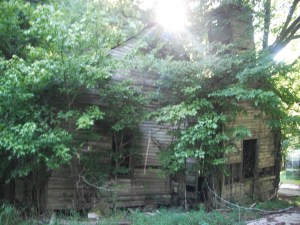
An old store building still stands. Grand Gulf Business DistrictEmpty paved streets lead to an ancient, falling-down church. DSCF7557The road continues uphill past Ft. Coburn and a few modern (occupied!) houses.
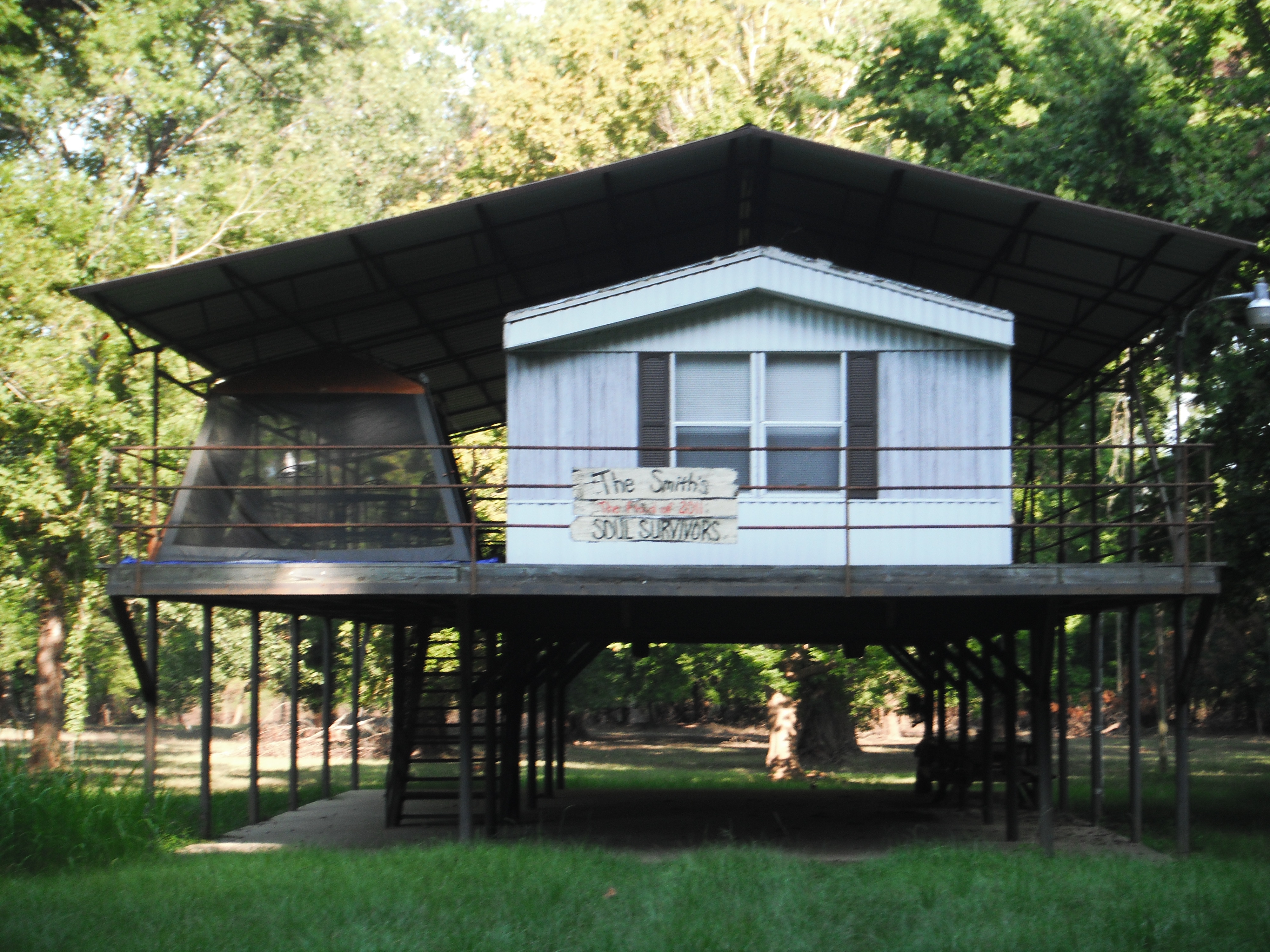
But the amazing thing is, between the paved road and the river are at least a dozen mobile homes and a handful of campers. And I never saw the like—the house trailers were set on stilts! Many had screened porches. The SmithsOne sported a sign declaring, “The Smiths—Soul survivors of the flood of 2011.” The trailer of a neighbor, whose loss that year probably made him more gun-shy of the river than most, perched on two stories of metal supports.

So Grand Gulf is not inhabited solely by ghosts. It has been rebuilt, destroyed, and rebuilt again. I wouldn’t be surprised if the Gorilla still has unfinished business with this town.

What makes people so stubbornly defy fate and the elements? Some day I will go back and ask the residents why they insist on living here. But I expect no better answer than I’d get from a homeowner who builds on the other side of the creek, when it would be less trouble to build elsewhere.


For more about Grand Gulf, visit:

http://www.grandgulfpark.state.ms.us/

http://www.legendsofamerica.com/ms-grandgulf.html


Read Full Post »

I’ve been reminded of my mortality. My cousin Michael died recently. I hadn’t seen him in years, yet it saddens me. Mike was only two years older than I, too young to die. I’m told he drank himself to death.

Mike hardly lead a charmed life—his mother died in childbirth. Uncle Buck remarried to a widow from Alabama who had two daughters. Aunt Ora Mae was no southern belle, but a scrappy gal who gave him two additional sons.

Mike grew up believing Aunt Ora Mae was his biological mother, until some “well-meaning” relative told him otherwise. Although given the same love and attention as the other children, Mike seemed to feel out of place. He was the only child in the home who’d been born to a different mother. I remember a conversation between him and his brother when they were very young. Uncle Buck, frustrated as parents sometimes get, had threatened to put the boys in a juvenile home. Paul, too young to know better at the time, bragged that his mother could get him out of the home but not Mike because he wasn’t hers. Ouch.

He was actually my father’s first cousin. Dad was born to Grandad’s oldest son and Mike to his youngest. With only a few years’ difference between them, my dad and Uncle Buck were buddies. Both served in World War II, came home, married, and started families. When I was born, Mike was only two and couldn’t pronounce my name. He called me “Tishie” which stuck as a nickname until I was a teenager. Then I decided I no longer wanted to be called that, but by my real name. Somehow I bent most of my relatives to my will and was able to change my appellation.

When I started school, Mike was put in charge of my safety, to walk me to our one-room schoolhouse each morning. He and I were among the last students to attend that school. After it was closed we rode the bus together to the city schools, but following Mike through the academic ranks was not easy. I was a well-behaved scholar and he was not. In junior high, one teacher asked if I was related to Mike Rogers. When I said yes, that I was his cousin, the teacher said only, “Oh.” That one word spoke volumes.

I had an English teacher who never seemed to like me. I got along well with most teachers because I was a good student. I was a favorite of English teachers, especially, because I enjoyed reading. I couldn’t figure out why this teacher never warmed up to me. Later, I learned that Mike had previously been in her class. He told me he got in trouble when she found girlie books in his desk. How unfair! After nine months of school, you’d think this teacher could have figured out that I was quite different from my cousin.

Mike’s family lived in an apartment upstairs in Grandad’s house, just up the hill from us. He and his brothers, and my brothers and I, were childhood playmates. In winter, we would ice skate on his grandfather’s pond and during summer we played baseball in my grandparents’ field.

Then time and distance separated us. My family moved to Florida and I saw Mike only a few times when we returned to visit. I did not know him as an adult. He married and moved to California, and I did not see him for a lifetime. I never met his wife or children.

I had led a rather sheltered childhood. The only people I knew who died were old people who had lived out their years. Even during the Viet Nam Era, most of those around me avoided the draft and I lost no one I knew well. At my 40th high school reunion I was shocked to learn that some of our classmates’ lives had been snuffed out, at least one by suicide. Mike’s death was similarly unexpected.

When my grandparents were still with us, I made a point of visiting them often. I didn’t want to regret not spending enough time with them while they were alive. After I became interested in genealogy and family history, I found holes in my knowledge and often wish I could ask my elders about this or that person or event. Despite my efforts, I have regrets.

In the summer of 2009, Mike accompanied Uncle Buck to our family reunion. I had not seen him in over forty years and would not have recognized him on the street. He’d turned into an old codger with a grizzled beard. With over a hundred other relatives in attendance, I didn’t have much time to visit with Mike. I didn’t know I would never see him again. He was not supposed to die so soon.

And so I regret not having made more effort to know my cousin Michael. I also wish I had collected his stories. Living in close proximity to Grandad, what family history did Mike know that died with him? And with two more years at Barnum Hill School, what memories did he have that I lack? Must we always regret such missed opportunities?

Read Full Post »

Like some people, some plants don’t get the respect they deserve. One of these is Dog Fennel. The name suggests an inferior type of fennel, but it’s not at all related to fennel, which is a culinary herb imported from the Mediterranean. Dog Fennel is a native plant that grows mostly in the southeastern United States. You should not eat Dog Fennel because it contains a toxic chemical called pyrrolizidine. This won’t kill you right away but it can cause liver damage, and you don’t want that.

Dogfennel2

The plant I’m talking is Eupatorium capillifolium. The Latin name is important because there are three other plants called dog fennel that also are not related. If you google either name you will find scads of information on how to eradicate this plant. It’s considered a nuisance weed which will overtake pastures, hay fields, and cropland if not kept in check. If you don’t watch out, it will also invade your yard and garden.

However, I let a few plants grow in my yard and along my driveway. I’ve always liked Dog Fennel, in moderation. In spring, feathery green shoots emerge from last years’ roots or seeds. Over the summer they grow into graceful fountains, three or four feet high, or taller. Sometime in October, tiny white blossoms burst out, abuzz with bees, butterflies, and other insects. If you get close enough, you can detect the flowers’ delicate scent. When winter comes, Dog Fennel is reduced to brown skeletons that persist until you, or time, knock them down. I break off any stems that are in my way, but I leave a few to shelter beneficial insects and their larvae during the winter.

There is an old saying that when the Dog Fennel blooms we have six weeks until frost. Over the years I have observed this and found it to be generally true. The past two or three years I’ve recorded the time of blooming on my calendar and found it to be uncannily accurate. In fact, Dog Fennel blooms earlier in open areas than in more sheltered ones and the frost follows accordingly, within a few days of the six weeks’ date.

A few years ago, a dog fennel seed landed inconspicuously on one of the garden beds at the elementary school. That compost-rich soil nurtured it through the summer. By the time school started, it towered over all else in the garden beds. When we weeded the gardens in preparation for fall planting, I left it alone, for a time, because it looked nice and wasn’t in the way, yet. When I tried to pull it out, I found that the root system was as massive as the upper part. The time came to use extreme measures to get this weed out of the garden, but first I wanted to know if it had any redeeming qualities other than those I already mentioned.

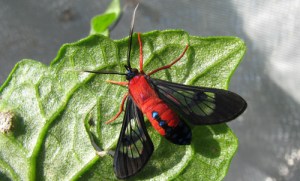
Googling and following links, I came across a reference to the Scarlet-bodied Wasp Moth. This colorful insect may look like a wasp but it’s really a moth and doesn’t sting. In fact, it is not known to cause any damage to nature or mankind. The larvae feed on wild hempvine, a plant with heart-shaped leaves and white blossoms.

Be on the lookout for this beauty if you live in Florida, along the Gulf Coast or in coastal Georgia or South Carolina.

Be on the lookout for this beauty if you live in Florida, along the Gulf Coast or in coastal Georgia or South Carolina.

Here’s where things get interesting. Adult butterflies and moths usually feed on nectar. That’s why they are considered pollinators. The adult male of this species feeds on Dog Fennel. He pierces the stems with his proboscis to obtain the toxic pyrrolizidine alkaloids. These chemicals do not poison our moth but make him distasteful to whatever would otherwise eat him. He also stores the chemical in little pouches under his abdomen.

The story gets more interesting. When he finds a lady friend, our gallant moth showers her with these compounds, which in turn protects her from predators. And even better, when she lays her eggs, they will contain these protective chemicals. The Scarlet-bodied Wasp Moth is the only insect known to transfer a chemical defense in this manner.

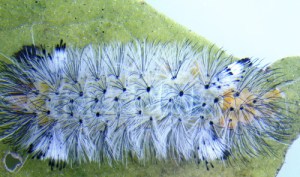
The caterpillar is quite harmless.

The caterpillar is quite harmless.

So, if the male doesn’t have Dog Fennel to feed on, his mate and their eggs are more susceptible to being eaten. In other words, no Dog Fennel plants mean fewer Scarlet-bodied Wasp Moths. Doesn’t this earn Dog Fennel our respect? It earned mine, and that of the children at the school. With no other Dog Fennel in the vicinity, we decided to leave the plant alone for the time being.

I don’t mean you should let your garden or pasture become overrun with Dog Fennel. A few plants here and there, along the fence or driveway or roadside, should be enough. These are small moths. They don’t eat much. If you find hempvine on your property, let it grow. If you have none, plant some for their babies. Then be on the look out for this pretty moth. And when the Dog Fennel blooms this fall, make a note of the date and wait to see if it predicts the first frost.

This homeowner understands the beauty of Dog Fennel. Unfortunately, this is not my yard.

This homeowner understands the beauty of Dog Fennel. Unfortunately, this is not my yard.

Read Full Post »

Last week I saw an Edsel. It’s uncanny how one thought runs into another, and almost spooky when one of those random thoughts materializes.

It began in my writer’s group. One member was struggling to reword an awkward phrase about surnames from different languages. My mind meandered to my eighth grade social studies class. At the beginning of the school year, when the teacher called the roll, going down the list of Polish and Russian and Slavic names, he came to “Rogers”. He asked me, “What are you doing in Johnson City?”

Indeed, what was I doing there? My English-sounding last name seemed out of place. Most of my classmates were descended from Eastern Europeans who escaped persecution in their homelands and were attracted to well-paying jobs in the shoe factories. The Rogers had come here by a different route.

Although he lived in Pennsylvania, my ancestor William enlisted in the Union Army in Elmira, NY. After the war, he went to Albany to marry Nancy Turk. He and Nancy must have met before the war, probably in Upstate New York.

The Rogers are such wanderers. William took his bride to Wisconsin where he taught school. Later they homesteaded in Kansas. He returned to the East when he inherited his brother’s farm in Pennsylvania, then settled in West Virginia with some of his sons. For reasons I am unaware of, Nancy returned to the Johnson City area where her relatives lived. Most of her sons eventually followed her, including my great-grandfather John Thomas, whom I called Granddad.

For the better part of the Twentieth Century, there were quite a few Rogers in that part of the country. Granddad had four sons. Uncle Jim had no wife or children, but he made his mark by building houses, including my grandparents’, before he moved to California. Uncle Floyd and Uncle Buck had three sons apiece. My grandparents had only one who survived to adulthood, but he made up for it with three sons and six daughters before we moved to Florida. Notice I keep saying sons. I was the first girl born in the Rogers family in a century.

So at one time there were quite a few of us in Johnson City and surrounding communities. Now I’m not sure if any remain. We are such wanderers. Uncle Buck and Aunt Ora Mae migrated to her home state, Alabama. Their sons now live in Alabama and the Carolinas. Uncle Floyd’s have similarly dispersed. My family is spread around the globe.

One thought drifting to another brought me to the Edsel. In that same social studies class, one day we held a debate. A boy posing as Henry Ford defended his position, whatever it was, by saying he hadn’t sold an Edsel in over three years. Unprepared with facts to the contrary, I countered with, “You must have. I’ve seen dozens on the road.” After the debate, the teacher set the record straight, “The Edsel went out of production in 1960.”

That was so long ago. I couldn’t tell you when I had last seen an Edsel or even thought about one. The Edsel had been a mechanical and marketing flop in its day. Now, the few that remain must be worth a fortune. The word is so obsolete my spell-check did not list it. But that’s where my thoughts wandered that day in my writing group.

On the way home, I saw an old car coming down the road toward me. As it drew closer, I noticed the distinctive grill. It was an Edsel! What on Earth was it doing on that back road? And, more significantly, why in Heaven’s name was it driving through my thoughts?

You might ask, what do these two topics have to do with one another? Nothing, except they converged in memories of my eighth grade social studies class. Interesting, how the mind works.

If you knew what an Edsel was before you googled it, congratulations. You win the Geezer Award.


Read Full Post »

« Newer Posts - Older Posts »

Abandoned Southeast

Preserving the Past | A Photoblog of Hundreds of Abandoned, Historic, and Forgotten Places

Bonnie T. Ogle

Award Winning Childrens Author

filmmaven

A great WordPress.com site

The Tony Burgess Blog

The Home Of T-Bird From The Dork Web.

Wells Family Genealogy

The study of my Family Tree

Alien Resort

A Terrestrial Romance

douglasfelton.wordpress.com/

Compelling Young Adult fiction from author Doug Felton

Hidden River Arts

Dedicated to Serving the Unserved Artist

Green Life Blue Water

Where Eco Meets Life

Pattie Remembers

Sunsets and Buzzards, and Other Stories

koolkosherkitchen

Welcome to my Kool Kosher Kitchen where food is fun and fun is to create food!

The Life in My Years

An anthology of life

cookingforthetimechallenged

Fast, easy, all natural, healthy, kosher cooking

CarpeDiemEire

Travel Through Ireland and Europe

Yeah, Another Blogger

An Arts-Filled, Tasty And Sometimes-Loopy Jaunt Through Life