Feeds:
Posts
Comments

Archive for the ‘Marie’s Musings’ Category

This summer I spent a few weeks in West Virginia with my granddaughter Tiffany and her family. They live near Kearneysville in the state’s eastern-most county, Jefferson County. Her husband Justin comes from a huge extended family. Both of his parents came from large families, as in ten or so kids, and their parents as well. He said none of them move away. They just stay there, generation after generation. He has so many cousins, known and unknown, that he wouldn’t date a girl from West Virginia. He played it safe, he thought, by marrying a girl from Florida.

My great-grandmother came from three counties away, Hampshire County, from the little community of Slanesville. Like Justin’s family, her forbears settled there in the 1700s and stayed, until one of the wandering Rogers, my great-grandfather John Thomas, married her and carted her off to upstate New York. I can see why they stayed. Unlike most of mountainous West Virginia, this area in the North River Valley is blessed with rolling hills and good farmland.

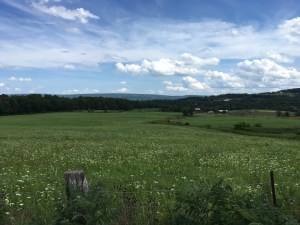
Slanesville, WV, looking toward the North River

Slanesville, WV. Looking toward the North River

Whenever I’m in the neighborhood, I like to do a little genealogical research. This can be challenging because these folks practiced subsistence farming and recycled most everything. They even recycled names. Say you have a man named John. He names his oldest son John. Half of John’s ten or so children might be boys. John, Jr. and each of his brothers name a son after their father, and in only three generations you end up with a half dozen or so men with the same name, and many of them are cousins about the same age. I’ve run into this sort of thing trying to trace my roots. I try to sort them by birthdates. Have you ever written a number or date wrong? Family historians are human, and records are not always accurate, if they even exist. Hampshire County libraries have good historical records, but I’ve been stymied by who is my ancestor and which are distant cousins. So before venturing over to Hampshire County, I went through my notes and wrote down the vital statistics of the people I was looking for.

One branch of the family tree is the Hietts. The name has variously been spelled as Hiatt, Hiet, Hyet, Hayet, and Hyatt. And the line is full of Johns. My ancestors John and Mary Hiett, Quakers, were born in England and joined William Penn in Pennsylvania around 1700. They had a large estate near Philadelphia and produced several children, among them, John Hiett, Jr. He married Margaret Stephens and they eventually ended up in Hampshire County, which at the time was part of Virginia.

Poring over my notes, I found an interesting tidbit: after they left Pennsylvania, before moving on to Hampshire County, the Hietts owned land in Frederick County, Virginia. In those days, the colonies were divided into large counties, which were later broken up into the smaller counties we know today. The part of Frederick County, Virginia where John, Jr. and Margaret lived is now Jefferson County, West Virginia! My ancestor Evan Hiett was born there in 1748. Wow

Historic Bridge on Opequon Creek

Historic Bridge on Opequon Creek, West Virginia

Several miles downstream  of the Hiett holdings.

Several miles downstream of the Hiett holdings.

The Hietts lived on Opequon Creek. I’d crossed that creek a dozen times going to and from Martinsburg. They lived upstream, near the town of Middleway.  “That’s just up the road from here!” Justin said. So Tiffany and I drove up the road to Middleway. I expected, at most, a sign indicating where the historical town once stood, but I was pleased to find Middleway is still, in its own way, thriving.

august-2016-189

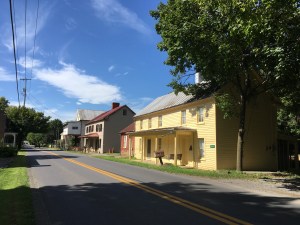
Main St. Middleway

Main St. Middleway. My ancestors settled in the neighborhood before these houses were built. 

The Gilbert House, built in the early 1800s.
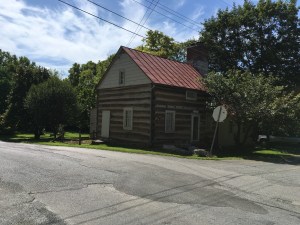
The Gilbert House, built in the early 1800s.

The Elizabeth Smith House, built around 1800.
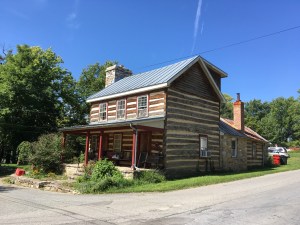
The Elizabeth Smith House, built around 1800.

Masonic Lodge and Schoolhouse, early 1800s.

Masonic Lodge and Schoolhouse, early 1800s.

Opequon Creek flows from what is still Frederick County, Virginia, forms the county line between Jefferson and Berkeley Counties, and empties into the Potomac River. John, Jr. had farms on both sides of the creek. Property records still exist, so one day I may go back and locate them.

When John, Jr. and Margaret moved to Hampshire County, Evan went with them. He settled in the town of North River Mills where the restored Hiett Log House still stands. (You can see this house at http://www.historichampshire.org/nrm/building/finelli.htm).

In 1784, Evan “Hyett” was listed as the head of a family of eight “white souls,” with one dwelling and four out buildings. He married Sarah Smith and their daughter Margaret married Benjamin McDonald whose father had emigrated from Scotland. One of their descendants was Rebecca McDonald Rogers, my great-grandmother.

Evan’s brother John Hiett III stayed in present day Jefferson County. Eventually, some of the Hietts and their descendants scattered to the Carolinas, the Midwest, and who knows where else. But not all moved on. Uncle John is reportedly buried at the Hopewell Friends Cemetery in present day Frederick County, Virginia, less than ten miles from Middleway. Sons are fairly easy to trace, but daughters marry and change their names. Who knows what names my distant cousins in Jefferson County go by?

Uh, Justin, I hate to tell you—maybe you didn’t go far enough away to find a wife who’s not your cousin.

Read Full Post »

The month of August saw me traveling and visiting grandchildren, wrestling with my new “smart” phone, and trying to figure out how to use GPS. Before I set out on my trip, I went to a Verizon store for help. I told the nice young man that the GPS insisted on sending me on the Interstate and I don’t do Interstates. “Why not?”  he said. “You get there faster.” What’s his hurry? He’s young. He has plenty of time. As for me, I’m in no hurry to get to the end of my journey, and I prefer to enjoy the drive. You miss a lot when you stick to the Interstate.

You won't find this on the Interstate.

You won’t find this on the Interstate. (Mabry Mill, Blue Ridge Parkway)

Google Maps on my computer gives me the option of avoiding highways. Apparently the young man didn’t know how to program my smart phone this way, so he put another app on the phone that (he said) would do back roads. It didn’t.

After plotting my course using road maps and Google Maps, I headed north.

Or this

Or this. (Near Ludowici, GA)

I planned to camp in Uwharrie National Forest in North Carolina. Since I got off to a late start that day, it was dark by the time I reached to Uwharrie. I thought this was a good time to put the GPS to the test, since I was far from any Interstate. I pulled over and typed in Uwharrie National Forest campground.

The lady’s voice on the GPS—whoa!–that’s too awkward. Let’s call her GyPSy. (We used to have a pony named Gypsy and she was cantankerous, too.) Anyway, Gypsy directed me down a series of back roads and deposited me in front of someone’s driveway. I didn’t think the residents of the house wanted me to camp in their yard, so I drove on, hoping the campground was nearby. I never found it. Gypsy kept telling me to make U turns, turn down such and such a road, and the like for the next hour until I figured out how to shut her up.

Consulting my map, I concluded I’d taken the wrong road to the national forest. It was raining and I didn’t want to backtrack, so I drove on. The next town had a Walmart. With the permission of a manager, I parked there for the night. The next day I stuck to the directions I’d written down before my trip and reached my granddaughter’s house with no trouble.

One thing I’ve discovered is that newer road maps are less detailed than older ones. That plus poorly labeled roads makes it hard to plot a course. Is there a conspiracy? Do “they” want us to stick to the Interstates? Are “they” trying to sell more GPS gadgets? Or is our growing dependence on GPS letting highway departments get away with sloppy work?

I spent two pleasant weeks in West Virginia. Toying with the phone during my stay, I figured out how to program Gypsy to avoid highways. Before leaving for Virginia, I drove over to Hampshire County in search of some ancestors who are buried in Slanesville. Although, I knew my way around, I thought I’d see if Gypsy could find a short cut. No–the poor dear was lost! Maybe I was too far from any Interstate. That thing on a computer that goes round and round when it’s searching for something went round and round and round until I reached Romney.

Slanesville, WV

Slanesville, WV

I consulted a map and spent the rest of the afternoon driving through picturesque West Virginia mountains. Almost Heaven. I hated to leave but was expected at my daughter’s home in Radford, Virginia that night. I stopped to eat in Covington. The day had been pleasant and sunny, but the night turned dark and rainy. Over supper, I consulted my road map for the most direct route to Radford, then I programmed Gypsy.

Computer savvy people refuse to believe that those devious machines have a mind of their own, but they do. I know what Gypsy was thinking: “So, she wants back roads? Well, I’ll give her back roads!”

And back roads I got. Roads with names like 617 and 725. Roads that weren’t on my map. Before long, I was helplessly lost and dependent on her caprice. Gypsy directed me to turn here and there, mostly in unpopulated areas, through two national forests. One road was so narrow that if I’d met an oncoming vehicle, we’d both have scraped paint off trying to squeeze by. Fortunately, I had plenty of gas and my compass told me I was gradually making my way south. I breathed with relief when I came to US 11, Lee Highway. Now I knew where I was and where I was going.

I have to give Gypsy credit—she got me there in one piece and in the time frame she’d predicted. But how’d she know about these forest roads when she was totally lost on a state road in West Virginia?

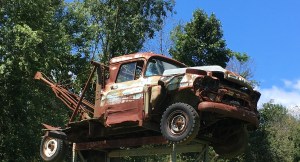
Is this Tow Mater?

Is this Tow Mater? (Near Hillsville, VA)

On my way home, she successfully navigated me through Salisbury, North Carolina, where I invariably get lost. I planned to spend the night at Santee State Park in South Carolina, so I gave her this destination. She found a short cut that wasn’t on my map, but when I got to the park, she argued with me that the campground was at a ranger’s residence. Don’t you hate a machine that thinks she’s smarter than you?  But I knew better. A sign clearly pointed to the campground.

The next morning, I expected Gypsy to find a shortcut home, but she routed me through Orangeburg, South Carolina. I didn’t mind. I never drive through that city without stopping at Edisto Memorial Gardens to smell the roses.

Edisto Memorial Gardens

Read Full Post »

Did you feel the Earth shake the other day? I took a step into the 21st Century. I bought a smart phone.

It all started with road signs, or rather, the lack of them. I’m disdainful of those who rely on GPS. I can read a road map just fine. Besides, GPS isn’t accurate in out of the way places, like the woods where I live. Before going on a trip, I consult Google Maps, but I rely on paper and ink road maps, as Google’s directions can go awry.

The problem is, so many places don’t label their roads accurately, if at all. Once, traveling north on US 301/US 1 in Georgia, I came to where the highways diverge. Signs said, “US 301 Left Lane” and “US 1 Right Lane,” so I got in the left lane. Then as I approached the intersection, signs pointed left for US 1 and right for 301! I hastily switched to the right lane. Other motorists ahead and behind me likewise swapped lanes. It looked like synchronized driving. I expected the road department to correct this, but every year it’s the same, the wrong signs slowly rusting away.

Florida may be known for its weirdness, but at least our Department of Transportation can label roads.

A few years ago, I visited Chattanooga. We saw a sign for the Chattanooga Choo Choo but couldn’t find it. There was no other signage to guide us. I had plotted my course and, looking for my turn, we saw something that made us laugh–a building with half a car sticking out the second story. I drove on.

Chattanooga is in a bowl surrounded by mountains and a river. I drove around and around in a circle but couldn’t find my intended route. Finally—a sign for the highway I wanted. Then I spotted something else—a car sticking out the second story of a building! We should have turned left at that intersection, but there had been no road sign. The highway took us up by Look Out Mountain, but by then I was in no mood for sightseeing. I only wanted to get away from that town. Maybe I’ll go back someday with GPS as well as a map, but Chattanooga lost my business that day.

One modern convenience I’ve embraced is the cell phone. In the last century, we had a car phone at work for whoever was on-call. Coverage was poor in remote areas, but it came in handy in case of trouble. Eventually, I got my own car phone. After the rest of the world moved on to cell phones, I kept my bag phone until it was so obsolete there was no fix when it malfunctioned. So I graduated to a cell phone. The world advanced to “smart” phones, but I was content with my “dumb” phone.

I noticed young people using their smart phones for GPS, Facebook, and myriad apps, but I had my road maps and a computer at home. Who needs to be “connected” every waking minute? I try hard to be a Luddite.

Ned Ludd

Ned Ludd

Actually, this term is widely misused. In the early 19th century, Ned Ludd was a fictitious leader of textile workers who protested unemployment and low wages. In loosely organized bands, they attacked factories and destroyed machinery. The original Ned Ludd was a young man who supposedly smashed stocking frames after a confrontation with his boss in 1779. Today, Luddite refers to someone who lives in the past, is inept with technology, or fears or resists innovation.

In 1829, Thomas Carlyle said that technology was causing a “mighty change” in “modes of thought and feeling. Men are grown mechanical in head and in heart, as well as in hand.” We are still wary of technology making us grow “mechanical in head and heart.” Some modern Luddites destroy things, such as with computer viruses, but most of us are innocently suspicious of and resistant to change.

Luddites

Luddites

Don’t ask me why. I’m typing this on a machine that has spell check, synonyms, and other features that make writing easier. Remember typewriters? You literally had to bang the keys on the old manual ones. If you made a mistake, you covered it with a white substance and retyped. The result didn’t look as clean and professional as this page will be when (or if) I print it. I constantly change my mind about wording and placement of phrases. In the old days, I’d have to retype the whole page. Now I can highlight and delete, retype, or drag a section to where I want it. Instead of typing “Chattanooga” half a dozen times, I highlighted, copied, and pasted the word, as I just now did. Sometimes technology ain’t so bad.

After my fellow writers kept bringing their laptops to our critique sessions while I relied on written notes, I bought one for myself. (And I’d always prided myself on being above peer pressure.) Earlier this month I volunteered at Wekiva Youth Camp and took my laptop. Our cabin had no Wi-Fi, yet my friends could read their email on their smart phones. It was nice to take a vacation from email, but I faced a mountain of it when I got home. To top it off, one of the ladies pays less for her smart phone service than I did for my dumb phone! That’s when I considered getting one.

So I called Verizon. The nice young man said I could get an iPhone for 99 cents. Of course, the nice young lady at the store tried to sell me bells and whistles, but I resisted. No written directions were included. Probably no one reads them anyway. I wasted over an hour trying to figure out how to set the alarm clock, then found directions online. Unfortunately, they’re as hard to follow as written directions. Maybe I’m still a Luddite.

Now if only I can figure out GPS, perhaps I won’t get quite so lost where they don’t post proper road signs.


Read Full Post »

I thought about Aunt Hazel a lot today. Like her, I crochet. I usually buy cheap yarn at Wal-Mart, but for a special project I bought a skein from Yarnworks, a little shop in Gainesville. This yarn came in a long loop that had to be wound into a ball before I could use it. I remember Aunt Hazel had a contraption, called a yarn swift. You’d stretch a skein on the swift and as you pulled the yarn to wind it into a ball, the swift would turn and let the yarn out in an orderly fashion without tangling. I wish I’d had one today. Having none, I hung the skein over a chair. It worked for a while, but little by little the strands twisted together and before long, I had a tangled mess. It took over an hour to unravel it.

When you grow up with a person you seldom appreciate her accomplishments. Aunt Hazel never married and lived with her parents, Grandma and Grandpa Brown, until they died, then with her sister and brother-in-law, Grandma and Grandpa Rogers, for the rest of her days. Not much to brag about, but looking back on her life, I realize now how much she exceeded expectations for a maiden lady of her time.

With Mutt, October 1964

Aunt Hazel with Mutt, October 1964

Aunt Hazel was born in 1904, the youngest child in her family. Grandma and Grandpa Brown had a daughter and a son who died before my grandmother and Aunt Hazel were born. Such was infant mortality in those days. Grandma must have been healthy—she lived to be 96. Aunt Hazel, however, was “sickly,” suffering from epilepsy as a child. Probably because they’d lost their first two children, her parents sheltered her. She was also near sighted and wore glasses. Boys called her “four-eyes.” No wonder she never married.

In rural America in those days, respectable unmarried women lived with family and seldom worked outside the home. Aunt Hazel went to school and did housework. When the family moved to a farm, she and Grandma helped with farm work.

When Grandpa Brown died, Aunt Hazel and her mother moved in with the Rogers. After Grandma Brown died, Aunt Hazel stayed. Where else was she to go?

She never lived independently, but Aunt Hazel became a career woman. At first, she crocheted. That’s where the yarn swift comes into the picture. I remember as a child watching TV in their living room. Aunt Hazel would take a skein of yarn, loop it around the swift, and keep her hands busy winding the yarn into balls. Then she’d crochet. She made baby sets to sell—matching bonnets, sweaters, and booties of soft pastel yarn. These she’d pack in paper-lined boxes and take to McCrory’s, a five and dime store in Johnson City, where they were sold. Aunt Hazel must have made hundreds of those beautiful baby outfits. Curiously, none of us got one, but she also made baby blankets, and I still have mine. It’s too fragile to use, but a treasure, none the less.

This is close to what I remember Aunt Hazel's looked like.

This is close to what I remember Aunt Hazel’s yarn swift looked like.

Later, she became an Avon Lady. She didn’t earn just pocket money. She was a powerhouse of a sales woman, taking each campaign by the horns, and winning prize after prize for sales. Her route covered Johnson City and Binghamton. When she visited a customer, if the woman wasn’t in the market to buy, they’d just have a friendly chat. Quite often, the lady would remember something she wanted for herself or as a gift, and Aunt Hazel would make a sale, after all.

Few women of her generation drove a car, but Aunt Hazel was different. Since Grandma didn’t drive, Aunt Hazel would take her to deliver butter every Thursday. She owned a series of cars, always a Plymouth. She patronized a certain gas station in town. In those days, filling stations were also auto shops and her mechanic kept her on the road. One time when I accompanied her, I was shocked to hear him call her “Hazel.” How rude! The only people who called her by her first name were my grandparents. People outside the family called her “Miss Brown.”

We lived with my grandparents until I was ten. Aunt Hazel was like a third grandmother in the home. She would rock us, read to us, sing to us. She taught us “Froggie Went A-Courtin’” and “There’s a Hole in the Bottom of the Sea.”

Sometimes adults can be indiscreet. If he was upset with Aunt Hazel, Dad would call her an “old maid” behind her back. Once I won a prize at school and chose a deck of Old Maid Cards. In all innocence, I proudly showed them to Aunt Hazel and said, “Look, I’ve got Old Maid Cards, just like you.” I distinctly remember the silence that followed. I think Dad watched his tongue afterward.

As she aged, Aunt Hazel developed diabetes. She attributed this to indiscretion while working her Avon route. Instead of eating a proper lunch, she’d grab a pastry. She managed her blood sugar by close watch on her diet, but she slowly declined until she could no longer work. Then she developed dementia. The day she died, I cried all morning, not knowing why, until I got the news. She was only 75, young for our family.

It’s interesting how events shape our lives. In a generation where women were almost exclusively homemakers, Aunt Hazel was a saleswoman and Grandma ran a dairy farm. Had their brother survived, leaving the Browns a son to help work the farm, these ladies may have grown up to fill more traditional feminine roles. The necessity of doing men’s work gave them the gumption to become modern 20th Century women.

I thought about all these things while I untangled that almost impossible knot of yarn. By stubborn persistence, I succeeded and now am prepared to crochet.  I wonder what became of Aunt Haze’s yarn swift? I sure could have used it today.

For more on Grandma’s dairy business, read Binghamton Butter to Texas Kolaches.

Read Full Post »

I’ve been trading at Jackson’s Hardware store in Lake Butler off and on for more than twenty five years. I’d rather shop at the locally owned establishments than the big box stores. I may pay a little more, but what I receive in return can be priceless. This trip was no exception.

The double glass doors were plastered with ads for local handymen, notifications of church services, and similar community announcements. Beside the handle on the door to the left was a handwritten sign, “Don’t use this door.” By the handle on the right, “Use THIS door.” I was glad that, for once, I took the time to read.

Once inside, I was overwhelmed by the quantity of items packed into the small building. Where could I find the plumbing supplies, I wondered. Behind the counter sat three old men, jawing with one another. Assuming one to be the proprietor, I began to move in that direction, when a younger gentleman, whom I mistook as a fellow customer, asked if he could help.

Yes, I wanted some PVC fittings. I took a stub of pipe out of my purse to show him what size I required. He led me into the next room where an array of wooden bins held elbows, couplings, and what not. As I ran down my list, he fished the pieces out of the bins and took time to sort misplaced items into their proper places. One connector I desperately needed was sold out. No problem, the man grabbed a bag from a high shelf, tore it open, and restocked the bin. Once my selection was complete, I followed him to the counter.

Image result for hunters fishermen and other liars

On the wall facing me, among more notices, ads, and offers, was a sign, “Hunters, Fishermen, and Other Liars Gather Here.” The three old men sat in a row of chairs beneath the sign. They’d been talking continuously the whole time I was in the store. While the proprietor jotted my purchases on a sales slip, tallied the amount, and figured up the sales tax, I listened to their gossip.

The scene was classic. All that was missing was a potbellied stove (but the day was too warm), and a cracker barrel (if the store had room in for one). As the old fellows chatted about various matters, their conversation eventually led to the virtues of meat loaf sandwiches. One said, “You take your leftover meat loaf and make yourself a sandwich, and there ain’t nothin’ better.” The second agreed, “Yep. Nothin’ wrong with that.” The third seemed to be asleep, his hands resting on his ample belly.

They may have been liars, as the sign suggested, but having partaken of a few meat loaf sandwiches in my day, I guarantee they were telling the truth on this point.

Little has changed over the years at Jackson’s Hardware. In the laid back atmosphere, customer service has always been personal and courteous. If I need some old fashioned item not carried by the big box stores, I’m likely to find it here. I suspect they even restock the old men from time to time.

Read Full Post »

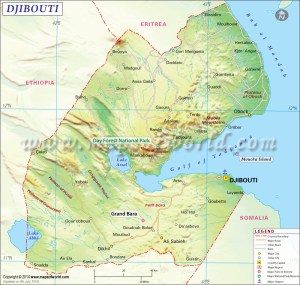
djibouti-map

Djibouti is a tiny country in the Horn of Africa, sandwiched between Eritrea and Somalia, where the Red Sea flows into the Gulf of Aden. If you look at a map, the southeast corner of the Arabian Peninsula points right to it. The capital city is also named Djibouti. My sister Lorraine and her family live there.

I visited them in 2004.  At the time, they lived in a two story house surrounded by a gated wall, a typical residence for well-to-do Djiboutians and middle-class expatriates. Next door, in a similar house, was the Saudi Arabian Embassy. Although Djibouti enjoys peace and good relations with the Western world and has not been a victim of the unrest that plagues the nations around it, I found it a little unsettling, at first, to stay next door to the Saudi Embassy. Not to worry, Lorraine and John assured me. They got along quite well with their neighbors. Indeed they did. When I wanted a sample of my name in Arabic, Lorraine sent their watchman next door and someone at the embassy wrote it on a piece of paper for me.

However, I hadn’t been there more than a few days, when one night I was jarred from sleep by explosions and lights flashing in the sky. I jumped out of bed and ran to my window, certain that we were under attack, that the wars raging throughout the Middle East had invaded peaceful little Djibouti, or the embassy next door was being bombed, but I couldn’t see anything except flashes of light. I knew it was no thunderstorm. So I ran to another window.

I’m not sure whether John’s sleep was disturbed by the explosions or by my running through the house. He accosted me on my way to a third window and said, “It’s all right! It’s all right. It’s only fireworks.” And so it was. We couldn’t get a clear view of them, only enough to know we weren’t about to die. Afterwards, we had a good laugh.

This is what it sounded like that night.

This is what it sounded like that night.

At home, I can hear the Fourth of July celebration eleven miles away in Lake Butler. My neighbors shoot off fireworks every July 4th, New Year’s Eve, or whenever they have a party. Those don’t alarm me. But we Americans can hardly wait until dark for the pyrotechnics to begin, and that night in Djibouti, not only was it well after dark, it was late enough that we were in bed asleep. There’d been no notice of a fireworks display and we never did learn what the occasion was. Someone in the city was celebrating something and fireworks was part of the entertainment. I wonder how many other people woke in alarm that night thinking the city was being bombed.

But it wasn’t. Did my expectations that this part of the world was dangerous cause my reaction? Or was my alarm reasonable? I’ll never forget the terror of the moment, yet I was safe. When I think about people who live in actual war zones, whose days and nights are disturbed, not by festive fireworks, but by actual bombs, my heart goes out to them. If the unexpected sounds of that night remain etched in my mind twelve years later, I can’t begin to imagine what effect it has on those who are exposed to violence on a continuous basis. Here in the USA, we have so much to be grateful for.

Read Full Post »

Spring caught me by surprise again. It does this every year. Winter in Florida is predictably unpredictable. It can be 80 degrees in the morning and plunge into the 20’s by midnight. Although the blooming of the Dog Fennel last fall predicted frost before Thanksgiving (and Dog Fennel’s predictions are more accurate than the almanac), Jack didn’t show his hoary head until January. Fruit trees that know no better began to bloom and set fruit. Then Winter skated in. Not a hard winter, as winters go, but enough frosts and freezes to nip those sassy buds and precocious peaches. Plants that know better, Yellow Jasmine and Wild Azaleas, knew to wait.

A thousand miles to the north, Punxsutawney Phil, that famous groundhog, predicted an early spring. I had my hopes, but didn’t bank on it. My misgivings were correct. I won’t be surprised if they fire that groundhog and replace him with another who can predict more accurately. But maybe it’s not his fault. Remember, my Dog Fennel was wrong, too.

Fortunately, we didn’t suffer the backlash of winter that hit our northern neighbors. No blizzards, but we did get a little snow, a few flurries that only the more adventurous caught before they melted to nothing. I missed the snowfall because it’s warmer in the woods where I live. If a few flakes drifted as far as the tree canopy, they never hit the ground.

Plants that hadn’t been fooled by our fickle weather stayed huddled in winter dormancy. When I gave my talk on Wild Eating to a neighboring garden club, the only thing I could find to eat was a pine tree. The usual weeds prudently remained in hibernation. At least we were able to enjoy a delicious pine needle tea.

Among leafless gray trunks of the woods and swamps, the Red Maples ignored warm days, cold nights, and the predictions of other species and blazed deep scarlet at their usual time. They’ve lived in Florida long enough not to be influenced by the uncertainties of what we call winter. You see, in Florida, seasons are backwards. Here, maple trees turn colorful in spring, not so much in fall. Soon their little helicopter seeds rained down into yard and flower pot alike and I have little maple trees coming up everywhere.

Then came March. Warm days of sunshine and short sleeved shirts, pollen from oaks and pines coating everything yellow, sending sensitive people to the doctor. I entered my best houseplants in the county fair. When I brought them home afterward, they begged to be left outdoors. They love the heat and humidity of summer. It reminds them of their jungle origins. In summer, they thrive on fresh rainwater and ask for no fertilizer. But they complain about the cool dry air of the winter house and need much coaxing to keep up appearances until fair time. It was the Ides of March. Was winter over? Against my better judgement, I left my tropical babies outside. Guess what—another cold front, nights in the 30’s. I brought the most vulnerable into the house and left the more hardy out. They weren’t happy, but they survived.

When I heard the first Whippoorwill, I knew spring had finally arrived. These aren’t really whippoorwills but that’s what we call them. They are actually Chuck-wills-widow, a cousin of the whippoorwill. Their song is not musical (Marjorie Rawlings described it as, “Chip hell out of the red oak”) but it’s unique and most welcome in March.

I love the light the sun sends in late winter—bright, unencumbered by foliage and haze, intense, almost silvery. It surrounds everything, leaving no shadows. Maybe that’s the cue. Buds began to plump. My Wild Azaleas bloomed, filling the woods with their sweet bouquet.

Then literally overnight, everything burst with color. A few trees tentatively put out green leaves. When no harm came to the early bloomers, other trees followed suit. Wildflowers have began to blossom. Yellow Primrose now decorates the dirt road from evening till noon. Phlox carpets the sunny roadsides and Lyre Leaf sage has turned the shady areas blue.  Before I knew what happened, my sunny yard transformed into a shady forest. Birds of more species than I can describe wake me with their morning songs.

I don’t know why Spring surprises me with its arrival. It happens this way every year. One day the oaks are bare, the next they are attired in spring green. Soon, the green will darken, the shade in my yard deepen, and heat and humidity will come home to stay. My tropical house plants will flourish, as will mosquitoes, and my human neighbors will wilt and hibernate in their air conditioning.

Read Full Post »

The first time I watched the movie Labyrinth with David Bowie, I recognized those ugly little things disguised as Muppets. They had plagued me during my most dire illness.

I was in high school when I came down with strep throat. I’d never been so sick in my life. For an entire week, I went to school with a sore throat and low grade fever because I hated to miss school. Instead of shaking it off, which I might have done had I stayed home a few days to rest, I became too ill to go anywhere but to a doctor. I lost a week of school and a noticeable amount of weight. During the worst of my ailment, I suffered hallucinations.

It was winter and our house didn’t have central heat. My bedroom being the coldest, I was allowed to sleep on the living room couch, near the fireplace. Only I couldn’t sleep. Every time I dozed off, goblins would fly out from behind the couch, fill the room, and squawk loud enough to wake the dead. I didn’t know how anyone else in the family could sleep. I was too sick to be frightened by them, too sick even to wonder at their existence. (The goblins didn’t bring David Bowie with them, but even if they had, I was too sick to care.)

Could you sleep with these guys in the room?

Could you sleep with these guys in the room?

Finally, I got up and went to my parents’ room to tell them I couldn’t sleep because, “Those things in there are making too much noise.” What things? I got no sympathy. The goblins’ racket apparently hadn’t disturbed their slumber, but I had. I was told to go back to bed. They didn’t even get up and shine a flashlight behind the couch to show me nothing was there. Maybe they thought I was old enough to figure it out for myself.

During the day, with sunlight to chase the goblins away, I was finally able to rest. Lying in the living room in my feverish malaise, I heard my little sisters whispering. An elderly friend of ours had recently died. My sisters thought I was asleep and couldn’t hear them. One of them (You know who you are!) said, “Is she going to die like Mrs. Brant?” I actually was miserable enough to die, but since I was more amused than offended by what they said, I didn’t wish for the Goblin King to carry them away.

The medication kicked in. The congestion in my throat began to break up and I started to cough up phlegm. With it came copious amounts of blood, too much for a few tissues to handle. I ended up in the bathroom. Too sick to stand at the sink, I sat on the floor by the tub, hacking and spitting. With all that blood, I thought I really was dying, but my parents didn’t act very concerned. As I hung over the bathtub, coughing up my guts, I saw something I’d never noticed before.

Our house was old and the bathtub probably older still. Our well water contained so much iron it stained everything. The tub, originally white, was almost entirely orange. Many months of diligent scrubbing had reduced the stain somewhat, and as I stared at it for what seemed hours, I saw that beneath the stains were pictures— black ink drawings of cowboys, as though someone had painted them on the bottom of the tub before the artwork was covered by iron deposits. I marveled how those pictures had survived years of staining and scrubbing. I wondered why no one had noticed them before.

When my throat took a breather from shedding bloody phlegm, I told my mother about the pictures. She must have thought I was crazy. As my fever receded, so did the drawings on the bottom of the tub. What had been so distinct was no longer apparent. After my recovery, I searched the floor of the bathtub for anything, even a rust stain, that could be mistaken for a cowboy, but I found nothing.

Fortunately I didn’t develop schizophrenia or any other delusional condition and haven’t hallucinated since. From time to time, like everyone, I see things that turn out to be something else at second glance, such as a stick mistaken as a snake. But I tell you, at the time, those goblins and cowboys were as real to my vision as the words on this page.

Read Full Post »

This was my first post when I started this weblog four years ago. I thought it was time to rewrite and republish it:

On Christmas night when I was a child, we would go to my grandparents’ house for supper with aunts, uncles, and cousins. Of course there’d be presents for all. I don’t know where she got this idea, but instead of labeling gifts with store-bought stickers, Grandma Masters used old Christmas cards.

When I became an adult and began exchanging Christmas cards, I continued Grandma’s tradition. The front face of a card is ideal for a large package. For small gifts, I use the tiny pictures on the back or cut pieces from cards. It’s nice to coordinate the card with the wrapping paper, such as a poinsettia card for paper with that pattern. A card may be a clue to the gift inside—labeling a box containing a doll with a card showing a little girl holding a doll. If the gift is opened at my house and the card not spoiled, it can be used again next year.

I keep a box of old Christmas cards for this purpose. Like most folks, I display new ones as they come in, but after the season is over, I put them in my box. It’s handy to have plenty of cards to choose from, and every year my collection grows. Some years I’ve had to graduate to a larger box.

I may have to find a bigger box.

I may have to find a bigger box.

My Christmas card collection has yielded an unforeseen delight. It has become a time capsule, going back many years. As I dig to the bottom, it’s like an archeological excavation, refreshing long forgotten memories. Most senders list their children, and I have a record, in reverse order, of the changes in their families. Children who have grown, moved out, and are no longer listed appear in earlier cards. Their names disappear again in cards sent before they were born. Some senders named my children individually and that list also grew and shrank over time, as some of my adult children moved out, and in, and out again.

Here are cards from nieces and nephews before they had children. Afterwards, they get too busy. I have a record of my former boss’ daughter growing up, in the photo cards he gave out every year. Since those are not suitable for labeling gifts, they collect in my box. Here is a card from a family I cannot recall. Perhaps one day something will nudge my memory. One is signed “your paper carrier” with only her first name. And one from my daughter-in-law before she married my son. Some people faithfully send cards every year and some are sporadic. One couple sent cards for seven years after they moved away, then silence. I never found out what became of them.

Like an archaeological record, the collection is incomplete. Many cards no longer exist as they have been used and discarded, and some lack the signature page, so their origin is forgotten. Here is one I will never use, from a dear friend who has passed away. Indeed, the deeper I dig, the more poignant they become. One card from my parents is also signed “Cookie Grandma”, in the last year of her life after my grandfather had passed. Another is signed only “Grandpa Masters” after Grandma Masters was no longer with us. There is one whose picture page was used long ago and only the message page remains, signed, “All our love, Grandma and Grandpa Masters”. I will keep this forever. It was the last I received from them before Grandma died.

Some of my relatives sent home-made cards so special that, although I may use them to label a gift, I will not throw them away even if they become wrinkled or torn. Of course, cards made by my grandchildren are sacred. Deep in the box are some my own children made when they were small. Scattered throughout are annual letters sent with or in lieu of cards. Someday I will go back and read them again.

What will happen to my Christmas Box of Memories after I am no longer able to enjoy it? Before then, I should put the cards into a scrapbook, making a history for succeeding generations. In the meantime, I continue to dig through the box every Christmas, looking for just the right card for a particular gift, being reminded of the past, and surprised by new discoveries.


Read Full Post »

Antique Dog

Last winter, my firewood man made a delivery when I wasn’t there. Later he remarked that no one was home but an “antique” dog. We now come to the last chapter of Teddy’s life.

As he aged, his arthritis progressed. One winter I decided he should no longer live outdoors, so I gave him a bath and let him in the house. He instinctively knew life had changed for him. The dog who’d never tried to climb on furniture took one look at my favorite chair, scrambled in, and curled up. I didn’t mind, as long as he was clean. To protect my good furniture, I’d set a basket of crochet on the seat. He knew it was off limits, and obeyed. Later, when he became incontinent, I had to keep him off all the furniture. Eventually, he became unable to climb on it anyway and could barely make it up steps. In the meantime, with Teddy indoors at night, deer and rabbits ate my vegetables and wild hogs rooted up my garden beds.

Living with Teddy was like sharing a house with a 90 year old man. He wouldn’t talk to me. He snored so loudly I could hear him through the walls and I swear he slept 23 hours a day. On nice days when he was outside, he’d crawl under the house and I could hear his snoring through the floor. He began to stink. I’d bathe him, he’d lick himself, and within hours he’d stink again. His incontinence grew worse, even with medication. I tried to diaper him but he developed diaper rash. Finally, I barricaded some rooms to keep him out and resolved to throw away the rugs in the others after he was gone. Despite all this, I loved him and (when I wasn’t mad at him) I enjoyed his companionship.

His traveling days came to an end when he couldn’t climb in or out of the van. Once when I went on a trip, a friend kept Teddy. Afterwards he told me, “He kept chasing my chickens!” Now, Teddy had never chased anything besides wild animals (or any cat who challenged him) and by now he couldn’t get around well enough to chase anything. I asked my friend what he meant. He laughed and told me how Teddy would lie in the yard and occasionally raise his head, turn towards the chickens, and bark. The chickens paid him no mind.

For three winters, I did not expect Teddy to make it another year. He was a tough old guy, but his mobility steadily decreased. He’d bark at the porch steps. When I told him barking wouldn’t make them go away, he’d glower at me. I knew he was in pain despite the medication I gave him twice a day.

Then he started to poop in the house. He’d never done anything like that before. I knew it wasn’t accidental—he just didn’t want to tackle the porch steps. My fussing and cussing must have been less trouble to him than climbing steps.

Finally, the time came. I called my vet. She had been treating Teddy for 16 years and was fond of him, but she agreed it was time. She prepped him and I stood beside the table with my arms around him when she gave him that final injection. I talked to Teddy, telling him how he would now be able to chase the rabbits and deer again, and it would no longer hurt. I felt him relax. I felt his gratitude and relief as the pain subsided. Don’t tell me dogs don’t have souls. The vet checked his heart and nodded. She was crying almost as much as I.

Wild sunflowers where Teddy rests

Wild sunflowers where Teddy rests

Afterward, it was so strange to come home and no Teddy to greet me. Or walk around the house and not see him in his usual napping places. Then I dreamed of him. Nothing significant, only a dream that he was in the house with me, doing normal, everyday things. These dreams came three nights in a row. On the fourth night, no dream. I knew then he had finally passed on to the Happy Hunting Ground, where all good dogs go.

Read Full Post »

« Newer Posts - Older Posts »

Abandoned Southeast

Preserving the Past | A Photoblog of Hundreds of Abandoned, Historic, and Forgotten Places

Bonnie T. Ogle

Award Winning Childrens Author

filmmaven

A great WordPress.com site

The Tony Burgess Blog

The Home Of T-Bird From The Dork Web.

Wells Family Genealogy

The study of my Family Tree

Alien Resort

A Terrestrial Romance

douglasfelton.wordpress.com/

Compelling Young Adult fiction from author Doug Felton

Hidden River Arts

Dedicated to Serving the Unserved Artist

Green Life Blue Water

Where Eco Meets Life

Pattie Remembers

Sunsets and Buzzards, and Other Stories

koolkosherkitchen

Welcome to my Kool Kosher Kitchen where food is fun and fun is to create food!

The Life in My Years

An anthology of life

cookingforthetimechallenged

Fast, easy, all natural, healthy, kosher cooking

CarpeDiemEire

Travel Through Ireland and Europe

Yeah, Another Blogger

An Arts-Filled, Tasty And Sometimes-Loopy Jaunt Through Life