Feeds:
Posts
Comments

Archive for the ‘Marie’s Musings’ Category

             When I feel stressed out and in need of a tranquilizer, I go out to my greenhouse and re-pot some plants. Dirt therapy. Afterwards, I feel better. We have known for a long time that contact with nature makes us feel better, whether it’s yard or garden work, walking or working in the woods, or even hunting and fishing. We used to think the effects were purely psychological, “all in your head”, but now scientists have learned that it’s also in your blood stream, nervous system, and who knows where else. Don’t you love it when scientists find evidence for things that we have known all along?

            Warning: this will be more serious than some of my postings and you will encounter some big words. Don’t let that phase you. The words are not as important as the ideas behind them. Let’s get one big word out of the way: Mycobacterium vaccae. If you want to pronounce it, try Mike-o-bac-ter-ium va-kay. Scientists abbreviate it as M. vaccae. Let’s just call it Mv.

            I first heard about this last spring at the Garden Club convention in Jacksonville. One of the speakers, a scientist, said that certain soil bacteria interact with chemicals in your skin, and this boosts your immune system and improves your mood. What a fascinating idea! Did I hear him right? I decided to find out more. It seems that there is a harmless soil bacterium, Mv, which does indeed have this effect on us. Scientists first found Mv in cow dung (vacca is Latin for cow) and started exploring its possible uses in medicine. About a decade or so ago, a London oncologist, Mary O’Brien, injected her cancer patients with Mv. (What doesn’t kill you makes you stronger.) Her patients’ symptoms improved. Not only did their pain and nausea decrease, but they felt better emotionally, had more energy, and could think more clearly.

            Since then, researchers have injected mice with Mv and found that it stimulates the growth of certain brain cells and lowers anxiety. They fed it to mice and the mice could find their way through a maze twice as fast, swim twice as long, and had less anxiety. After they stopped feeding it to the mice, the effects lasted about three weeks. No wonder I feel better with dirt under my fingernails, but it seems that we need to be exposed to Mv on a continuous basis to benefit from it.

            Doctors are still doing research with Mv on people with a variety of illnesses including asthma, depression, rheumatoid arthritis, and several skin conditions. In humans, the bacteria activate immune cells which release chemicals which affect the nerves. They have found, as in mice, Mv stimulates the growth of nerve cells that increase serotonin and nor epinephrine, and these chemicals improve mood and cognitive functioning. This is the same way that Prozac works.

            So, with dirt under my nails, not only do I feel better, I can think more clearly, too. But how does Mv get into my body? I do not eat dirt by choice and I certainly don’t inject it. Scientists aren’t really certain. They think the bacteria get into the air and we inhale it, or some gets into our food and we eat it, or it may enter through cuts in our skin. I haven’t found anything that verifies that it can interact with unbroken skin, but I may not have looked hard enough.

            All this applies to children also, so if you want them to learn better and do better on those standardized tests, instead of making them spend all day with their noses in books, let them play outside and get dirty. Scientists believe that the rise in asthma and allergies is due to our living “too clean”. Children growing up on traditional farms have fewer of these problems than do other children. They are exposed to harmless micro-organisms that train their immune systems to ignore pollen and other common allergens. Remember, Mv was first found in cow manure.

            So, what does all this really mean? It means that our relationship to our world is much more complex than we realize. We really are one with Nature. We need more than air, water, and food. On the physical level, our bodies interact with lowly things in the natural world just as our minds and hearts interact with its beauty. We have known that our intestines are home to bacteria and such that aid digestion. Now we find out that another bacterium makes us healthier, happier, and smarter. What other beneficial things are out there to be discovered?

            When we humans venture out into space, we need to be cognizant of these unseen things our bodies need. And when we travel to other worlds, we will need to bring some of our home with us to keep us healthy and happy. By the same token, we must be cautious of microorganisms we find there. The implications of all this are astronomical in extent.

Read Full Post »

          Let me take you back in time to a place that no longer exists.

On a warm day in early September, my mother walked me up the road to the corner of my grandparents’ hay field, where their property abutted my great-grandfather’s farm. There my cousin Mike, some two years older than I, met us. Mom returned to the house and the younger children, and Mike walked me the half mile up East Maine Road to Barnum Hill School. This one room schoolhouse had seen the education of my father and his brother and my grandfather and his brothers. Now I was the third generation, and Mike and I were the last of the family to attend.

Over time, memories become incomplete or altered but this is what I remember. I had not been introduced to the teacher or my classmates before this day. Having led a sheltered life, I felt intimidated by all those new people. There seemed to be such a crowd, but I estimate the whole school consisted of fewer than twenty children.

Small for my age, I sat in a front seat, the second row from the north windows. These were the old fashioned desks you see in pictures, the kind that were bolted to the floor. My “desk” was actually part of two units. Underneath the writing surface was a shelf-like compartment for books , and in front was a seat where another student could sit if an additional desk were added to the row. Those front seats generally remained folded up and not used, except on occasion to hold books or papers. My seat was attached to the front part of the desk behind me.  To my left were three more rows. As you looked in that direction and towards the rear wall, the desks got larger, for the older children.

I was five and a half and this was my first school experience. The city schools offered Kindergarten to familiarize young children to the disciplines of formal education, but Barnum Hill started at first grade. As a concession, the first and second graders attended only until lunch time. Mrs. Cobley, our teacher, was able to give the older children more individualized instruction in the afternoons when her attention was less divided.

My mother had taught me to read and write my name, but in those days you did not learn to read until you were in first grade. Mrs. Cobley gave us a list of rules and wrote them on the blackboard. To avoid constant disruptions, we were to make silent requests by holding up a certain number of fingers. Mrs. Cobley could then grant permission for a student to sharpen his pencil, go the bathroom, etc. with a nod. The list seemed long and complicated. Since I could not read the rules, when I had to use the bathroom, I was in a quandary. I took a chance and held up one finger. Thank goodness, it was the correct signal and I was allowed to go.

We had electricity at Barnum Hill but no running water. Behind the school were two outhouses. The girls’ had three holes in the seat and the boys’ had two. That was in the days before potty parity, but it was an acknowledgement that girls usually needed more time to do their business than did boys. I don’t remember whether we had any way to wash our hands, but we did have a water cooler and paper cups in the classroom, and an oil furnace stood in the back of the room.

The school technically had more than one room. You entered through a small chamber where coats were hung in cold weather. Opening from this were two closet size spaces where an older student occasionally worked with a small handful of us younger children on reading.

That half day seemed very long to me. It was broken up by recess when we could eat snacks we brought and spend a few minutes playing outdoors. The school yard was a long triangle, boarded on one side by the road and the other two sides by farmland. The right size for a baseball diamond, the older children had time for a short inning during recess. Along the fences, chokecherry trees and other wild things had grown up into a hedge.

A first grade girl named Esther sat next to me in the first row. A few of the other children I remember were Marcene Ritch and her older sister Karen. They lived not far from me, on Lindberg Street. Granddad had sold a row of building lots and named the road after the great hero, Charles Lindbergh  Another first grader was Larry who had a brother in the second grade, but I do not recall his name. They lived up Reynolds Road, at the top of the hill. Then there was Johnny McNish who lived next door to the school. The first and second grades were largest classes, then class size dwindled down to only two students in the sixth grade, a boy and a girl. They looked so big and mature to me.

I do not remember any child being driven to school. In those days the country road had little traffic and parents had less to worry about. Also, children then had more autonomy than they are given now. After the long morning, we were excused to go home. Those of us who lived down hill from the school walked together until our ways parted. The Ritch girls walked with me as far as Lindberg Street, and I was almost home, ready for lunch and a well earned nap

Today, few of the familiar places remain. My grandparents’ farm is now a school bus facility. Granddad’s house burned down a number of years ago. The old folks have passed on and my cousins live far away. I Google “Barnum Hill School (historical)” and find a website that shows its location, now overgrown with trees. Maybe it’s time to revive some memories.

http://www.placekeeper.com/New_York/Barnum_Hill_School-2492967.html

Read Full Post »

I went to Wal-Mart the other day for a few things and the nearest express lane happened to be the one that sells cigarettes. As I loaded my goods onto the counter, I noticed a sign advertising  “E-Cigarettes”. Now, I wondered, what could an e-cigarette be? The cashier was a savvy-looking young woman, so I confessed to her that I had been “living in a cave” and asked her what an e-cigarette was. She admitted she was not sure, either.

When I lack the energy to do anything constructive, I sometimes resort to thinking. So I gave this matter some thought.

I know what an e-book is. You read it on an e-reader. I’ve even e-published one from my cave. Some people send e-greeting cards. These can be cute and can include music and animation, but you can’t display them on your desk or by your sick bed or use them to label Christmas gifts. I’ve heard about E Trade and that people can get in as much trouble with that as they can with the real stock market.

I know what an e-mail is. It’s a message you read on a computer rather than holding it in your hand like a real letter.  So, instead of trying to decipher someone’s handwriting, you resort to deciphering their abbreviations. Even in my cave, I use e-mail. It saves paper and can take minutes rather than days to get a reply, provided your correspondent reads his e-mail in a timely fashion. Just like regular mail, I get all kinds of junk e-mail, called spam. (Not the kind of spam you hoard for the Zombie Apocalypse.) Unless the computer beats me to it, I always delete those spam-mails. Sometimes I get spam from something called e Harmony. I suspect it’s a computer dating service, but the idea of an e-man doesn’t appeal to me.

I also get requests for donations from worthy causes, questionable causes, and even from people with more money than I have, such as politicians. These are easy to delete, too. Unlike regular junk mail they don’t clog up the landfill. However, I suspect those political mailings that clog my mailbox before every election would be good garden fertilizer. The only problem with email from worthy causes is that they are not accompanied by those nice address labels that are so handy if you still use real mail.

So, if e-mail is paperless, I suspect e-cigarettes are as well, but what good are they? Are they tobacco-less? I doubt that this would appeal to my friends who are dedicated smokers. After smoking was banned in buildings, my co-workers would go outdoors to smoke. We had a picnic table under an oak tree and it was a pleasant place when the weather was nice. They would spend so much time out there, we called it the “branch office”. If you wanted to talk with one of them you had to go to the branch office and inhale second hand smoke. After I retired, my sinuses cleared up dramatically.

I am picturing an e-cigarette as something you plug into your computer. Then what? Do you sit in front of a smoky screen and inhale? Does it give you a picture of a pleasant day, complete with picnic table and oak tree? Can it satisfy the craving for nicotine?

So to satisfy my curiosity about e-cigarettes, I go to Google. A wonderful invention, it’s like having both a secretary and a private detective at your beck and call 24 hours a day. I type in “e” and several choices immediately come up. E coli. Those are real bacteria. Nothing virtual about them. E-learning is offered through brick and mortar schools as well as e-academies. An e-Sword, however, turns out to be not a sword used in computer games but a Bible study software. Companies are copyrighting all kinds of e-words.

Google directs me to Wikipedia, an e-encyclopedia. Now this is definitely one of the world’s greatest inventions. Remember the old Encyclopedia Britannica? You had to take out a second mortgage on your house to buy a set, and then a third mortgage to build on a new room to house all those books. Unfortunately, with the rapid rate that knowledge increased during the 20th century, the whole thing was obsolete by the time you made your first payment.

There aren’t enough trees to put all of Wikipedia’s information on paper. Even in my cave, I use it all the time. Once in a blue moon, they’ll ask for donations and even though they don’t give me free address labels, I’ll send them some money. It’s cheaper than buying a set of  Britannica. The only drawback is that when the Zombie Apocalypse comes we won’t have the electricity to access this vast store of information. Maybe we need to hold on to those old encyclopedias just in case.

Wikipedia informs me that an e-cigarette is a “personal vaporizer”, an “electronic inhaler that vaporizes a liquid solution”, thereby delivering nicotine to the lungs. The first patent for something like this was in 1963, before there was e-anything (except E coli, of course). In those days, computers were the size of a mid size car and data was stored on punch cards. Remember them? Do not fold, staple, spindle, or mutilate. (There are e- dictionaries for any of you youngsters who don’t understand these archaic words.) The e-cigarettes of the 60’s didn’t catch on because very few people at the time had computers to plug them into.

The Chinese began developing e-cigarettes before (the recent) turn of the century and started exporting them in 2005. I guess it’s been seven years or so since I was in Wal-Mart. E-cigarettes are smokeless, but they still are not good for you. They are powered by a small battery. The battery can be recharged with an A/C adapter,  in your car, or by your computer using a USB port. I scroll down the Wikipedia page and what do I see?

I kid you not:

I was only joking when I said an e-cigarette must be something you plug into your computer! I’m going back to my cave.

Read Full Post »

If you are a novice at photography or kayaking, or both, you could use some advice. I’ve been taking pictures since LBJ was President, but being new to kayaking, I have discovered some pointers to pass on. The following instructions are for a point and shoot camera for two important reasons. First, it is beyond the scope of this essay to cover the vast variety of cameras in use. Second, this is the only kind of camera that I know how to use. Some important considerations:

1. Choose a waterproof camera. To discover at the end of the day that all your precious pictures have been ruined because your camera got wet would be heartbreaking. Your heart may get broken anyway, but at least you can eliminate this cause.

2. Secure your camera by its wrist strap or other means. You will not drop the camera in 18” of still water. It will dive in while you are clipping along at top speed, never to be seen again. While my top speed is modest at best, had I dropped my camera it would have been easier to grab hold of a fish. At least you can bait a fish.

3. Your camera should also be shockproof. While securely attached to your wrist, it will dangle just enough to bang against the rim of your kayak as you paddle. I reduced my anxiety by tying a cord to the wrist strap and securing it to the zipper of my life vest. When not using my camera, I tucked it inside the bosom of the life jacket.

Now we can move on to other considerations. Back in the 20th Century, when cameras still had film, all you had to do was press the shutter button and it would snap the picture. I’m sorry to say those days are gone forever. When I reluctantly joined the 21st Century by purchasing a digital camera, I found myself no longer in control but at the mercy of a gadget smarter than I am. My camera turns itself off to save battery power. That’s fine, but when I push the button to turn it back on, it will argue with me:

Camera: Are you sure you want me to turn back on?
Me (pressing the button for the second or third time): Yes! I want to take a picture!
Camera: Oh, all right.

Finally, camera ready, you aim at your subject, push the shutter button, and…nothing happens! A few seconds later, after either the kayak or the target has moved, it takes a photo. That’s a minor problem on solid ground if shooting a stationary object, but bouncing around in the water trying to photograph a bird in flight will result in many images of empty sky. Don’t give up. If you take enough pictures of the sky you are likely to find a bird in at least one of them. Here is one example of digital technology’s superiority to the old fashioned stuff. Can you imagine how expensive it would be to have all that film developed?

Motion can be an issue when you are a passenger in a moving vehicle, but it is even more so when you need both hands to paddle. You also need one or two hands to operate the camera. How many hands do you have? Read these instructions carefully before you attempt kayak photography:

1. You are happily paddling along, enjoying the sun and the wind and the water, when you spot something you want to photograph. For simplicity’s sake, let’s say it’s not a bird in flight but something sitting quietly on the bank minding its own business. Carefully set the paddle down across your lap so you won’t lose it (and find yourself up that proverbial crick).

2. In your excitement you fumble the camera and drop it into your lap, but since it’s shockproof and securely tied, it’s fine. So you pick it up again and have the usual conversation with it before it consents to turn itself on. You take aim, but by now one of two things (or maybe both) has happened – you have overshot your mark and/or the wind has blown you sideways. As you twist around in your seat you realize that, encumbered by a life vest, even a contortionist could not reach the angle necessary to take the proposed picture.

3. Tuck the camera back into your bosom, pick up the paddle, turn around, return to the place where you spotted your photo op, and try again. By now the camera has turned itself off. Repeat #s 1 and 2.

4. This time paddle further back so you will have time to turn on your camera, set it down, pick up the paddle, re-position the kayak, set down the paddle, and pick up the camera in time to snap the picture. If you are trying to photograph an inanimate object, you may be successful. But if it is a living creature, by now it has stopped wondering what that nut is up to and has decided to have nothing more to do with you. If you are fast enough, you may catch its hind quarters as it disappears into the brush. If not, you can file it in your memory bank of photos not taken.

If you are under the age of 40 you may elect to skip this next section. (You may want to read it anyway, as your day will come: your eyeballs will lose their flexibility, and you will have to hold things across the room to read them.) Mature photographers will need reading glasses to see to operate the camera. Otherwise the pictures may be sadly out of focus. (They may be out of focus anyway, but that’s not my fault.)

In addition to the paddle and the camera, you need to manage your reading glasses and it would be wise to secure them in some way. I just use a cheap pair from Wal-Mart which would be a small loss and tuck them into my bosom beside the camera. The procedure is the same as above with the addition of a few extra steps:

1. Same as above. When completed, take the reading glasses out of your bosom, put them on, and proceed to #2.

2. Same as above, except that you can’t see distance clearly through the reading glasses, so after you realize you are not ready to take the picture, take them off and put them back in your bosom.

3. Same as above with the additional task of putting on and taking off your reading glasses. Avoid taking the camera out of your bosom first as the reading glasses will come out with it and try to jump into the water. Then you have to grab for them, which wastes time and disrupts your concentration. You may need to repeat the previous steps a few times.

4. Same as above with the addition of the reading glasses. If your victim has not disappeared by now, you are all set, except – you have splashed water on your reading glasses and still can’t see clearly.

5. Try to find something dry to clean your glasses with and repeat #4.

6. Download your pictures at the end of the day. The memory card will be full of photos of empty skies and retreating wildlife, but there should be some good pictures as well But wait, as you download the images, you find that a number of them have a curious blur in the middle where water had splashed on the exterior of the lens and you were taking pictures through a bubble.

7. Take a deep breath. Clean the lens. Tomorrow is another day. Begin again with step #1.

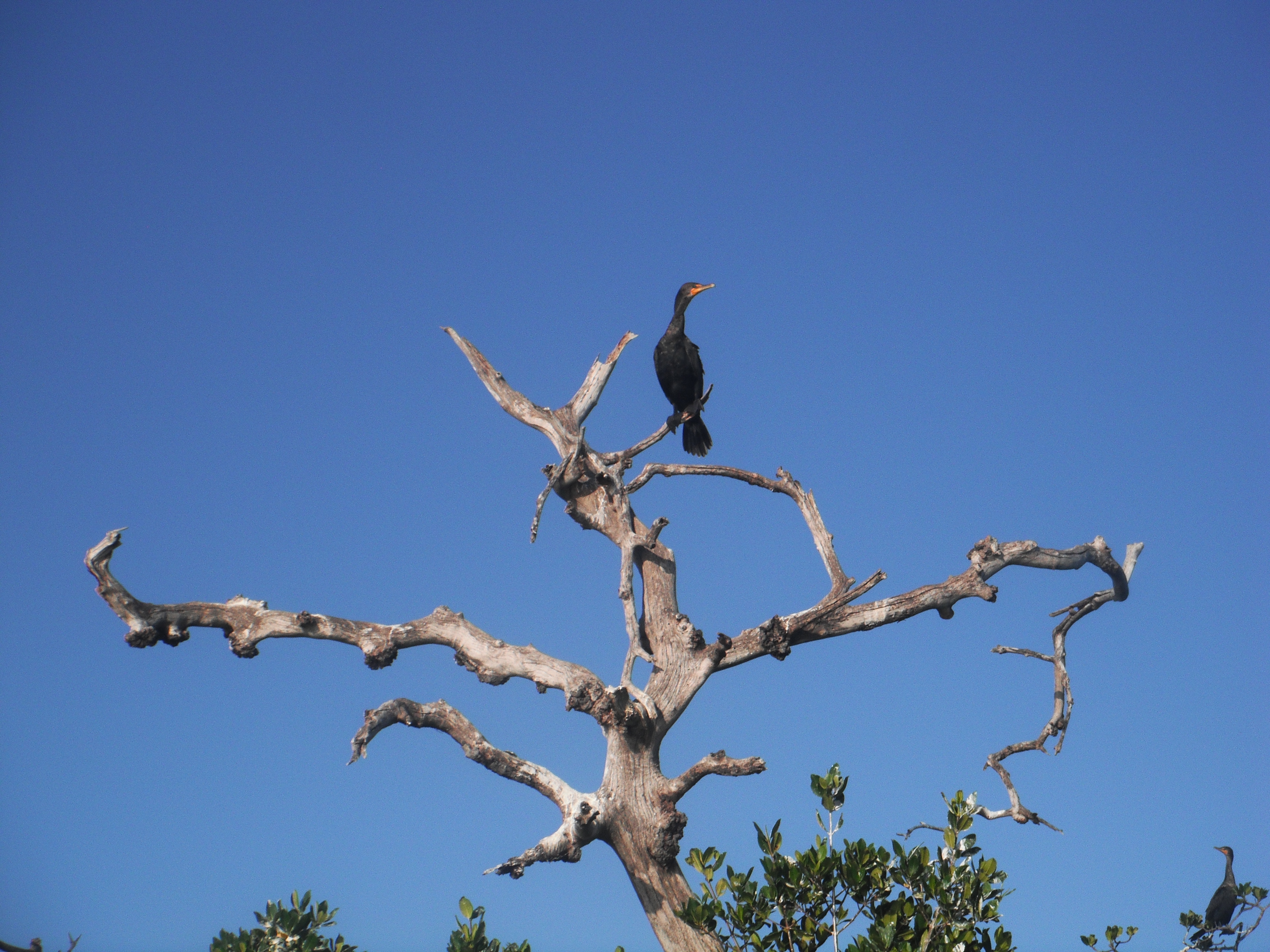
DSCF2633
This one didn’t get away.

Read Full Post »

I started to call this “Riding Dutchess”, but this title seems more apt. It is also a story about how events from the forgotten past can influence what we do today.
When I was in junior high school, most of my friends were horse crazy, which is certainly better than being boy crazy at that age. Few of the girls actually had horses, but one claimed to work at a riding stable and would talk about it. Her favorite horse, she maintained, was a descendant of Man of War. We were never sure how much to believe. Skepticism is a good mask for jealousy.
One of the privileged few, I did have a horse available to me, a Belgian draft horse named Dutchess. When I was small, Grandpa worked the farm with her and her teammate Jessie. After he got his Massey Harris tractor, the horses no longer had to work and would pass their time in the barn munching hay. My family was too sentimental to be good business people. Animals who had outlived their usefulness were kept around as pets. And they loved horses.
Jessie was a sweet tempered sorrel. One day I noticed her absence and was told she had been sent to a retirement farm for old horses. I did not question why she had to go to a special farm when she had actually been retired for years.
Fortunately, Dutchess stayed around for my horse crazy days. Not as even tempered as Jessie, she was almost as beautiful, a chestnut with a white blaze down her face. When I expressed a desire to ride her, my elders acquiesced. Grandpa built a mounting bench by the barn so I could climb aboard. I began feeding and grooming her and was shown how to bridle her. I was taught to put my finger into her mouth behind her back teeth, tickling her tongue to get her to accept the bit. That can be scary for a kid, even if the half-ton beast is a vegetarian. Soon I learned that Dutchess would open her mouth for me if I just put the bit up to her teeth. But that was the extent of her cooperation.
I was not allowed to use a saddle. I was told it was too dangerous, that I might fall off, catch my foot in the stirrup, and be drug to death. Apparently, tumbling down from sixteen hands high was an acceptable risk.
Possibly because she associated the outdoors with work, Dutchess liked to stay in her stall. The only way to get her to leave the barnyard was to use a switch. Only then could I coax her to carry me to my proposed destination, somewhere in the pasture. Grandpa said Dutchess had some race horse in her. I know that the moment I turned her head back toward the barn she would take off like a thoroughbred from the starting gate. I would grab her mane and if I managed to stay on, it was a wonderful ride. She had a smooth gallop, but if she trotted, I would bounce off. Sometimes she would wheel around without warning and make for the barn, leaving me behind in the mud.
My elders knew I was falling off. They could not help noticing how many times Dutchess returned to the barn without me. Once Grandma was walking down through the pasture as Dutchess and I went flying back toward the barn. Suddenly, Dutchess turned a sharp corner and I kept going straight. Grandma was alarmed, but I was unhurt.
Another time, my sister Jenny and I were riding Dutchess together, she behind me holding on around my waist. We made it to the farthest reaches of the pasture, turned around smoothly, and at breakneck speed down the hill, we came to the creek. Dutchess could not be bothered to slow down. We usually crossed the creek at the path built for farm equipment, but today she chose to jump over a deep part. What a thrill – just like in the movies! The three of us cleared the creek successfully, but when she landed on the far side, I could not hold on well enough for two of us. I guess kids were pretty indestructible in those days.
I didn’t fall off every time I rode Dutchess. I have a photo of myself sitting proudly on the back of a calm steed, but the times I fell off stick in my memory more than the times we successfully returned to the barn together. I was never injured and I was never prohibited from riding her but I could never understand why I could not use a saddle. Now I have the answer.

A Family Mystery Solved

Long before my father was born, when my grandfather’s parents were just newlyweds, on August 31, 1899, one Francis Marion Kidwell “bought a box of nails at a Higginsville, West Virginia store. The nails’ rattling spooked the horse. Since his feet were not completely in the stirrups, he died from being drug to the river.”
But what did this have to do with me? His sister, Mary Virginia Kidwell McDonald, was my great-great grandmother. I discovered this story last year when I was in Hampshire County, West Virginia doing genealogical research.
Uncle Frank’s death must have been a terrible shock to the family. This summer I visited the Kidwell Cemetery in Slanesville, West Virginia, where the graves are laid out in the usual neat rows, except for Uncle Frank’s, which lies at an angle to the others. It was as though his survivors wanted to make a statement that would impact the generations. It did.
This tale would have been told to Grandpa when he was a child, then some version to Dad when he was a boy, but I never heard it. Was this the reason I was not allowed to ride with a saddle? Unfortunately, neither is available today to enlighten me. So I asked my mother, who said Dad wouldn’t let any of us use a saddle because someone Grandpa knew about a long time ago was killed when his foot got caught in the stirrups. Three generations later, Uncle Frank’s name may have been forgotten, but the wisdom that stirrups were dangerous survived. Better just to fall off.
When I had children, they had a pony, but they showed little interest in riding her. We did not have a saddle. If they had asked for one, would Uncle Frank’s ghost have haunted my decision? Or would I have succumbed to reason and bought one? I hope so.
I am sure of one thing, that if I ever take up horse riding again, I will definitely use a saddle. But maybe I won’t ride to the store for nails.

Read Full Post »

“A truly happy person is one who can enjoy the scenery on a detour.” What wise man or woman said this? No one seems to know. It was probably only a cynical quip, but then, the Cynics were philosophers. Anyway, I guess that makes me a truly happy person. My life has been full of detours, both figurative and literal.
One of my most memorable was when I got off the Interstate and discovered the Natchez Trace. It was the summer of ’99. We were on our way home from a family reunion in Arkansas. I still traveled the Interstates in those days, always anxious to get to a destination as quickly and directly as possible. That year, I-20 seemed to be under construction everywhere and we were tired of sitting in traffic in the hot sun. After we crossed the Mississippi River and made it through Vicksburg, there was another construction zone. We crept forward. An exit with a brown sign indicated the Natchez Trace. I had seen those signs before on my trips to and from Arkansas but I had only a vague idea of what the Natchez Trace was. At least it wasn’t a construction zone.
“Let’s check this out,” I said. My life hasn’t been the same since.
Originally an Indian trail, the Trace was used by “Kaintucks” returning home from Natchez after floating their produce down the Mississippi to market. There they would also sell their rafts and make their way back home on foot. As more white settlers invaded this part of the country, traffic increased and the Trace became a rough wagon road between Nashville and Natchez. It reached its heyday in the 1800’s only to be virtually abandoned after steamboats took over the river traffic and other roads were built.
In the 1930’s, during the Great Depression, a Mississippi congressman, Thomas Jefferson Busby, saved the Trace and its history for future generations. He proposed construction of the parkway as a public works project to benefit his unemployed constituents. Of course it took an Act of Congress, much money, and many years to accomplish, but it was well worth the trouble.
The 500 mile long Trace is a leisurely drive through some lovely country, with picnic areas, restrooms, and campgrounds. The speed limit is only fifty and commercial vehicles are prohibited. With no stop signs or traffic lights to impede your progress, you stop only when you want to. I stop often. Every few miles there are historical and geological sites. I have spent days on the Trace, steeped in History. Even when I lack sufficient time, I never drive through Mississippi or Tennessee without visiting some part of the Trace.
I became so enamored by the Trace that I began to study it. One family’s story has so gripped my imagination that I am researching them with a historical novel in mind. It has been quite a detour.
I seldom take major highways anymore. I can read a road map and, if the roads are properly marked, I can follow a planned route. I said, “If.” For the most part, Florida roads are well marked, but that is not the case every where. I often find myself on unplanned detours. To be honest, I get lost. No matter, the scenery can be enjoyable and eventually I stumble across a town or roadway that I can locate on my map and steer myself back in the right direction.
One time I passed a mound of kudzu in the shape of a house. It was so remarkable that I had to turn around and check it out. Indeed, it was an abandoned house, chimney and all, that had become totally engulfed with vines. I have encountered many such interesting things on my “detours” but I haven’t been able to find the vine covered cottage again.
In 2006, heading south through Pennsylvania, I ran out of road signs. I had little idea where I was or, the way the roads wind among the mountains, no idea in what direction I was going. Oh, well, the scenery was beautiful, so I kept on. Whenever I came to an intersection, I’d take the road that felt right. Before I knew it, I had descended into Pennsylvania Dutch farmland and was not far from a highway which would take me home.
Our detour philosopher was probably referring to life, not roads, but isn’t it the same thing? I’ve always marveled at the people who can boast with confidence, “In five years (or ten or twenty), I will be at (a certain job, income level, or other goal).” Wouldn’t it be boring to have your life play out in an orderly succession with no surprises? I will never know. In high school my goal was to go to college and that was probably the last thing that worked out the way I’d planned. Another philosopher has said, “Life is what happens while you’re busy making other plans.” How true!
In college, I majored in Literature. I wanted to write, but journalism did not appeal to me. By my senior year I realized that I would have to make a living somehow, so I went into teaching. When I had children I wanted to be a stay at home mother and write in my spare time. How unrealistic. I did not plan to be a single parent who had to work. Since I had become disillusioned with teaching, I tried social work. This required a lot of writing and that helped me hone my craft. Quite a detour, wasn’t it? This career also exposed me to a lot of things I would not have encountered in a boring, well planned life. I learned a lot about people – good material for fiction. Now, with my state pension, I don’t have worry about where my next meal will come from, even though it is more likely to be hamburger than steak. I have the leisure to write without worrying about how soon it will sell. I don’t aspire to live in a mansion in a gated community. I’m happy with my little house in the woods.
And when I travel, if I end up somewhere unexpected, it’s not a detour, it’s an adventure.

Read Full Post »

Almost 150 years ago, a boy wanted to ride a carousel, but he was too poor to buy a ticket. He must have been fascinated by the brightly painted horses that galloped around and around to the cheery music. He made himself a promise that if he ever became rich, he would build carousels for children to ride for free.
When he grew up, he became an industrialist and owned several factories. He was a good employer and a benefactor to the communities that housed his factories. Among many other things, he built parks and donated carousels to the parks. There was one condition, that the cities would never charge money for riding his carousels.
This is a true story. My grandfather worked in one of those factories, and as a child, I rode those carousels.
My siblings and I were very fortunate. We lived out in the country where we could climb trees, swim in ponds, wade in creeks, catch fish, and roam about the fields and woods. The city children had to be content only with playgrounds. I’m sure that going out to the country was as much a treat to them as going to a playground was for us. But they were able to walk to their parks, and we depended on adults to take us there, so going to a playground was only an occasional pleasure for us.
The swings and slides were fun, of course, but the best of all were the merry-go-rounds. They were magic. The horses came in all colors and styles and there were also lions, tigers, and other wild beasts. For parents with babies too small to sit on a horse, there were chariots where they could be seated and enjoy the ride. Being a fan of the Black Stallion books, my mount of choice would usually be a black horse with a flowing mane.
My favorite merry-go-round had music from a Wurlitzer band organ. In my memory, it played one tune over and over but I never got tired of it. I do not know the name of the song but I can recall the melody and the words I put to it in my head. Beside the organ was a bass drum. A mechanical arm would strike the drum to the beat of the music. The drumstick had hit that drumhead so many times, it had worn a hole in the center, which was patched with tape.
Riding around and around with the music in my head, in my fantasies I was riding a real horse. When the ride ended, we would all exit and run around the pavilion to line up for another ride, over and over again, until we had to go home.
This summer, my son Joel told me he wanted to show his family where I had lived as a child and where his grandparents and mine had lived, worked, and gone to school. I did not tell him about the carousels before we made the trip. I wanted it to be a surprise. My favorite was closed for repairs, which is forgivable after nearly 100 years of delighting children, but my second choice was open and running.
This merry-go-round was in pristine condition. The pavilion it is housed in looked newly painted. Inside, around the top of the carousel, the panels painted with pastoral scenes and faces of Indians and frontiersmen looked as fresh as they had when they were first made. There were no wild animals to ride, but the horses were beautiful. They were of all colors and styles: some tossing their heads, some with fierce defiance in their eyes, and some intent on racing forward. The old music had been replaced with a modern sound system. This music was more varied, but it was still instrumental, with no lyrics to impinge on a private fantasy.
My son pointed out what a feat of engineering the carousel was. As a child I had never taken note of this. The large, round platform held 72 horses, four abreast. Each horse was suspended on a pole from a jointed rod which extended from the center pole. As this rod turned, each horse galloped independently of its mates. Platform, horses, hardware, and riders were all supported by guy rods from the single pole in the center. A motor turned the whole mechanism through a complex series of gears. Our ancestors managed to work wonders without the help of computers.
With still no admission price, and no posted age limit, I mounted a horse beside my grandson James and was carried away. The magic is still there.
I did not ride over and over again like I had when I was a child. Once or twice was enough. I wanted to take pictures, which was a challenge since the merry-go-round moves faster than my shutter finger, but it was pleasant to sit on a bench alongside the wall and watch my child and his enjoying themselves.
I look forward to going back again to ride the merry-go-rounds. Of course, it would be best if I were to take grandchildren with me.

Read Full Post »

GIVING THANKS

I sit down to breakfast, but before I eat, I give Thanks for my food. It is a modest breakfast: coffee, eggs, toast, and sliced kiwi. But when I think about giving Thanks for all who helped make my breakfast possible, it reaches cosmic proportions.

I bought the eggs from a friend who has chickens, so I thank both him and his chickens, but it goes beyond there. The chicken feed was grown by farmers and prepared by other hands and machines, transported by trucks driven by truckers, and sold in a feed store. There a clerk handled the transaction and a hefty young man loaded it onto my friend’s pick-up truck. The tractors, trucks, and other machines were made by factory workers from metals extracted from the Earth by miners and their machines, and the ore was processed in other factories, all made possible by the minds of inventors, scientists, and engineers. Did I mention the fuels involved and their processing? And the wood and concrete and metal which went into the buildings? And the workers who constructed them? My Thanks is extended to all those who made this possible with their muscle and their minds, to the Earth which yielded the metals and the fuels, to the soil and rain that nourished the grains and the trees, and the sun which gave the energy to make it all possible.

I made the bread myself. But it was made from flour whose journey paralleled that of the chicken feed, and yeast produced by other hands and machines and microorganisms, butter from a dairy farm, salt from the Earth, and gas for my stove, again from the Earth with the help of men and machines, and ultimately, the sun.

The kiwi is from New Zealand, grown by farmers, picked by laborers, and sorted by many hands and shipped halfway around the world for my health and pleasure, again with all else that made this possible.

The coffee was grown in South America or maybe Africa. Again I must thank the farmers and pickers, the coffee bush, the soil, the rain, the sun, and all those who processed it and brought it to the store where I bought it. To the coffee I add milk from a dairy farm, thanks to the farmers, cows, feed producers, the grass, soil, rain, sun, and all those in between who had a hand in bringing it to me. I also add sugar, grown in South Florida or Jamaica, thanks to…etc.

And what about my dishes, utensils, and kitchen appliances and all that went into them?

It has taken a global effort to bring me my little breakfast and my expression of Gratitude takes more time than it takes to ingest the food. I am humbled. All this for me.

Read Full Post »

When I was a small child, one room school houses were still in existence in some rural areas. One by one they were being closed as citizens succumbed to the progressive wisdom that children would be better educated in the large consolidated schools. I was fortunate enough to attend a little schoolhouse in the first grade. This was the same school where my father and grandfather had been educated in their days, but that’s another story. Unfortunately, by the end of that year, our school district had voted to close the school and bus the students to the education factories in town.

In our area, the county did not provide school buses. Each school district would contract with a bus company. Ours was a one-man operation owned by a fellow named John Sokol. Here was a character if ever there was one. He seemed to enjoy his job and most of his kids, and the students, for the most part, liked him.

On my first day of second grade, I stood dutifully at the foot of our sidewalk as the bus jiggled down the road toward my house. But I was small for my age, and along the road was a hedge of barberry bushes. I was already nervous about the new school and it did not help that, instead of stopping for me, the bus just kept on going! I heard the children on the bus yelling, and the bus screeched to a stop and backed up. Mr. Sokol said something about my being smaller than a bush and from that day on, he called me “Bush.”

I don’t remember any discipline problems on the bus. Even though Mr. Sokol could be as rowdy as the roughest boy, the kids behaved for him. I remember him laughing more than any thing else, but he was certainly no angel. Usually, if a child was not at the bus stop but could be seen running down the driveway, or if a parent came out and said Johnny was putting on his coat, he would wait for him. Mr. Sokol had some favorites among the children but there was one family he clearly did not like and I never knew why. The oldest boy was no longer in school but Chester must have been in high school at the time. Mr. Sokol would make unkind remarks about Chester, in and out of the boy’s hearing, and the older children would jeer Chester. The boy appeared to be clean, did not smell bad, and to my knowledge he was from a respectable family, but there may have been some past quarrel I was unaware of. If Mr. Sokol could leave Chester behind, he would. One morning the older brother came out and asked Mr. Sokol to wait for a few minutes. He did, but the second Chester came out the front door, Mr. Sokol drove away, laughing.

We made up a song about Mr. Sokol, to the tune of “The Old Gray Mare”:

                    Old John Sokol jumped in the Delaware,
                    Pulled off his underwear,
                    Smashed all the silverware.
                    Old John Sokol jumped in the Delaware
                    Many long years ago.

When we sang that song, he would laugh and laugh. Once he resorted to a serious voice and said there was some truth to it. He used to have a campsite on the Delaware River with an old school bus for a cabin, and he said he had jumped in the Delaware many times.

At the end of the school year, it was traditional for the bus companies to host a “bus picnic” for the students and their families at a local park. The usual fare was hot dogs and ice cream. I remember seeing a supply of Dixie cups packed in a cardboard box covered by a heavy gray army blanket. I wondered why they would cover the ice cream with a blanket on a warm day. The explanation that the blanket would keep it cold just didn’t make sense to my seven year old mind. Blankets keep you warm, right?

All good things come to an end. I’m not sure whether his treatment of Chester had anything to do with it, or what the reason was, but after a few years our school district stopped contracting with Mr. Sokol and went with the larger company that served much of the area. The buses were newer and probably better maintained, and our new driver was nice enough, but it just wasn’t the same. He was a quiet man who lacked Mr. Sokol’s sense of humor.

Eventually my family moved away. The last news I had of Mr. Sokol was a newspaper clipping my grandmother sent me. It showed an old school bus, our old bus, rusting in a field. In the caption under the picture some upstanding citizen was bemoaning the fact that the county was full of such “eyesores” and they should be removed.

I thought it was sad, not that the old bus was rusting in a field, but that someone would call it an eyesore. I thought about how beauty can be more than a well manicured roadside, and how memory, laughter, and tradition, while sometimes untidy, have an important place in our hearts.

Read Full Post »

Traveling the Backroads, I stumble across many interesting little places that you will not find along the interstate highways. Scattered around the Southeast are small public springs and artesian wells where the public is free to take water. I’m not talking about  springs where you go swimming, but places where you drink the water.

One of the most famous, though hardly off the beaten path, is Hot Springs, Arkansas. People have enjoyed its healing waters for thousands of years. About one million gallons of water flow daily from forty seven springs. This  is ancient water which fell as rain some 4,000 years ago and percolated slowly through the Earth’s crust, finally to emerge from the depths at 147 degrees Fahrenheit, rich in minerals. Over the past one hundred fifty years, bathhouses have been constructed over the springs, and various health treatments have been offered to supplement the waters. Although the popularity of bathhouses has declined, people still flock here every day. Many do no more than fill water bottles at the public spigots. I once encountered a hale senior citizen whose car trunk was full of gallon jugs. He told me that this water is what keeps him alive and healthy, and he is not alone in this contention. I go out of my way to visit Hot Springs and take some of its health with me.

Over in Oklahoma, along Highway 259 in the Ouachita National Forest, is a small roadside park called Pipe Springs. The place has a history I will not relate here. Today it is visited only by the few who pause to picnic, climb the nature trail, and drink the water. This spring is no more than a pipe sticking out of the rocks which emits a steady stream of sweet water. It is not much to look at, but the water is well worth stopping for.

Back East, somewhere in the Carolinas on Rt. 15, is another little park whose name I do not know. An artesian well gushes from the ground through pipes. Here you will always find a line of people with their water cans ready. They seem to be mostly local people who know the value of the tasty mineral water, but there are a few like me who have wandered by and taken the time to stop. The water is good.

One of my favorite places is Healing Springs, near the antique town of Blackville, SC. I often overnight at the nearby Barnwell State Park, which is a comfortable days’ drive between my home and other destinations. I was told of this place by a park ranger and I make the pilgrimage about once a year. Native Americans considered this spring to be sacred and they would bathe here when they were sick or injured. During the American Revolution, as the story goes, four British soldiers were brought here by friendly Indians for this purpose. The men had been mortally wounded in battle. Two able bodied men had been left to care for them and bury them when they died.  Six months later, the soldiers rejoined their garrison in Charleston, healthy and ready to resume action.

Since that time, ownership of the springs passed from the red man to the white man. In 1944, the last owner deeded the property to God, so that the water could be enjoyed freely by all people. This is a legally recognized deed. The place cannot be sold without God’s signature. An adjacent church maintains the park, called God’s Acre, which is no more than a couple of picnic tables and several pipes in the ground. Each pipe has four branches from which a generous stream of water continually flows. What is not collected in people’s bottles spills into a picturesque little creek. Healing Springs is visited daily by folks of all walks of life, some of whom swear to the healing power of its waters. I always take some home to my loved ones.

These waters have diverse histories and their taste is different depending on their mineral content. They may or may not have purported or scientifically proven virtues, but the one thing I have found in common in all these places is the friendliness and good will of the people I encounter there. None of them know me and few of them know one another, but they will engage in cheerful conversation. It’s as though, coming together to share a gift from the Earth, people find a common connection that goes beyond ethnicity, social class, or religious affiliation. Is it the magic of the waters? Or is it something much deeper that finds a bond among our souls? At Healing Springs, especially, parting is frequently accompanied by a heart felt, “May God Bless.”

There is another, very unlikely place that I consider it to be one of the friendliest I have found to take water.  DeFuniak Springs is a little town in the Florida panhandle, built around a spring-fed lake which is ringed by a public park. A street encircling the lake and park is lined with Victorian era houses. This is a popular place for locals to jog or walk. But what I find most interesting here is not the park, and the water I take is not from the lake. At the sidewalk in front of one of the houses is a water fountain inviting one to stop and take a drink. A sign posted behind the fountain quotes, “I am the bread of life: he that cometh to me shall never hunger; and he that believeth on me shall never thirst.” Although no food has ever been evident, I almost never fail to stop by for a few minutes to take a few sips of water.  Usually I am the only one there, but I feel a connection with others who stop by and with the owner of the house who has extended hospitality to strangers, many like me just passing through, some who may never return.

So when you travel, slow down and explore the back roads and out of the way places. Don’t be afraid to stop or take time to visit. You, too, may find yourself partaking of the gifts of the Earth or sharing the hospitality of strangers.

Read Full Post »

« Newer Posts - Older Posts »

Abandoned Southeast

Preserving the Past | A Photoblog of Hundreds of Abandoned, Historic, and Forgotten Places

Bonnie T. Ogle

Award Winning Childrens Author

filmmaven

A great WordPress.com site

The Tony Burgess Blog

The Home Of T-Bird From The Dork Web.

Wells Family Genealogy

The study of my Family Tree

Alien Resort

A Terrestrial Romance

douglasfelton.wordpress.com/

Compelling Young Adult fiction from author Doug Felton

Hidden River Arts

Dedicated to Serving the Unserved Artist

Green Life Blue Water

Where Eco Meets Life

Pattie Remembers

Sunsets and Buzzards, and Other Stories

koolkosherkitchen

Welcome to my Kool Kosher Kitchen where food is fun and fun is to create food!

The Life in My Years

An anthology of life

cookingforthetimechallenged

Fast, easy, all natural, healthy, kosher cooking

CarpeDiemEire

Travel Through Ireland and Europe

Yeah, Another Blogger

An Arts-Filled, Tasty And Sometimes-Loopy Jaunt Through Life