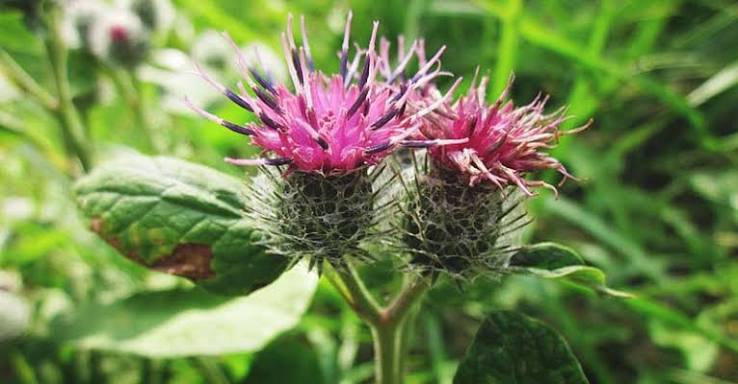
Opening an email, a blog post by someone I follow, a picture of strange flowers pops out at me. Clusters of tiny tubular blossoms—a lovely purple—against the backdrop of muted green foliage, flanked by ephemeral globes of purplish green. Burdock. It evokes a childhood memory. A pleasant one, although the actual event wasn’t entirely so.
Burdock doesn’t grow wild in Florida, although other thistles do. Some are quite edible. Usually their spines soften when you cook them, so you don’t have to worry about biting into something that bites back.
One of my favorite local thistles is the “yellow” thistle which does not have yellow flowers, at least around here. It’s more aptly named Purple Thistle. You see them on roadsides and fields, even those which are regularly mowed, as though a flower stalk could spring up overnight from its almost invisible basal rosette and complete its cycle before the road crew makes another pass.
Its Latin name, Cirsium horridulum, aptly describes its appearance. Every part of the plant above ground is covered with bristles of various lengths. The pretty purple flowers morph into spiny seed heads that dare you to approach. No sane person would touch this plant without leather gloves and a machete.
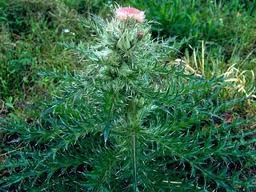
Actually, that’s how you harvest this surprising delicacy. If you have no machete, a good shovel or pair of loppers will do. You cut the flowering stalk from the basal rosette of leaves and stow it in a way that no one will be injured while you take it home.
Still wearing your leather gloves, you remove the outer layer, the tough prickly part, to expose the inner stem. You wouldn’t think this inner part came from the same plant. Imagine a stalk of celery with no strings. The Purple Thistle has a taste similar to celery, but milder, sweeter, and in my opinion, better. You can nibble on it like you would celery, add it to a salad, garnish it with peanut butter or cream cheese, but I wouldn’t cook it. It’s too good raw.
The roots and leaves are also edible, Besides human uses, Purple Thistle is an important pollinator plant and is the host for Little Metalmark and Painted Lady butterflies. Burdock is also edible, has medicinal properties, and is another host plant for Painted Ladies.
Back to the childhood memory. We lived in upstate NY, in the house my father built across the road from my grandparents. My siblings and I had the run of their 40 acre farm. Lots of interesting things grew wild on pastures and fence lines, including milkweed, chicory, and burdock.
One day, my sisters and I picked the pretty purple blossoms of burdock and decided they would make nice hair ornaments. We used them as we would barrettes to pin back strands of hair. They worked quite well and looked attractive, at first. But when it came time to remove them from our coiffures, that was another story.
Burdock is native to Asia, but it’s found all over the US except in hot climates. My sisters and I became examples of how burdock seeds get so widely distributed. The seed heads are covered with little grabby things that hook onto an animal’s fur (or your clothes) and stay there until the creature is able to rub them off. Burdock was the inspiration for Velcro. Those pretty blossoms anchored themselves in our hair. After a day of outdoor play, they were so entangled that we couldn’t pull them out.
My poor mother, hip deep in small children, lacked the patience to remove them gently. When she pulled on the flower heads, she pulled out hair. Ouch. Before she resorted to scissors to cut them out, Grandma took over. That woman was the epitome of patience. She managed to coax those stickers to release their grip without inflicting further pain.
I don’t recall what she did with those discarded flowerheads. I’m sure she disposed of them in some way to keep them from sprouting in her yard and flower beds. It made no diffrence. There were enough seedheads in the pasture to insure further propagation of the species.
Needless to say, we never put burdock blossoms in our hair again.
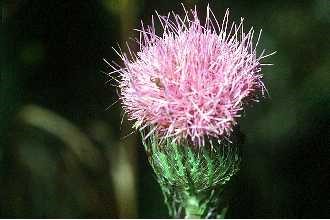


I enjoyed this story and love thistles…but not in my hair, thank you! They are a real joy to paint!
As always, Connie
Connie Biddle Morrison Connieann’s Corner http://connieannscorner.blogspot.com/ (My Blog) The Dragonfly and the Ladybug https://www.amazon.com/Dragonfly-Ladybug-Connie-Biddle-Morrison/dp/B08JDTNJ2Y/ref=sr_1_1?crid=3E9C08EVXZSXV&dchild=1&keywords=the+dragonfly+and+the+ladybug&qid=1602970368&s=books&sprefix=the+dragonfly%2Caps%2C163&sr=1-1 (My Children’s Book) My Goodreads Author Page https://www.goodreads.com/author/show/20769166.Connie_Biddle_Morrison http://www.youtube.com/@connieannscorner
LikeLiked by 1 person
If I ever see one of these, I’ll admire it but not touch it!
LikeLiked by 1 person