Feeds:
Posts
Comments

Posts Tagged ‘Adventure’

Travels with Teddy

When my daughter Amber lived at home, she took care of my animals when I traveled. Once she said Teddy missed me so much he wouldn’t eat when I was gone. It turned out she was feeding him twice as much as I did! He ate like a cat, nibbling his food throughout the day, not gulping it down all at once like some dogs. He’d leave what he didn’t eat.

When Amber was not available, a neighbor tended my animals. One summer, I came home to find Teddy wearing a pink flea collar. No one knew where he got it. Of course, he managed to scratch it off and lose it. One day Teddy and I took a walk on the dirt road. A neighbor I didn’t know well said, “Hello, Teddy.” I stopped to inquire how he knew Teddy and learned that while I was traveling, instead of staying home to keep the varmints out of the yard, my faithful dog was nearly living at their house! That’s where he got the flea collar.

After this, I took him with me. Teddy loved to travel. If I went somewhere in my van and didn’t take him, he’d pout. On the road, he was well- behaved and even tolerated a leash once I explained that city dogs had to wear them. He accompanied me as far north as West Virginia and as far west as Arkansas. On hot days, I couldn’t leave him in the van and tour a museum or antebellum house, but we stopped at parks and walked the trails. Here are Teddy and Tristan, both dog tired after a long walk through a North Carolina swamp:

2011 pics 391

One summer we spent several days on the Blue Ridge Parkway, stopping at every cabin and walking every trail that wasn’t too steep for him to climb. I’d go sightseeing and Teddy’d go smell-sniffing. He delighted in new and unusual smells. Here he is checking out something that looks disgusting to a human:

Copy of 10-15 131

He seemed to understand that the van was our home away from home. If a park ranger stopped by our campsite, Teddy would bark until I told him it was ok. One year we went to Arkansas. From there my mother and I flew to Washington to visit my sister Sue. I left Teddy and my van at Mom’s house, under the care of my nephew. Teddy made himself at home and didn’t leave the farm as long as my van was there.

But things were different in the city. One summer when we visited Amber in Virginia Beach, I tied Teddy in the back yard at night and slept in the house. The next morning he was gone. I hiked all over the neighborhood but no one had seen him. We called the pound but he wasn’t there. I was afraid I’d lost him forever.

That afternoon, Amber’s father-in-law returned home and said, “Get your damn dog out of my car.” He’d found Teddy! On a whim, he’d decided to take a different route home, spotted an Animal Control truck, and Teddy being led toward it. Randy convinced the officer he knew whose dog it was, and Teddy was released without bail. Apparently, Teddy had gone as far as a house on a lake and hung out in the backyard all day. When the owners got home from work, they called the pound. After this, I slept out in the hot van with Teddy so he wouldn’t escape again.

Teddy got along with most dogs but my sister Bonnie’s dog is jealously territorial. He wouldn’t let Teddy out of my van. Brutus sees me only once or twice a year but always greets me with wagging tail, even if no one’s home. He doesn’t even object when I use their hidden key to get into the house. Some watchdog! Bonnie said he senses I belong there. But Teddy was not welcome. Brutus had to be distracted so Teddy could get out to relieve himself. Then Brutus got curious about my van and wanted to check it out, but that was Teddy’s territory. He wouldn’t let Brutus near.

As he aged, Teddy had trouble climbing into the van. He could get his front paws in, but I’d have to pick up his hind quarters and shove. Sadly, his traveling days were over. I always felt safe when he was with me, and I missed his company when he wasn’t.

Next time I’ll tell you how Teddy became known as my Million Dollar Dog.

.


Read Full Post »

This September, National Weather Service in Jacksonville celebrated the 50th anniversary of Hurricane Dora, the only tropical cyclone to hit the area in recorded history. I remember Dora quite well. It was one of my family’s many adventures. We weathered the storm in the men’s bathhouse at Ocean Pond Campground, in the Osceola National Forest, just west of Jacksonville.
Let’s back up. This was not my first hurricane. When I was a little girl, Hurricane Hazel ripped up through the eastern United States. All I remember was that she badly damaged our cherry tree.
In January, 1964, we moved to Florida, first settling in the Everglades, in Moore Haven, a small town on the shore of Lake Okeechobee. We rented a house on the bank of the Caloosahatchee River, a picturesque cottage on stilts, which had the distinction of having survived the 1928 Okeechobee Hurricane.
In the early 20th century, a small earthen dike had been built around Lake Okeechobee. In 1926, storm surge from a deadly hurricane breached the dike. The 1928 storm was even worse. Hundreds of acres were flooded, some areas under twenty feet of water. Thousands of houses were swept away and at least 2500 lives were lost. Many bodies were never recovered. Our house, and presumably its inhabitants, survived because, being built on stilts, the water washed under the house.
Thirty six years later, the disaster remained fresh in the memory of survivors and their descendents, who recounted the horror to anyone who would listen. The old two-story schoolhouse still stood, with scars on the walls of the second floor where boats had scraped against it during the flood. After 1928, the Army Corps of Engineers had erected a huge levee around the lake, but our neighbors said they didn’t really trust it.
August brought Hurricane Cleo. My parents stayed glued to the radio for storm predictions. I remember townspeople expressing anxiety as Cleo approached, but few made plans to evacuate. One of my friends said her family might shelter at the high school, but that building had a ground floor only. We didn’t take chances. We packed our camping trailer and tents and headed north on Highway 27.
After fifty miles or so the flat Everglades gave way to sandy hills. We pulled into Highlands Hammock State Park. Cleo followed. She snaked up the east coast of Florida as a Category 2 storm, slowing to a Category 1 as her eye passed fifty miles east of us. We were safe from flood, but the wind would have blown our tents away. Fortunately, the park rangers let us stay in the lodge, a sturdy building built by the Civilian Conservation Corps during the Depression.
This storm was unlike anything I’d experienced. Instead of heavy raindrops pounding the earth as in a thunderstorm, which finishes its business and moves on, falling rain danced all day at the mercy of the gale. Through the windows we watched trees thrashing in the wind and heard its incessant howl. I recall being more bored than afraid. There was little to amuse us in the dim light of the lodge. Once the weather cleared, we returned home. The Lake had remained within its banks and surrounding communities were safe.
For various reasons, not limited to hurricanes, my parents decided to move to the northern part of the state. A week or so later, we were camped near Olustee while my father looked for another job.
Were hurricanes out to get us? Two weeks after we fled Cleo, Hurricane Dora caught up with us. She headed straight towards North Florida as a Category 3 storm. For the second time, we found ourselves with only a few sheets of canvas between us and a tempest. At least we didn’t worry about a 20 foot flood, since Ocean Pond is a tea cup compared to Okeechobee. Other campers packed up and went home. We had no home to go to, having given up our house in Moore Haven. One other family remained, a retired couple in a pop-up camper.
The men’s bathhouse had a large open area surrounded by concrete block walls. We moved our bedding in as Dora slammed into Jacksonville as a Category 2 hurricane. The other couple joined us, their little pop-up no match for 110 mph winds. Cleo had been gracious enough to hit Florida during the day. Not Dora. She made landfall at 2 am, but we had felt her blast hours before.
The bathhouse was lit by an open skylight, practical in fair weather, but not in a major weather event. Mom and Dad put tarps over our beds, so we could sleep dry, but they did not sleep. As the wind roared through the night and rain swirled through the open roof, I woke now and then to see them pacing the floor. I remember Mom adjusting a tarp that had blown loose. Little splatters of rain hit my face, but I felt safe. Only when I experienced a tropical storm as an adult could I appreciate what my parents must have endured.
As daylight came, the storm subsided. By early afternoon she moved on. The retired couple crawled into their camper to get a few supplies and the lady cooked grits. What food supplies weren’t soggy must have run low and I was hungry. Those plain grits were the best thing I ever tasted. When it was safe to go outdoors, we went down to the lake. To our surprise, a plastic orange fish came bobbing across the lake toward us, carried by the wind and waves. My little sisters scooped it up. We had no way of knowing who it belonged to, so we kept it. That orange fish stayed in the family for years and is featured in several old photographs. I wonder what became of it.
After a few more adventures, my family settled in Scrambletown, Florida. More adventures were to follow, but the next time a hurricane blustered through, we had a strong cypress house to protect us from its wrath.

Read Full Post »

The biosphere of Planet Earth is a miracle. We know of no other world where we could live outdoors. The moon is inhospitable, Venus a furnace, Mars’ air thin and oxygen-poor. Forget the other planets in our solar system. And we know little about those beyond. By comparison, Earth is a paradise. Every day we should rejoice in the sunshine, breathe deeply with gratitude, and take water as a sacrament. So why do we spend so much time inside?


Once I took a plane trip on a perfect day in May. Flowers bloomed and trees wore new leaves. We flew at low altitudes where I could see the towns and neighborhoods, parks and school yards, fields and forests below. But no children played on the playgrounds. No one walked or jogged. No farmers worked their fields. No workmen or fishermen were evident. How could they stay indoors on such a beautiful day?


People move to Florida “for the weather”, then find it too hot, too cold, too humid, or too many mosquitoes. Day and night they keep windows closed and the air conditioner running. Why not live where the climate requires such confinement?


“When was the last time you spent the entire day outdoors?” A character in a movie asked another. Nothing substitutes for the physical, mental, and spiritual refreshment you find in the open air. Last January on the Mirage, we lived outdoors the entire week. Only the cabins are enclosed. The dining area, where we spent mealtimes and evenings, is open to the elements. Surrounded by wilderness with no light pollution, we stood on deck at night and enjoyed the stars. We spent our days on the water, under the sun, in the wind, and it was good.


But not perfect. Nature is not always kind. In Pine Island Sound, destruction by Hurricane Charley nearly a decade ago is still evident: heaps of uprooted, storm-tossed trees.


Monday’s sun heated the cabins below deck. To hasten cooling, I left my hatch open until bedtime. By then, my cabin was full of mosquitoes. I don’t know how many I swatted before I started to count, then I killed sixteen, more during the night, and probably another dozen in the morning. Afterwards, I was more vigilant.


If you kayak in the sub-tropical sun, you need skin protection. I wore a hat, long sleeved shirt, and long pants all week. Splashing waves cooled me. I used sunscreen on my face and hands, but forgot UV protection for my lips, which burned, cracked, and peeled. A lesson learned.


At least I didn’t turn into a Gumbo Limbo. Natives call it the “tourist tree” because its bark is red and peeling. On Wednesday, we encountered the human variety. The kayak trail in Commodore Creek was choked with tourists. Poorly prepared, they probably lathered on sunscreen, but did little else to protect themselves. Most wore shorts and short sleeved shirts or tank tops and, while they remembered sunglasses, few wore hats. Even though Commodore Creek is shaded by mangroves, I’m sure by evening they resembled Gumbo Limbo trees.


The week was not all smooth paddling. Wednesday morning was calm but the wind picked up when we returned to Mirage. We skirted the shore in Pine Island Sound but had to cross open water to get to the boat. The wind kept blowing me off course. I’d paddle several times on one side to get straight, then over-correct and be blown the other way. Finally, Jun suggested I align myself perpendicularly with the waves and let the wind blow me along. I told him I was trying to align myself with Mirage. He said to align myself with the waves and Mirage would take care of herself. He was right. The wind blew me right to the ship. Nature is bigger than we . Why exhaust ourselves trying to work against her? Better to cooperate.


That evening, waves too choppy for kayaks, we took the dinghy out to North Captiva Island, beached on the inland side, and crossed a short neck to the Gulf of Mexico. We collected shells and watch the sunset. The water was cool but pleasant enough for a swim.

Kayak voyage 081


Thursday dawned with a nice south wind, but a cold front loomed in the northwest. When we reached the south point of North Captiva Island at 1 pm, the wind shifted and picked up speed, the weather turned cold and the water choppy. Paddling became difficult. We hugged the shore until we came to a shoal too shallow to paddle, so Elke and I got out and waded, towing our kayaks. Keith and Jun detoured the shoal and landed on a small beach. My muscles cramped from the chill. Jun came back for our kayaks, allowing us, thankfully, to walk on the sand.


From there, as the gull flies, Mirage was not far, but I struggled against the wind. When I’d stop for a brief rest, it blew me back. At one point a strong current caught us. Keith offered to tow me. Fatigue and pain eventually conquered my stubborn pride, and I let him. Sometimes you just have to accept help.


Tarps were lowered around the dining area to shelter us and we wore coats to supper. All night, the rigging snapped in the wind and Mirage swung back and forth on her moorings. There’s a saying in Florida: if you don’t like the weather, wait a few hours. The morning dawned cool but soon warmed and we enjoyed beautiful weather the rest of the week.


Did discomfort diminish my pleasure? Only temporarily. Afterward, I could laugh and reflect. I don’t go looking for trouble and “No pain, no gain” is rubbish, but roadblocks lead to self discovery, adversity to growth. Adventures yield good memories once we are safe at home. Being outdoors all week was well worth it.


As I write on this beautiful day in May, the sun is shining, the birds are singing, and the yellow flies are biting. I almost need armor to go outside. Oh, well. At least my windows are open so I can breathe fresh air. I don’t have to leave the house to pump water, so I can take it as a sacrament.


Read Full Post »

Last month I began to relate my adventures aboard Mirage, the mother ship for Kayak Voyagers. This month, I focus on the parallels between life on a small boat and existence on a small planet.

We view our world as a big place and seldom consider how everything comes from the Earth. Once we regarded her resources as limitless. We Americans are especially guilty, originally gifted with a sparsely populated continent, virtually unfarmed, uncut, un-mined, immense. Over the past half century, we have become painfully aware that all this land, water, forest, and wildlife are finite after all. If we want to continue to enjoy them, we must be careful.

A planetary disk of white cloud formations, brown and green land masses, and dark blue oceans against a black background. The Arabian peninsula, Africa and Madagascar lie in the upper half of the disk, while Antarctica is at the bottom.

To prepare for the trip, Elke had sent me a “What to Bring” list. The first words were, “Pack light”. How do you pack “light” for a week with no opportunity to do laundry? I usually travel in my Road Trek which has the capacity for a complete wardrobe. In my defense, driving from Florida to points North, I must pack for more than one climate, but I tend to plan for every contingency, forgetting I’m in a civilized country with access to stores and washing machines. But Mirage was cruising in wilderness areas with no stores or laundromats. Storage space on a boat is limited, so packing lightly is imperative. I had to be more resourceful, making do with less.

Technically, Mirage is a catamaran, seventy feet long and twenty six feet wide, but little of this is living space. Her main hull (the vaka) is only eight feet wide. Three passenger cabins and two for crew are nestled in the vaka. My cabin, accessed by a hatch on the deck, could sleep three, but I had the luxury of being the only occupant. Like my pioneer ancestors, I could to spread out my things without bumping elbows with anyone. I suppose Mirage could sleep a dozen, but the open-air dining area accommodates only eight. With just four of us on board, we were comfortable.

Technically, Earth is a satellite of the star we call the Sun. Her circumference is about 25,000 miles, equal to about a dozen round trips between Disney World and New York City. Like Mirage, Earth is unique. She is the mother world for our species and millions of others. Compared to the few other planets we know, she is a paradise. We have nowhere else to live. Over seventy percent of Earth’s surface is water, so we air breathers are confined to less than a third of our planet’s area. Earth’s population is increasing astronomically. We do not yet know how many she can accommodate.

On Sunday, Elke hauled a car load of groceries out to Mirage. She had to plan meals carefully. The food must be not only tasty and nutritious, but adequate for the week. Additional trips to the store would have been inconvenient and wasteful. Another consideration was food storage. The Mirage has only two small refrigerators, one gas and one electric, a cooler for frozen foods, and only a few shelves for non perishables. Careful planning is important.

Earth has no stores floating around in outer space to replenish our supplies. We are restricted by what we have here and what we can make from it.

In preparation for the voyage, Keith emptied the holding tank and filled the fresh water reservoir. This water is for washing and had to last the week. An almost inexhaustible supply of sea water is available to flush toilets, with a caveat – the capacity of the holding tank is finite, with no opportunity to empty it during the voyage. Storage space for trash is also limited. Once, people just dumped their garbage and waste in the ocean. Now we understand we need to keep our only home clean, so we generated as little waste as possible on our Blue Boat Home.

Each of us had a water bottle labeled with our names. Elke had bought several gallons of drinking water to refill our bottles as needed, nothing wasted. Despite the quantity of water on Earth, we are learning how precious clean drinking water is and struggle to conserve it.

Mirage is propelled by two large outboard motors. Again, the fuel supply is finite and has to last a week. Electricity on board is at a premium despite the solar panels and limited to 12 volts unless the generator is running or the boat driving, both which require fuel. Besides the refrigerator and lights, laptops, cell phones, and camera batteries require daily charging. Running the motors charges the storage batteries, but only when driving to a new location.

Earth’s supply of fossil fuel is also limited, but she does have a virtually infinite source of solar energy. Like the solar panels on the ship, we need better ways to harness it for our use.

Of course we were not confined to the Mirage the entire week. Every day we paddled out to the mangroves for birding or to the beach for shelling. We visited a lagoon occupied by manatees. Every day Keith would move Mirage to a new location. Twice we lunched at shore side restaurants. But for our daily living, our resources were confined to what we had on board. All this may sound like a hardship, but it was not. We only had to stay mindful.

How often in our busy lives do we stop and think about the consequences of our actions? Of carelessness? Perhaps we could all benefit from a voyage like this, an opportunity to leave behind all the extraneous fluff and focus on true needs. More than the sea shells and photographs, as much as the memories, I cherish the lessons in ecology and sustainability I brought home from my voyage.

 Standing on these mountains and plains
Far away from the rolling ocean
Still my dry land heart can say
I’ve been sailing all my life now
Never harbor or port have I known
The wide universe is the ocean I travel
And the earth is my blue boat home
(Peter Mayer)


Read Full Post »

We sing a hymn at my church, “Blue Boat Home” by Peter Mayer. Even a landlubber like me can’t resist rolling with the rhythm. Some of the words are:

                                The wide universe is the ocean I travel                                                                              And the earth is my blue boat home.

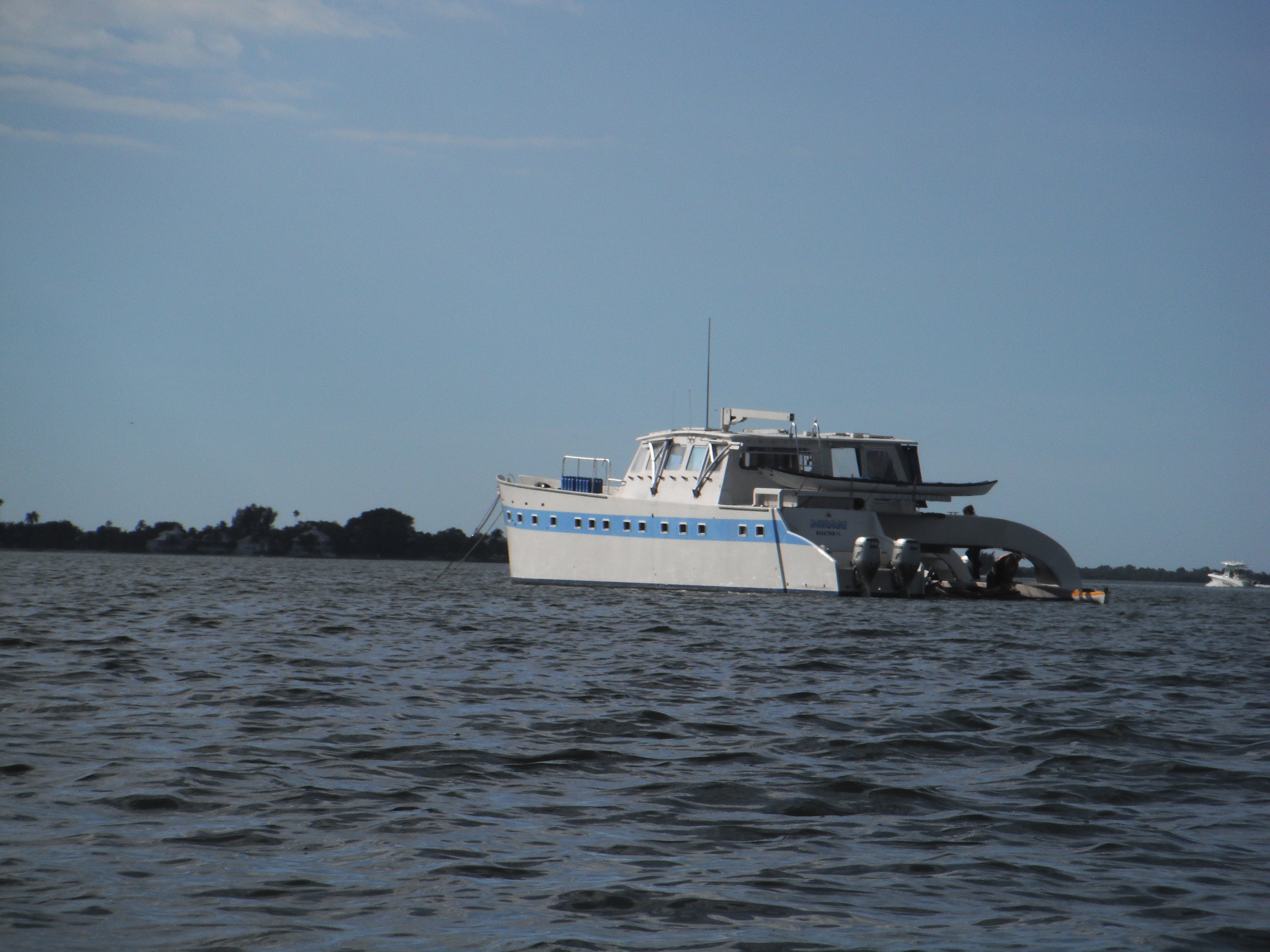
Of course, this refers to the Earth in her voyage through the heavens, but whenever I hear the song, I think of another blue boat home, the Mirage. Last January, I was privileged to spend a week on board, cruising Pine Island Sound near Ft. Myers, kayaking through the mangroves, viewing birds and other wildlife. A white boat trimmed in blue, on blue water under blue sky, Mirage is a magnificent sight. Viewed from the port side, she resembles a substantial yacht. Seen from other angles, your head snaps back for a second look. “Did I see that right?” Hence, the name Mirage. She is unique, custom built by John Bartlett and operated by Kayak Voyagers out of Alva, Fla. There is no other like her.

Kayak voyage 165

The Mirage is seventy feet long and twenty six feet wide. Her main hull, called the “vaka”, is only eight feet wide. This is joined to the outrigger, the “aka”, by two arches called the “ana”. Mirage is not a luxury yacht. She is a mother ship for a small fleet of sea going kayaks. On our trip, there were only four of us aboard but she can comfortably accommodate twice that many.

In “Taking Pictures from a Kayak” I wrote about one aspect of my adventure. This post will be one of a series I have been working on as I digest the meaning of the experience.

Much more than a pleasure trip, it was the breaking of a mold for me. I was a late-comer to open water. My childhood was spent in the foothills of the Catskill Mountains and I never laid eyes on a body of water larger than a lake until I was fourteen. Then my family migrated to Florida. I caught my first glimpse of the Atlantic Ocean as we drove over a high bridge in Savannah. That night, we stopped on a Florida beach after dark, my first intimate contact with salt water. I was unprepared for the sheer power of the ocean. Roaring like a lion, it surged forward, receded with a sigh, then attacked again. By the headlights of our car, I could see only those lion paws clawing the sand and the black depths of the sea and the sky. No way would I commit my body to that behemoth!

Of course, living in Florida brought better acquaintance with beaches, and with lakes, canoes, and sail boats. Then work and family responsibilities kept me from the water for many years. I did not touch a kayak until after I retired.

On my first kayaking adventure, I tagged along with my daughter Amber and her friends to the SuwanneeRiver. I did not tell anyone I’d never been on a kayak before. I hoped I could fake my way through the experience, and I did. As we launched, I considered strategy. Those young people could paddle all day without breaking a sweat, but could I? I suggested we paddle upstream, so that the return trip would not be too difficult if we were tired, and everyone went along with it. I was pleased with myself at day’s end.

But when the opportunity arose for a week-long kayak voyage in South Florida, I had second thoughts. And third thoughts. Was I up to it physically? I had obligations on my schedule. Could I be gone from home that long? These concerns only masked my trepidation over trying something entirely new, engaging in an activity for which I had few skills, spending a week with people I had yet to meet.

I took a deep breath, cleared my calendar, and broke the mold. I committed myself to the adventure.

On the appointed day, I drove half the length of the peninsula to the Ft.Myers area. Many years had passed since I’d visited southwest Florida and I expected to see the countryside covered with concrete. I was pleasantly surprised by the amount of farm land, mostly cattle ranches and orange groves, which survive, and the wilderness areas that have been preserved.

I enjoyed the scenery so much I took a wrong turn in Punta Gorda, heading north toward Tampa instead of south. As a result, night had fallen by the time I reached Pine Island. Although the island is only fifteen miles long, the road seemed to stretch forever in the dark. Finally, I crossed the small bridge to Bokeelia Island. Out in the bay, I could see the lights of the Mirage. I parked by the dock and called Elke. What did we do before cell phones? Soon, I heard the put-put of the dinghy and Elke pulled up to the dock. We loaded my stuff and cruised over to the Mirage.

I knew I would have my own cabin and head. I pictured a hallway in the hull with cabins opening from it, but the hull is too narrow and that would have been wasted space. To my surprise, my cabin was accessed by a hatch on the deck and a steep set of stairs almost like a ladder.

Keith had gone to the airport to meet Jun, our other passenger. When he called from shore, Elke picked them up in the dinghy. After introductions, Elke rustled up a nice supper, which we enjoyed in the open air dining area. In the morning after breakfast, we embarked on our first paddle, around Back Bay.

In the week that followed, we explored mangrove islands and swamps, wildlife refuges, and an Indian mound. We viewed untold numbers of birds, visited manatees, collected shells, and took lots of pictures. The days brought not only good times, but lessons in self sufficiency and interdependence, ecology and sustainability. Stay tuned for the next installment.

For more about the Mirage, visit http://kayakvoyagers.com.

Read Full Post »

Lately, I’ve been watching a lot of movies. There is probably no genre I do not enjoy, as long as the movie is good. I like classical films and period pieces, many of them British, where the only firearms are hunting pieces, but I also watch action films in which fast car chases, explosions, and machine gun fire are the order of the day. I avoid those which fail to rise above the violence, that feed only fantasies of rage and revenge. I can’t relate to them. But many have heroes, sometimes anti-hero heroes, who engage in a mission, wrestle with inner demons as well as diabolic villains, and save not only the world, but their own souls. Stories of any kind get me to thinking. Here are some of my observations.

WHY ARE THE BAD GUYS SUCH POOR SHOTS?

This puzzles me. Our hero, armed with only a hand gun (which in reality would have limited range and accuracy) can pick off the bad guys 100 feet away while literally running to save the heroine, or his own life, or both. At the same time, the bad guys are spraying the atmosphere with automatic weapons, and not one bullet hits our hero. Or our heroine, unless it is written into the script that she is to die in order to deepen his distress.

Come on, now. I can do more damage with a water hose.

The only explanation I can find for this phenomenon (besides its being written into the script) is that heroes wear invisible armor, an aura of protection, which evil cannot penetrate (unless it’s written into the script). The bad guys, of course, have no such armor, with the exception of the arch villain whose life must be spared for a sequel. So they are doomed to die like flies.

Actually, that is a poor metaphor. Have you ever tried to kill a fly?

I WANT ONE OF THOSE SUITCASES

Have you paid attention to suitcases in movies?

I used to marvel at how my then-teenage daughter would pack more bags for an overnight visit than I require for a week’s vacation. Then I watched an old movie about a group of people gathering for a weekend at a haunted house. One comely young lady arrived carrying only her modest purse and a suitcase that would barely hold a teenager’s cosmetics. I couldn’t believe she came so poorly prepared.

This week I watched “White Christmas”. The heroines are a pair of sisters who perform a song and dance act, traveling by train up and down the eastern seaboard. Early in the movie, they are threatened with arrest due to a landlord dispute. The heroes help them escape through a back window. When they pass three or four suitcases through the window and place them in a taxi, the inattentive viewer might imagine that was a lot of luggage. But stop and think. This took place in the early 50’s. These stylish gals wore crinolines that occupied a square yard of floor space each. The girls also had their costumes, which included headpieces with large feather plumes. Plus their clothing.

Edith Head had a hey-day designing costumes for this movie. Every time the girls stepped in front of the camera, they sported new outfits. Sure, they borrowed each other’s dresses, but half a boxcar would be needed to haul all the clothing the movie displayed.

One sister decides to go off on her own. She is seen at the train station with a single suitcase barely large enough to hold her spare crinoline. In succeeding scenes, she again changes clothes every time the camera man takes a break. If she had successfully crammed all she owned into that one bag, she would not be able to lift it. In those days, luggage did not come with rollers.

It must be magic. Something like Dr. Who’s Tardis, roomier inside than it appears, and all that weight dissipating into something ethereal that a skinny young actress can pick up and carry. As I pack for a week’s getaway, I’m thinking, “I wish I had one of those suitcases.”

MAN ON THE ROOF OF A TRAIN

Not long ago, I watched “The Great Train Robbery” starring Sean Connery, a movie well worth watching. It was released in 1979 when he was still young (well, 49) and special effects were still in their infancy. This was long before 007 began jumping out of perfectly good airplanes to ski down mountain sides so he could tangle with bad guys.

The story takes place in 1854 and our hero is a train robber. The most exciting scene, showing Sean Connery walking on the roof of the moving train, takes several tense minutes. The train is pulled by a steam locomotive spewing smoke. Our hero climbs from his passenger car onto the roof and tries to walk on the jolting, swaying cars, jumping from one to another to get to the back of the train where the loot is stashed. What made it most thrilling is that it is Sir Sean himself, not a stunt man, on the roof of that train.

As I watched the movie, I was struck by how this simple stunt, without the aide of CGI, equaled the more sophisticated antics we have become accustomed to. Actually, it more than equals them. I found it more thrilling because, although staged, it was real.

Read Full Post »

If you are a novice at photography or kayaking, or both, you could use some advice. I’ve been taking pictures since LBJ was President, but being new to kayaking, I have discovered some pointers to pass on. The following instructions are for a point and shoot camera for two important reasons. First, it is beyond the scope of this essay to cover the vast variety of cameras in use. Second, this is the only kind of camera that I know how to use. Some important considerations:

1. Choose a waterproof camera. To discover at the end of the day that all your precious pictures have been ruined because your camera got wet would be heartbreaking. Your heart may get broken anyway, but at least you can eliminate this cause.

2. Secure your camera by its wrist strap or other means. You will not drop the camera in 18” of still water. It will dive in while you are clipping along at top speed, never to be seen again. While my top speed is modest at best, had I dropped my camera it would have been easier to grab hold of a fish. At least you can bait a fish.

3. Your camera should also be shockproof. While securely attached to your wrist, it will dangle just enough to bang against the rim of your kayak as you paddle. I reduced my anxiety by tying a cord to the wrist strap and securing it to the zipper of my life vest. When not using my camera, I tucked it inside the bosom of the life jacket.

Now we can move on to other considerations. Back in the 20th Century, when cameras still had film, all you had to do was press the shutter button and it would snap the picture. I’m sorry to say those days are gone forever. When I reluctantly joined the 21st Century by purchasing a digital camera, I found myself no longer in control but at the mercy of a gadget smarter than I am. My camera turns itself off to save battery power. That’s fine, but when I push the button to turn it back on, it will argue with me:

Camera: Are you sure you want me to turn back on?
Me (pressing the button for the second or third time): Yes! I want to take a picture!
Camera: Oh, all right.

Finally, camera ready, you aim at your subject, push the shutter button, and…nothing happens! A few seconds later, after either the kayak or the target has moved, it takes a photo. That’s a minor problem on solid ground if shooting a stationary object, but bouncing around in the water trying to photograph a bird in flight will result in many images of empty sky. Don’t give up. If you take enough pictures of the sky you are likely to find a bird in at least one of them. Here is one example of digital technology’s superiority to the old fashioned stuff. Can you imagine how expensive it would be to have all that film developed?

Motion can be an issue when you are a passenger in a moving vehicle, but it is even more so when you need both hands to paddle. You also need one or two hands to operate the camera. How many hands do you have? Read these instructions carefully before you attempt kayak photography:

1. You are happily paddling along, enjoying the sun and the wind and the water, when you spot something you want to photograph. For simplicity’s sake, let’s say it’s not a bird in flight but something sitting quietly on the bank minding its own business. Carefully set the paddle down across your lap so you won’t lose it (and find yourself up that proverbial crick).

2. In your excitement you fumble the camera and drop it into your lap, but since it’s shockproof and securely tied, it’s fine. So you pick it up again and have the usual conversation with it before it consents to turn itself on. You take aim, but by now one of two things (or maybe both) has happened – you have overshot your mark and/or the wind has blown you sideways. As you twist around in your seat you realize that, encumbered by a life vest, even a contortionist could not reach the angle necessary to take the proposed picture.

3. Tuck the camera back into your bosom, pick up the paddle, turn around, return to the place where you spotted your photo op, and try again. By now the camera has turned itself off. Repeat #s 1 and 2.

4. This time paddle further back so you will have time to turn on your camera, set it down, pick up the paddle, re-position the kayak, set down the paddle, and pick up the camera in time to snap the picture. If you are trying to photograph an inanimate object, you may be successful. But if it is a living creature, by now it has stopped wondering what that nut is up to and has decided to have nothing more to do with you. If you are fast enough, you may catch its hind quarters as it disappears into the brush. If not, you can file it in your memory bank of photos not taken.

If you are under the age of 40 you may elect to skip this next section. (You may want to read it anyway, as your day will come: your eyeballs will lose their flexibility, and you will have to hold things across the room to read them.) Mature photographers will need reading glasses to see to operate the camera. Otherwise the pictures may be sadly out of focus. (They may be out of focus anyway, but that’s not my fault.)

In addition to the paddle and the camera, you need to manage your reading glasses and it would be wise to secure them in some way. I just use a cheap pair from Wal-Mart which would be a small loss and tuck them into my bosom beside the camera. The procedure is the same as above with the addition of a few extra steps:

1. Same as above. When completed, take the reading glasses out of your bosom, put them on, and proceed to #2.

2. Same as above, except that you can’t see distance clearly through the reading glasses, so after you realize you are not ready to take the picture, take them off and put them back in your bosom.

3. Same as above with the additional task of putting on and taking off your reading glasses. Avoid taking the camera out of your bosom first as the reading glasses will come out with it and try to jump into the water. Then you have to grab for them, which wastes time and disrupts your concentration. You may need to repeat the previous steps a few times.

4. Same as above with the addition of the reading glasses. If your victim has not disappeared by now, you are all set, except – you have splashed water on your reading glasses and still can’t see clearly.

5. Try to find something dry to clean your glasses with and repeat #4.

6. Download your pictures at the end of the day. The memory card will be full of photos of empty skies and retreating wildlife, but there should be some good pictures as well But wait, as you download the images, you find that a number of them have a curious blur in the middle where water had splashed on the exterior of the lens and you were taking pictures through a bubble.

7. Take a deep breath. Clean the lens. Tomorrow is another day. Begin again with step #1.

DSCF2633
This one didn’t get away.

Read Full Post »

“A truly happy person is one who can enjoy the scenery on a detour.” What wise man or woman said this? No one seems to know. It was probably only a cynical quip, but then, the Cynics were philosophers. Anyway, I guess that makes me a truly happy person. My life has been full of detours, both figurative and literal.
One of my most memorable was when I got off the Interstate and discovered the Natchez Trace. It was the summer of ’99. We were on our way home from a family reunion in Arkansas. I still traveled the Interstates in those days, always anxious to get to a destination as quickly and directly as possible. That year, I-20 seemed to be under construction everywhere and we were tired of sitting in traffic in the hot sun. After we crossed the Mississippi River and made it through Vicksburg, there was another construction zone. We crept forward. An exit with a brown sign indicated the Natchez Trace. I had seen those signs before on my trips to and from Arkansas but I had only a vague idea of what the Natchez Trace was. At least it wasn’t a construction zone.
“Let’s check this out,” I said. My life hasn’t been the same since.
Originally an Indian trail, the Trace was used by “Kaintucks” returning home from Natchez after floating their produce down the Mississippi to market. There they would also sell their rafts and make their way back home on foot. As more white settlers invaded this part of the country, traffic increased and the Trace became a rough wagon road between Nashville and Natchez. It reached its heyday in the 1800’s only to be virtually abandoned after steamboats took over the river traffic and other roads were built.
In the 1930’s, during the Great Depression, a Mississippi congressman, Thomas Jefferson Busby, saved the Trace and its history for future generations. He proposed construction of the parkway as a public works project to benefit his unemployed constituents. Of course it took an Act of Congress, much money, and many years to accomplish, but it was well worth the trouble.
The 500 mile long Trace is a leisurely drive through some lovely country, with picnic areas, restrooms, and campgrounds. The speed limit is only fifty and commercial vehicles are prohibited. With no stop signs or traffic lights to impede your progress, you stop only when you want to. I stop often. Every few miles there are historical and geological sites. I have spent days on the Trace, steeped in History. Even when I lack sufficient time, I never drive through Mississippi or Tennessee without visiting some part of the Trace.
I became so enamored by the Trace that I began to study it. One family’s story has so gripped my imagination that I am researching them with a historical novel in mind. It has been quite a detour.
I seldom take major highways anymore. I can read a road map and, if the roads are properly marked, I can follow a planned route. I said, “If.” For the most part, Florida roads are well marked, but that is not the case every where. I often find myself on unplanned detours. To be honest, I get lost. No matter, the scenery can be enjoyable and eventually I stumble across a town or roadway that I can locate on my map and steer myself back in the right direction.
One time I passed a mound of kudzu in the shape of a house. It was so remarkable that I had to turn around and check it out. Indeed, it was an abandoned house, chimney and all, that had become totally engulfed with vines. I have encountered many such interesting things on my “detours” but I haven’t been able to find the vine covered cottage again.
In 2006, heading south through Pennsylvania, I ran out of road signs. I had little idea where I was or, the way the roads wind among the mountains, no idea in what direction I was going. Oh, well, the scenery was beautiful, so I kept on. Whenever I came to an intersection, I’d take the road that felt right. Before I knew it, I had descended into Pennsylvania Dutch farmland and was not far from a highway which would take me home.
Our detour philosopher was probably referring to life, not roads, but isn’t it the same thing? I’ve always marveled at the people who can boast with confidence, “In five years (or ten or twenty), I will be at (a certain job, income level, or other goal).” Wouldn’t it be boring to have your life play out in an orderly succession with no surprises? I will never know. In high school my goal was to go to college and that was probably the last thing that worked out the way I’d planned. Another philosopher has said, “Life is what happens while you’re busy making other plans.” How true!
In college, I majored in Literature. I wanted to write, but journalism did not appeal to me. By my senior year I realized that I would have to make a living somehow, so I went into teaching. When I had children I wanted to be a stay at home mother and write in my spare time. How unrealistic. I did not plan to be a single parent who had to work. Since I had become disillusioned with teaching, I tried social work. This required a lot of writing and that helped me hone my craft. Quite a detour, wasn’t it? This career also exposed me to a lot of things I would not have encountered in a boring, well planned life. I learned a lot about people – good material for fiction. Now, with my state pension, I don’t have worry about where my next meal will come from, even though it is more likely to be hamburger than steak. I have the leisure to write without worrying about how soon it will sell. I don’t aspire to live in a mansion in a gated community. I’m happy with my little house in the woods.
And when I travel, if I end up somewhere unexpected, it’s not a detour, it’s an adventure.

Read Full Post »

« Newer Posts

Abandoned Southeast

Preserving the Past | A Photoblog of Hundreds of Abandoned, Historic, and Forgotten Places

Bonnie T. Ogle

Award Winning Childrens Author

filmmaven

A great WordPress.com site

The Tony Burgess Blog

The Home Of T-Bird From The Dork Web.

Wells Family Genealogy

The study of my Family Tree

Alien Resort

A Terrestrial Romance

douglasfelton.wordpress.com/

Compelling Young Adult fiction from author Doug Felton

Hidden River Arts

Dedicated to Serving the Unserved Artist

Green Life Blue Water

Where Eco Meets Life

Pattie Remembers

Sunsets and Buzzards, and Other Stories

koolkosherkitchen

Welcome to my Kool Kosher Kitchen where food is fun and fun is to create food!

The Life in My Years

An anthology of life

cookingforthetimechallenged

Fast, easy, all natural, healthy, kosher cooking

CarpeDiemEire

Travel Through Ireland and Europe

Yeah, Another Blogger

An Arts-Filled, Tasty And Sometimes-Loopy Jaunt Through Life