Feeds:
Posts
Comments

Archive for the ‘Marie’s Musings’ Category

MENDING PILE

I have a fool-proof system for mending clothes. Before I reveal it, however, let me tell you how I got there.

I grew up in an era when girls were taught to sew,  in both 4-H and home economics class. Grandma Masters loved to sew and she would make pajamas for all her grandchildren. It was not surprising that I came to love clothing construction as well. I was never as good at it as Grandma was, but I did OK. As a teenager I made all my new dresses and blouses. (Pants are harder to make and were more easily bought.) When in college, I bought a used sewing machine for $10. I used it to make my wedding dress, and when I had children I would make their play clothes.

After I returned to work I had less time to sew, and by then it had become cheaper to buy clothes than to purchase the materials to make them. However, as my girls got older, I could make a much nicer prom or wedding dress than I could afford to buy.

Unfortunately, love of sewing does not equal love of mending. When the children were small and I did not work outside the home, I had the time and inclination to keep buttons sewn on and seams stitched. As a working mother, even if I’d had the inclination, I lacked the time.

That was when I developed my fool-proof mending system. I had a large basket to collect  items in need of repair. I still have that basket. If you dig through it today, you will find a blouse I started to make before I gained weight, some pillow cases whose lace trim has come loose, and a few articles of clothing dating back to the 20th century.

I do not say that I never mended anything. Quite the contrary. If it was something that was immediately needed, it would get fixed in a timely manner. Otherwise, it would be tossed into the basket where it would eventually be buried under other garments. Occasionally I would go through my mending pile. If I was lucky, the children would have outgrown some of the clothes and they could be discarded. Some things would actually get repaired, but others would just have to wait. The mending basket became like a black hole. Some things might never be seen again.

My children eventually caught on to my system. One day, my teenage son brought me a shirt with a ripped seam. It would have taken only a minute to sew, but more time and energy than that were required to set up the sewing machine and wind a bobbin with the right colored thread. I was busy and not up to the effort. “Just put it on the mending pile,” I told him.

With a stricken look on his face, he replied, “But, Mama, I really liked that shirt!”

Read Full Post »

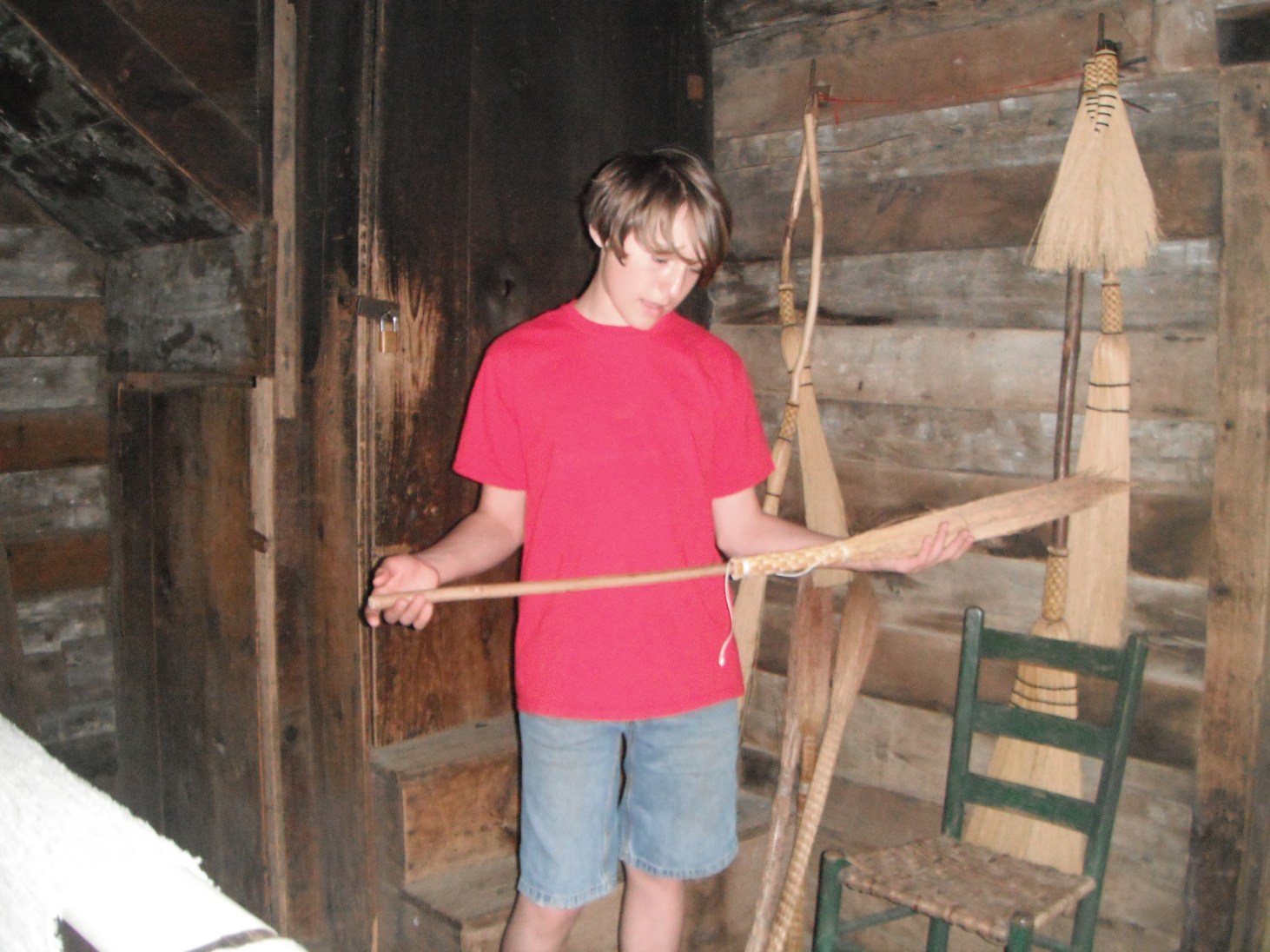
Grandsons are fun to have around. Their fascination with tools and machinery makes them easy to entertain. In March, I took Tristan and Conall to the PioneerVillagein Green Cove Springs. This museum collection of old buildings and items from the 19th and early 20th centuries portrays early life in rural Florida. As we went through the grounds and buildings, I pointed out various objects to the boys and described what they were used for and why, many of which are now to be found only in museums. I drew the boys’ attention to the bell atop the little church tower and told them how it would be rung to call people to meetings. In the store, most of the goods were behind the counter, not out on shelves, which not only gave customers more personal service, but undoubtedly cut down on thefts. (People of the past were not really much different from us.)

I actually remember many of the old timey items being used during my early childhood. Rewind a half century or so. My great-Grandad had a little store that supplemented his farm income. I did not need to read the sign in front of a great wooden hulk to know that it was a threshing machine like Grandad’s. I remember seeing it in operation once when I was very small and I can’t forget how noisy it was and how it would shake. What is a threshing machine? A precursor of the combine, it would separate grain from straw. I believe Grandad was threshing oats that day. The machine was stationary and they would feed the oat hay into it with pitch forks. It was powered by a flywheel connected by a belt to the power wheel of a tractor. Before they had tractors, I suppose they used horses or other means to run those machines. And before they had machines, they did it by hand. That we are here today attests to the fact that they got the job done one way or another.

I remember Grandpa Rogers using a horse-drawn plow, mowing machine, and hay rake like those on display, before he got his first tractor. He kept his Belgian draft horses, Jessie and Duchess, around for years even after they retired from employment. I would ride Duchess when I was older, but that’s another story.

The houses had antique stoves similar to those my grandmothers used before they got modern stoves. I remember Grandma Masters feeding sticks of wood into her kitchen range. Grandma Rogers had a kerosene stove. The modern gas and electric ranges that replaced them were easier to cook on. I remember many of the kitchen utensils displayed, some still in use but others having been consigned to history. I remember Grandma Rogers using a crank churn to make butter, like one shown. I’m sure it was more efficient than the older upright churns, also on exhibit. I explained all these things to the boys and related my memories of them. They did not act bored.

Fast forward to the present. A few weeks later, Tristan helped me clean out a shed where some things had been stored untouched for more years than I care to admit. There were buckets of tools and sundry items, covered with dust and rust and unidentified debris. One by one, I emptied and sorted through them. Discarding the trash, I picked through the relics and asked Tristan if he knew what things were. If he didn’t know, I would tell him and explain their purpose: a vise, a drawing knife, a carpenter’s plane, some electrical components, and so on.

There was a fuse from an old electrical box. I explained to Tristan that these were used before circuit breakers like I have in my house. I didn’t tell him the story about when I rearranged the fuses in my grandparents’ cellar. I didn’t want him to get ideas. Maybe when he’s older I’ll tell him how they were many different colors, to my eyes randomly placed, so I proceeded to organize them into a prettier pattern. Of course, since each was of a different amperage, this affected some of the circuits in the house. When the adults went down to see why the electricity wasn’t working, I had to explain how the fuses had moved from one socket to another. I got into some trouble over this, but at least no one got hurt.

Fast forward another half century or so. I imagine my grandchildren going through my attic after I’m done with all my material things. I imagine them saying to their children or grandchildren, “Do you know what this is? Do you know what it was used for?”

“This is an electric typewriter. That’s what people used before they had personal computers. And what’s this? It’s a manual typewriter, which they used before they had electric typewriters. And here’s my grandmother’s old sewing machine. She used this to sew clothes with before they had … (a more efficient invention might be mentioned here).” What other gadgets that I now use will be replaced by new ones that I cannot envision? If I could, I’d invent them myself.

I’m not advocating that we live in the past, although a return to a simpler life style wouldn’t hurt us. I like writing on my computer, even though it seems to have a will of its own at times. I don’t have to rely on white-out when I make my myriad mistakes. It’s so easy to edit, and I don’t have to retype whole pages to get a manuscript to look right. But it won’t work when the electricity goes out, like the old manual typewriter did.

Much lore was lost with the passing of my grandparents’ generation and those before them. While my family was fortunate enough to have listened to the old stories, how many did we miss? We need to insure that what we learn and do today is shared with our descendants. An appreciation of our heritage enriches us. When we know how our ancestors lived, how they grappled with challenges and overcame obstacles, we have a better understanding of ourselves, of our own strengths and needs. Knowing where we came from better equips us for our future. Our children and grandchildren will have richer lives if we continue to pass down the lore.

Read Full Post »

“Treat people as if they were flowers and you will have a happy life.” I recently came across this quote by a man named Jacques Romano. Largely forgotten today, he was quite a sensation in his time, chemist, traveler, philosopher, and psychic, who maintained his down to earth personality even while hobnobbing in the salons of the rich and famous. He died 50 years ago at the age of 98. I believe he deserves lasting renown on the basis of that one quote alone.

“Treat people as if they were flowers.” How do we do this? There are so many  flowers and their lives are so very different. Some are beautiful, some smell nice, some are useful, some are unpleasant, and some are downright treacherous. But all have their place in the world.

Take the hybrid tea roses. They are cultivated for their beauty. Some have a romantic fragrance and some have no scent at all. But like the beautiful people in this world they have needs. They can easily be devastated by insects and disease and thus they require our care.

Some people are more like azaleas. They bloom their hearts out each spring, then they fade into the background for the rest of the year. They are quite hardy and require little care, but be wary of stunting their growth. I have seen azalea bushes pruned like ordinary shrubbery. They lose their form and grace. When spring comes, a few brave blossoms try to emerge from the squareness and they look sad, if not ridiculous. Leave them alone. Let them grow.

Some flowers of course need to be pruned. My Cherokee rose blooms in profusion for a few weeks in early spring then spends the rest of the year trying to take over the world. If I did not cut her back, she would. When I approach with pruning shears, she fights back with thorns that can deeply wound an ungloved hand. The runners seem actually to lash out at me, tearing at my face, arms, and clothing. I have to treat her with respect, but I keep her around because of her beauty.

Many flowers are not only showy but useful. Think of fruit trees. After the lovely petals drop, the blossoms are pregnant with new life – to sustain us and to perpetuate new generations. Other useful flowers are not as showy. Think of the many vegetables without whose flowers we would starve.

Speaking of starvation, think about our pollinators, the bees and butterflies. We have learned to plant flowers to attract these insects and hummingbirds to our yards. The canna lily is one. Not a true lily, it is so called because it looks like one. The native varieties have small, bright flowers rich in nectar. New varieties have been developed that have more showy flowers but our nectar loving neighbors are unable to get past the big petals to drink the life-sustaining fluid. Do not disdain the modest but useful. Nurture them.

Many plants that we call weeds have beautiful flowers. Some of these we now call wildflowers because we have learned to appreciate them, such as the Florida state wildflower, the coreopsis. We actually plant them on roadsides now, but once I saw a work crew mow down a bank of black-eyed Susans in full bloom. I’m sure the men were told to mow down those “weeds”. No flowers ever bloomed in that place again. Some other less showy weed replaced them. Do we sometimes treat people that way?

I have learned to appreciate a cursed weed called Bidens. It is also called Spanish needles because of the barbed seeds that will attach to every thread of your garment if you get too close. They don’t hurt, but the seeds are a devil to pull off because there are so many of them. But the Bidens has a small daisy like flower which is edible. So are the leaves. The plant’s most saving grace, however, is that it’s popular with the butterflies. I have seen Bidens bloom in winter when they were the only food available for the butterflies. Be sure to include them in your butterfly garden. Or just leave a patch along the edge of your driveway or in a corner of your vegetable garden. If you don’t want them to spread everywhere, just pinch off the spent flowers before they go to seed.

Bidens may deserve its bad reputation but goldenrod does not. These yellow spikes that brighten roadsides and waste spaces in the fall are blamed for people’s allergies. Do not prejudice yourself with rumors. The real culprit is ragweed which blooms invisibly at the same time. So enjoy the goldenrod.

But what about the ragweed? They are a nuisance in your garden and to your sinuses and they are not even pretty. Maybe the world would be better off without them. Do you know people like that? But wait – the larvae of several moths feed on ragweed and the seeds are an important winter food for many birds. So don’t obsess over your bird feeders. Leave some ragweed in your garden for the birds.

Sometimes as I walk around my yard I catch a whiff of something that causes me to check the soles of my shoes. No, nothing there. The smell is from a variety of viburnum whose blossoms smell like dog poop. Do you know people like that? But the viburnum is a native shrub. It belongs here. Other than its unpleasant odor, it is an attractive shrub which produces berries that are food for wildlife. Sometimes we just have to put up with a little unpleasantness.

Treat people like flowers. Each is unique. Treat each with love and respect. Appreciate them for their virtues, have patience with their shortcomings, and be wise in handling their vices. When we treat our flowers this way, they make us happy. How much more happiness would this world have if we would treat all people like flowers?

Read Full Post »
In my childhood, sweets were not as readily available as they are today. One of my pleasant memories is of getting to lick the bowl after someone had mixed up a cake or a batch of cookies. Today, as I was beating some batter, I remembered a time a few years ago when my grandson Tristan was visiting. One day I made a cake. As I was pouring the batter into the pan, I asked him, “Who should I be today? Grandma Masters or Grandma Rogers?”

You see, my grandmothers were quite different individuals, but there were lessons to be learned from each. Both were strong women who reared their families during the Great Depression and made sacrifices during World War II.

Grandma Masters was French Canadian, one of 11 children who grew up on a farm. She once told me that when she was a child she had only one dress. On washday, she had to hide in a corner until it was clean and dry. Life was more comfortable after she married my grandfather, a factory worker, but they still had to be frugal. During the war when sugar was rationed, they used saccharine in their coffee. After the war, they continued this habit for the rest of their lives. Grandma Masters was also very clean and I swear you could eat off her floor. It was not surprising, then, that after she finished making cookies, she would scrape the bowl so clean it hardly needed to be washed. There was little left for an eager child to lick.

Grandma Rogers was one of two surviving children whose father was a wall paper hanger. She did not suffer as much privation as a child, but she married a farmer and the Depression hit them hard. She never talked much about the war when her only surviving son was a soldier in the Pacific theater. I can only imagine her anguish. She, too, was not one to waste anything, but when she finished a bowl, she would leave a satisfying amount of batter in it. I don’t know if it was because her arthritis made it harder for her to scrape the bowl clean, or if she was only trying to please a treasured grandchild.

Anyway, I briefly explained to Tristan the differences between my two grandmothers. Again I asked him which one he wanted me to be that day. Not surprisingly, he chose Grandma Rogers. I obliged him and left a generous amount in the bowl for him.

Today as I poured my batter, with no grandchild in attendance, I declared, “I should be Grandma Masters today.” Actually though, my performance fell short. Scrape though I might, I still had to wash the bowl.

Read Full Post »

Wild Winter Eating

While most of the country is shivering under a blanket of snow, we in North Florida alternately shiver on frosty days and sweat when the mercury hits 80. You may think we’re wimpy to complain about our winters, but our summers are truly brutal. While folks in most parts of the country grow vegetables in summer, little will grow here then. Even heat-loving tomatoes will not bear fruit when the temperatures stay in the 90’s around the clock. Here, we garden from September to May. Right now, our lettuces, cabbages, and carrots are happy, until an arctic air mass moves in and it plunges into the 20’s. Then even they threaten to move south.   

Winter is the time to enjoy home grown salads in Florida. I pick a few lettuce leaves and look for something else to add without going to the grocery store. I don’t like radishes, so I didn’t plant any. My carrots aren’t mature enough yet, so I take a stroll around my yard to see what I can find.

My grandmother had a plant she called “shamrocks” and I inherited her love for them. The leaves look like clover and they have cute little pink blossoms. They are not true shamrocks, but an oxalis. “Shamrock” is derived from the Irish word for “clover” which is what true shamrocks are. Oxalis is a member of the wood sorrel family. They grow all over the world, and they grow in my yard.

I don’t remember when I acquired my first oxalis but they do not like to stay contained. They reproduce by seeds and bulbils and I find them all over my yard, in my garden, and even in my potted plants. Since they are so plentiful, it’s fortunate they are edible. They have a tangy flavor and are high in Vitamin C. As their name suggests, they also contain oxalic acid which is toxic in large quantities. But spinach and many other vegetables also have oxalic acid. Spinach didn’t kill Popeye. Unless you eat rhubarb leaves (which is not advisable) you are not going to consume enough to harm you, so don’t worry.

I find three varieties of oxalis in my yard. One has rounded leaves that look like clover and another has triangular leaves. Both have pink flowers. Then there is a native called wood sorrel with yellow blossoms and seed pods that will explode in 1000 directions. You don’t want to encourage this one too much. It will take over. I have another that I bought at a nursery a few years ago. This one has purple leaves and white flowers. They assured me it would not escape and so far it has stayed nicely in its pot.

I pick oxalis leaves and scatter them on my salad. I chop the stems and cook them in soups and with mixed greens. One day I realized I was out of pickle relish and added some to egg salad, which they flavored nicely. You can also make a refreshing tea from this plant. The flowers are also edible. They may not make it as far as the kitchen as they are so tempting.

Wandering about my yard, I find a winter resident that is found all over the world, probably spread by European explorers. Chickweed (Stellaria media) makes a soft, spreading carpet no more than six inches high. The leaves are pointed ovals and it has tiny white flowers. The taste is as delicate as the plant appears to be, reminiscent of raw corn. This makes a sweet addition to my salad and can also be put in soup and cooked greens.

Ralph Wald Emerson wrote, “What is a weed? A plant whose virtues have not yet been discovered.” One much maligned plant is Florida Betony (Stachys floridana). If you Google it you will find 101 ways to eradicate it. Why not just eat it? I actually planted some in my yard for the pinkish-purplish spring flowers that honeybees love. This wildflower is a member of the mint family. The leaves are edible but not very tasty. Other names for Florida Betony are rattlesnake weed and wild radish. Dig down and you will find a small white tuber shaped like a snake’s rattle which tastes like a mild radish. This is the part to eat and it goes nicely on my salad. Unfortunately for some of you, it grows only in the southeast. Like most snowbirds, you won’t encounter it when summer comes, because it doesn’t like the heat.

Wild onion and wild garlic grow as far north as Canada and as far west as Arkansas. You can smell them when they mow the roadsides. They taste like their cultivated cousins, can be used the same way, and don’t cost anything. I’ve planted some of these in my garden. With chopped wild onions, wild radish, and oxalis leaves, my salad needs no further flavoring.

Emerging from the ground are the wild violets. They’re not blooming yet and the leaves are too small to harvest but they too will soon dress my salads. The blossoms are higher in Vitamin C than oranges. The leaves can thicken soups, the flowers can be made into candy, and the whole plant will make a nice tea. There should be some growing near you, maybe in your lawn. They, too, can be found around the world.   

Some words of caution: don’t eat anything unless you know what it is, don’t pick plants that have been sprayed with chemicals, and be sure to wash anything an animal may have watered. If you don’t live in Florida and your landscape is still buried under snow or brown from frost, don’t despair. As winter begins to recede north, you, too, will be able to enjoy these, and other, culinary delights. Bon appétit!

Read Full Post »

I keep a box of old Christmas cards. Every year, like most folks, I display Christmas cards as they come in. Unlike most, however, I do not discard them after the season is over, but add them to my collection.

Like most people, when I was a child, we would go to my grandparents’ house on Christmas night for supper with aunts, uncles, and cousins, and there would be presents for all. Unlike most people, however, Grandma Masters did not label her gifts with store-bought stickers. She used the pictures from old Christmas cards. She might wrap a package in paper with pictures of the three wise men, then decorate it with a card showing a manger scene, and a ribbon.    

When I became an adult and established my own home, like most people I began to send and receive Christmas cards. That’s when I continued my grandmother’s tradition of labeling gifts with last year’s cards. I use the front face and usually discard the rest of the card unless it has a smaller picture, as some do, that I can use on a small gift. In any particular year, I may not use all my old cards, so they will collect in a box. Some cards get recycled if the gift was opened at my house and the card not spoiled. I try to coordinate the card with the wrapping paper and give, especially for the children, one that would appeal to the recipient. A card may be a clue as to the gift inside. A box containing a doll might have a card showing a little girl holding a doll. It’s handy to have lots of cards to choose from, and every year my collection grows. Some years I have to graduate to a larger box.

My Christmas card collection has yielded an unforeseen delight. It has become a time capsule, going back many years. As I dig to the bottom of the box, it’s like an archeological excavation, refreshing long forgotten memories. Most senders list their children, and I have a record, in reverse order, of the changes in their families. Children who have grown, moved out, and are no longer listed on recent cards will appear in earlier cards. Their names disappear again in cards sent before they were born. Some senders named my children individually and that list has also grown and shrunk over time, as some of my adult children have moved out, and in, and out again.

Here are cards from nieces and nephews before they had children. Afterwards, they may be too busy to send cards. I have a record of my former boss’ daughter growing up, in the photo cards he gave out every year. Since those are not suitable for labeling gifts, they collect in my box. Here is a card from a family I cannot recall. Perhaps one day something will nudge my memory. There is one signed “your paper carrier” with only her first name. Here’s one from my daughter-in-law before she married my son.

 Some people faithfully send cards every year and some are sporadic. Some I have only a card or two from, and some, like one of my brothers, never, although I will send him one. One couple faithfully sent cards for seven years after they moved away, then there was silence. I never found out why.

Like an archeological record, the collection is incomplete. Some cards no longer exist as they have been used and discarded, and many lack the signature page, so their origin is forgotten. Here is one I will never use, from a dear friend who has passed away. Indeed, the deeper I dig, the more poignant they become. One card my parents also signed “Cookie Grandma”, in the last year of her life after my grandfather had passed. Another is signed only “Grandpa Masters” after Grandma Masters was no longer with us. There is one whose picture page had been used long ago and only the message page remains. I will keep this one forever as it is signed, “All our love, Grandma and Grandpa Masters”. It was probably the last I received from them before Grandma died. 

Some of my relatives have sent home made cards so special that although I may use them to label a gift, I will not throw them away even if they become wrinkled or torn. Deep in the box are cards my own children made when they were small. Scattered throughout the box are annual letters sent with or in lieu of cards. Someday I will go back and read them.

What will happen to my box of cards after I am no longer able to enjoy it? Hopefully, before that time comes, I will put them into a scrapbook, making a history for succeeding generations. In the meantime, I will continue to dig through the box every Christmas, looking for just the right card for a particular gift, being reminded of the past, and surprised by new discoveries.

Read Full Post »

« Newer Posts

Abandoned Southeast

Preserving the Past | A Photoblog of Hundreds of Abandoned, Historic, and Forgotten Places

Bonnie T. Ogle

Award Winning Childrens Author

filmmaven

A great WordPress.com site

The Tony Burgess Blog

The Home Of T-Bird From The Dork Web.

Wells Family Genealogy

The study of my Family Tree

Alien Resort

A Terrestrial Romance

douglasfelton.wordpress.com/

Compelling Young Adult fiction from author Doug Felton

Hidden River Arts

Dedicated to Serving the Unserved Artist

Green Life Blue Water

Where Eco Meets Life

Pattie Remembers

Sunsets and Buzzards, and Other Stories

koolkosherkitchen

Welcome to my Kool Kosher Kitchen where food is fun and fun is to create food!

The Life in My Years

An anthology of life

cookingforthetimechallenged

Fast, easy, all natural, healthy, kosher cooking

CarpeDiemEire

Travel Through Ireland and Europe

Yeah, Another Blogger

An Arts-Filled, Tasty And Sometimes-Loopy Jaunt Through Life